[0:00]Hello and welcome. Take a deep breath. Because what you're about to hear, might change your life forever. This is not just a video. This is not just a book summary. This is your mirror. This is the story of your inner battle. The war between the life you dream of, and the fear that holds you back. The name of the book is The Mountain Is You. And in this mountain, you will see yourself. You will learn: Why you keep repeating the same mistakes. Why you procrastinate, sabotage your happiness, or stay stuck even when you want to grow. Why healing is not about fixing who you are, but becoming who you were meant to be. How to understand your emotions, your patterns, your inner wounds, and how to finally become the master of your life, not the prisoner of your fear. Let me ask you this: What if one idea could change your mind forever? What if one sentence could give you back the power you lost years ago? Books have changed history. Books have built empires. Books have saved people from depression, bankruptcy, and even suicide. And books are how the rich get richer, not just in money, but in wisdom. Did you know? The average CEO reads at least 50 books a year. Warren Buffett spends 80% of his day reading. Bill Gates reads one book per week. Now ask yourself, why? Because they know this truth: Books are time machines. One book can save you 10 years of mistakes. One author's lifetime of lessons, given to you in just a few pages. And today, you're not just reading a book, you're discovering your hidden mountain. If you're learning English, this video will help you in 3 powerful ways: One. Real Spoken English, natural words, emotional tone, and phrases used by native speakers. Two. Slow, clear explanation. Every sentence is crafted for easy understanding. Three. Deep Motivation, you won't just learn English. You'll learn how to change your life. So your brain learns English, and your heart learns power. By the time this series ends, you will no longer ask: Why do I always mess things up? You will start asking: What is this mountain teaching me about myself? You will walk away with: More clarity. More self-respect. More emotional strength. More tools to rebuild your life. And most importantly, the belief that you can. So now, let's begin. Chapter 1, The Mountain Is You. Let's imagine a mountain. You're standing at the bottom, looking up. It's huge. It's cold. It's scary. The peak is covered in clouds. You want to reach the top. That's where your dream life is waiting. But you feel stuck. Maybe you've felt this before: You want to speak confidently, but you stay silent. You want to start a new habit, but you delay it every day. You want to leave a toxic job, but you can't move. You want love, but you keep pushing it away. You think: Maybe the problem is out there. But the book tells you: The mountain is not outside of you. The mountain is you. It means: You are standing in your own way. Your fear. Your self-doubt. Your guilt. Your past. Your trauma. Your excuses. Your habits. You built this mountain. And now, you have to climb it. Let's say it again: Self-sabotage is not failure. It's communication. You sabotage because a part of you is scared. Scared to grow. Scared to lose control. Scared to be seen. Scared to succeed. You get offered a promotion. You feel excited, then anxious. You start showing up late. You miss deadlines. You don't know why. But deep down, you think: What if I'm not good enough? That's self-sabotage. Not because you're lazy. But because you're protecting your old self. There's a war inside you. One part wants to grow. One part wants to stay safe. The second part is stronger, because it's been with you for years. Since childhood. Since trauma. Since pain. So when change comes, it panics. It whispers: Stay where it's comfortable. Don't risk getting hurt again. Just do what we always do. Even if that habit is killing your happiness. You are not broken. You are not weak. You're just running an old survival program. And now, it's time to update it. Just like updating an app, you delete the bugs, improve the system, and relaunch. You can do the same with your mind. Let's go back to the mountain. Each step you take is a moment of growth. The step where you forgive yourself. The step where you stop blaming others. The step where you wake up and choose better, even when it's hard. The step where you finally say: I deserve more. I'm ready. Let's go. You don't need to climb it in one day. You just need to take the first step. The mountain is not your enemy. The mountain is your teacher. You created it. To learn how strong you are. You built it. So you could become the person who climbs it. You are not here to stay at the bottom. You are here to rise. And this book, is your map. Chapter 2: There's No Such Thing as Self-Sabotage. Before we start, take a moment. Close your eyes. Think about the last time you messed up something in your life. Not by accident, but by your own hand. Something inside you knew it was important, but still, you ruined it. You skipped the job interview. You ignored the healthy habit. You pushed away the person who loved you. You stopped yourself from shining. Then, you whispered: I don't know why I always do this. I sabotage myself. I'm the problem. But today, the book tells you something that can change everything: There's no such thing as self-sabotage. It doesn't exist in the way you think. What does that mean? Let's go deep. When you hear the word sabotage, what comes to mind? Blowing up your own chances? Destroying your own happiness? Getting in your own way? But the truth is, your brain doesn't want to hurt you. It's doing what it thinks is best for your survival. Even if it looks like destruction from the outside. Self-sabotage is self-protection in disguise. Let's understand this with real-life examples: Imagine: You see the perfect job opening. You know you're qualified. Your heart says: Go for it! But you wait. And wait. And wait. The deadline passes. You didn't apply. You call it self-sabotage. But let's break it down. Subconsciously, you might be thinking: What if I get the job and fail? What if I succeed and people expect more from me? What if I leave my comfort zone and I'm not ready? So instead of facing the unknown, your brain whispers: Let's stay where we are. At least it's familiar. That's not sabotage. That's your inner child trying to stay safe. You finally meet someone who loves you, respects you, supports you. But slowly, you start pulling away. You pick fights. You create distance. You break it off. You say: I ruined it. I always do this. But your subconscious might be saying: Last time I opened my heart, I got hurt. Love feels dangerous. This can't be real, I don't deserve this. So your brain protects you. It builds walls. Not to hurt you, but to avoid feeling pain again. This is the core idea of Chapter 2. Let's break it down: You are not one single voice inside. You are a mix of: Dreams. Fears. Habits. Memories. Pain. Hope. Old stories. New desires. And sometimes, these parts disagree. One part of you wants success. Another part of you is scared of what success will change. One part of you wants love. Another part of you is terrified of being abandoned again. This creates a conflict. It's not that you want to destroy your life, It's that one part of you is trying to protect the life you've already survived. Your subconscious doesn't care about growth. It only cares about familiarity. It asks one question: Have we felt this before and survived it? If yes, it keeps repeating it. Even if it's unhealthy. Even if it hurts you. Even if it's a dead end. That's why some people: Keep choosing bad partners. Stay in toxic jobs. Avoid taking risks. Reject success. Repeat old patterns. Not because they want pain. But because pain feels more familiar than peace. Let's say you're trying to speak English in public. You know your grammar. You've practiced your lines. But when it's time to speak, your throat closes. You freeze. You say nothing. You think: Why do I sabotage myself? I've practiced so much. But inside, there's an older voice saying: What if they laugh? What if I make a mistake? What if I sound stupid and lose respect? That voice is scared. Not of English, but of emotional pain. So your brain says: Let's be quiet. That way, we stay safe. It's not sabotage. It's a protection mechanism based on your past experiences. If your house is on fire and a child is crying, do you yell at the child? No! You protect them. You hold them. You comfort them. The same way, you must hold your scared inner self with kindness, not judgment. Say: I see you. I understand why you're scared. But we're not in danger anymore. We can do this together. Ask yourself: What do I want? And what am I afraid of losing if I get it? Clarity is the first step to freedom. Instead of ignoring fear, talk to it. Say: Fear, what are you trying to protect me from? Write the answer. You'll be surprised how much your subconscious is trying to help you, even in the wrong way. Instead of saying: I'm sabotaging everything. Say: I'm learning to understand myself. I'm discovering the part of me that needs healing. Self-sabotage ends when your inner world feels safe enough to grow. Create rituals of safety: Meditation. Self-talk. Supportive friendships. Journaling. Coaching or therapy. Learning new skills (like English!). Reading books like this. When you feel safe, you stop sabotaging, and start thriving. You are not broken. You are not lazy. You are not your mistakes. You are a story in progress. A healing heart. A rising soul. A person climbing the mountain they once built out of fear. There is no such thing as self-sabotage. Only parts of you that need to feel safe, seen, and supported. The moment you stop punishing yourself, and start listening to yourself, That's when transformation begins.
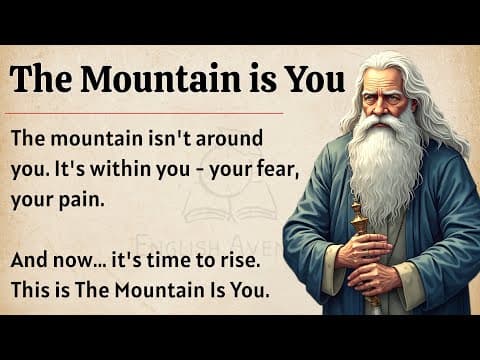
The Mountain Is You || Learn English Through Book Summary 📖 || Improve Your English Skills ✅
English Avenue
13m 23s1,768 words~9 min read
YouTube auto captions
Transcript source
YouTube auto captions
This transcript was extracted from YouTube's auto-generated caption track. The transcript below is server-rendered so it can be read, searched, cited, and shared without opening the original YouTube player.
Pull quotes
[0:00]Why you procrastinate, sabotage your happiness, or stay stuck even when you want to grow.
[0:00]Why healing is not about fixing who you are, but becoming who you were meant to be.
[0:00]How to understand your emotions, your patterns, your inner wounds, and how to finally become the master of your life, not the prisoner of your fear.
[0:00]And today, you're not just reading a book, you're discovering your hidden mountain.
Use this transcript
Related transcript hubs
Watch on YouTube
Share
MORE TRANSCRIPTS


