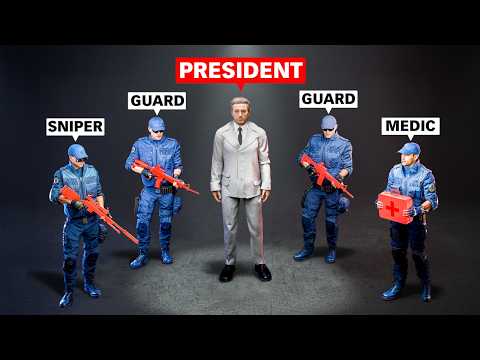
[0:03]A shooter is taking aim at the President of the United States.
[0:10]For the Secret Service, it's their worst case scenario. The nightmare they've trained for for years. In the next few seconds, each branch of the Secret Service springs into action. The protective detail, the counter-assault team, the Airspace Security branch, the counter-snipers, and the emergency response team. What happens next will decide the course of history. If the Secret Service succeeds, today will be forgotten soon enough. Keeping the president alive is just business as usual. The job the agency has successfully done every day since the death of JFK. But if they fail, it will rock the nation to its very core and threaten the stability of America's democracy. This is the moment that determines everything, when instinct, training, and sacrifice have to come together. Or else. Who are the people protecting the president? How do they prepare for the unthinkable? How does the Secret Service actually work?
[1:17]This video is largely based on the books Zero Fail: The Rise and Fall of the Secret Service by Carol Leonnig, and In the President's Secret Service by Ronald Kessler. Links in the description.
[1:32]Fort Worth, TX, 1963. The Secret Service is exhausted. JFK is their toughest assignment yet. He's constantly traveling, Miami one day, DC the next. His predecessors were older and spent most of their days working inside the White House, where the president is considered to be the safest. But JFK loves to travel the world and attend to his many adoring fans. Ich bin ein Berliner.
[2:02]And he has a taste for danger. Sneaking past his agents to swim in open water, where he's swarmed by dozens of other swimmers. Throwing himself into crowds. Letting all kinds of unvetted guests into his room, night after night. Keeping up with JFK is more than a full-time job. It's a blur of double shifts and all-nighters. So tonight, a few agents are blowing off some steam. They heard about a famously shady nightclub called The Cellar, where Texan beatniks rubbed shoulders with off-duty cops, often resulting in brawls. It's illegal to serve alcohol past midnight, but The Cellar is one place you're sure to get a stiff drink at any hour. And the agents stay way past midnight. One is late as 5 AM. Four of them are assigned to protect Kennedy the next morning, starting at 8:00 sharp. Compared to today's Secret Service, the agency protecting President Kennedy in the 60s is bare bones, basically the size of a municipal police force. There are just 350 agents, most of them spread throughout the US. Only 36 are assigned to the White House, with a rotating team of six guarding the president. Keeping the agency lean is partly due to an American aversion to treating its presidents like kings, going back to the Founding Fathers. People felt that the Secret Service shouldn't be anything like a royal guard. Until that cool November morning in Dallas.
[3:41]JFK likes to be seen. For this trip through Dallas, he's insisted on riding around in a convertible, and though the Secret Service doesn't like it, he also insists that his usual bodyguards ride in separate cars. He wants to appear accessible to the people. thousands of waiting to greet him in downtown Dallas. At 1:25, the motorcade moves into the downtown area. JFK and Jackie smile and wave as their limousine inches through Dallas at just 11 miles an hour. It's following a route that Dallas newspapers published in advance. None of the buildings on the route have been inspected. This is Clint Hill, the agent assigned to protect Jackie Kennedy. Normally, he's stuck to her like a shadow, but today he's following JFK's orders to give the couple a little space. Of the agents who went to The Cellar last night, Hill was the first to leave, at 2:45 AM. Today, he's also the first agent on duty to recognize this sound for what it is.
[4:47]An attempt on the President's life. This is Bill Greer, the agent driving Kennedy's limo. He's not trained in evasive driving. He slows down, waiting for instructions on what to do next. Another shot is fired. Clint rushes out of the car. He runs to the limousine hoping to be at the President's side before worse can happen. But he's too late.
[5:13]Clint throws himself on the trunk of the car, only to find a gruesome aftermath. Within six seconds of the first shot, President Kennedy is dead. If I had reacted just a little bit quicker, I could have, I guess, I'll live with that to my grave. What happens next is history, and it will haunt the agency for years to come. President Kennedy's death revealed that something needed to change. But he wasn't the first president to be killed in office. Abraham Lincoln. James A. Garfield. William McKinley. But now the United States is a global superpower. The president is the most powerful person on Earth. The threats to his life are multiplying and evolving. And Kennedy's death traumatized the nation profoundly. Nothing like this should ever happen again. In the 60s and 70s, the Secret Service massively expands its personnel and budget. No longer will it be a small cadre of glorified bodyguards. Gone are the days when the service will hire any athletic ex-marine or patriotic beat cop. Recruitment, training, and operational protocols become way more rigorous. And this is what six decades of evolution looks like. Protecting a president isn't just about reflexes or muscle, it's about training agents to think clearly under pressure, spot patterns, and solve complex problems fast. The good news is, you don't need to join the Secret Service to sharpen those same skills. Brilliant is built to turn the potential you already have into real problem-solving power. You can build logic, math, coding, and scientific thinking skills. It helps you click with ideas that used to feel abstract or intimidating. Their Truth and Lies course is a perfect place to start. You're given incomplete information, build up clues, eliminate what's impossible, and learn how to tell real deductions from educated guesses. Figure out exactly what's provable even when the situation is messy. With Brilliant, you're not just watching explanations, you're actively working through step-by-step interactive lessons until concepts truly make sense. It's designed for ages 10 to 110. To start learning free for a full 30 days, go to brilliant.org/fern or scan the QR code. You'll also get 20% off an annual premium subscription and unlimited access to everything Brilliant offers.
[7:45]Protecting the President is a round-the-clock job. It's hours and hours of mind-numbing boredom, with occasional moments of sheer terror. When these moments come along, every split second counts, and the agents' response better be automatic. There's no time to weigh options. Their mission is zero fail. The Secret Service calls any would-be assassin a "jackal," according to journalist Ronald Kessler. Jackals tend to strike outside of the White House. A president is most vulnerable when arriving at or leaving an event, so the agents are currently on high alert. At least 10 days before any external event, agents head to the destination. Some high-profile events, like the President's inauguration, take up to a year and a half. That's because the Secret Service isn't just about making sure a bullet doesn't hit the president. It's about making sure it never enters the event to begin with.
[8:45]Agents are sent in advance to assess the number of metal detectors needed, scrutinize all access points, and prepare explosive detection. Mainly, they're thinking of the ways a jackal could sabotage the event. Could he cut the lights to create chaos? Could he access the air conditioning units to introduce poison gas?