[0:00]Hard things! Whether it's deep work, working in general, working out, studying, or focusing on reading, resisting a bad habit, or otherwise just stepping outside of your comfort zone, we can all agree doing them brings a net benefit to your life. But they're hard. Hence we don't want to do them. So here are 11 time tested principles that will help you make doing hard things easier than picking your nose. Which begs the question really?
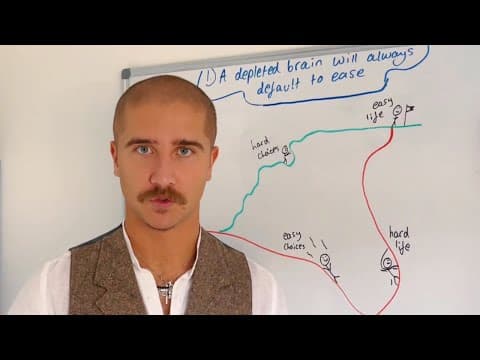
[0:26]How hard is picking your nose? One more strike and you're out. But if you've only got 30 seconds, here's the bottom line of this video. To make doing hard things easy, you simply need to rebalance your dopamine stools, so the cheapest form of dopamine you get is doing the hard thing itself. And then you need to cast enough votes with your actions in favor of you forming the identity of being the type of person who does hard things. But if you'd like a bit more of an explanation, follow me. Point number one, or principle number one. Okay, the first principle is, a depleted brain will always default to ease. Quick note here, if you watched the other video we did about dopamine, or you know anything else about dopamine, some of this stuff will sound familiar. But I still recommend you listen to this section instead of skipping on because this is the most important principle of this whole video. And if you just understand this stuff, you will be fine when it comes to making doing hard things easier. So just treat it as a refresh of your memory. Anyway, let's begin. The molecule dopamine is something your brain produces, otherwise known as a neurotransmitter, that is responsible for your feelings of craving, motivation, and reward. Basically, dopamine is responsible for you feeling motivated to do the hard thing and then find it enjoyable and rewarding, while you're doing it, and after you've done it. But here's the tricky thing when it comes to molecules in the brain and dopamine. Your brain can only produce a certain amount of dopamine throughout the day. So in order to protect its dopamine levels, your brain is always trying to maintain a homeostatic balance of its dopamine levels. You can imagine your dopamine levels exist in like a scale. You have five being the ideal state your brain would like to stay at, zero being depletion and ten being an influx of dopamine. So each activity that you do throughout the day, has its dopamine cost. Meaning, if you're engaging in activities that are, first of all, very dopaminergically rewarding, pleasurable activities such as scrolling, drugs, sex, porn, eating junk food, all of the bad habits. That is going to result in your dopamine levels crashing below baseline as soon as you stop that activity. And when your dopamine levels crash, you're in a state known as a dopamine deficit state, whereby, as above, so below. First a peak, then a crash, because your brain needs to go below baseline in order to come back up. This process is otherwise known as the pleasure-pain balance, which was popularized by the psychiatrist Dr. Anna Lembke.
[3:36]And the pleasure-pain balance works like this. As soon as you stop doing something that initially gave you instant pleasure, the dopamine gremlins jump on the other side of the balance to tilt it towards pain, causing you to feel the complete opposite of everything you felt while you was doing this pleasurable activity. For example, when you scroll on social media or YouTube, you feel connected, engaged and entertained. But as soon as you stop, you feel tired, groggy, lonely, depleted and bored. So how does this relate to making doing hard things easier?
[4:18]Well, because you now understand your brain needs dopamine in order to find something desirable and rewarding while you're doing it, you can also understand that if you're constantly in a dopamine deficit state, as a consequence of engaging in activities that first result in pleasure, but later result in pain, you're robbing your brain of the one resource it needs in order to find hard things desirable and rewarding. So no matter how much you try to motivate yourself to do the hard thing, if you're constantly in a dopamine deficit state, you're not going to want to do that hard thing, nor are you going to find it rewarding while you're doing it, because you don't have the dopamine available for that to happen. In fact, think about whether this cycle I'm about to put on the board sounds familiar to you. First of all, you get yourself into a dopamine deficit state due to engaging in fast dopamine activities, fast dopamine also meaning high pleasure activities. Then you set the expectation that you should be able to do this hard thing, whatever it is. Maybe you're scrolling and you start comparing yourself to other people and you start thinking, I should be working more, I should be doing more deep work, learning more, working out more, study more, whatever it is. Then you try to do the hard thing, but what happens? Well, you're in a dopamine deficit state, so obviously you fail. Then you criticize yourself for not being able to do the hard thing. Obviously, that's uncomfortable, so then you seek escape from that self-hatred and discomfort with more fast dopamine, which puts you in, again, a dopamine deficit state. So in order to make doing hard things easier, and to escape this whole annoying cycle, there's only two things you need to do. The first thing you need to do is reclaim your dopamine from 90% of fast dopamine. That's a bit weird, well, it sounds a bit weird, so let's un-pack what that means. Purge your life of all of the activities that are causing this spike in dopamine and then crash into pain. And you can find what these activities are by simply asking, What makes me feel good immediately, but leaves me feeling drained after? As we've mentioned, it could be common culprits, junk food, scrolling, checking social media, shopping, porn, whatever it is. I reckon, I this the other day, before I even knew I was going to record this video, if you journal or whatever, just write down a list. I titled it as all the things distracting me from fullness. All of the things that are sources of fast, cheap dopamine that leave you depleted after. And then you might like to do the opposite, which is write down all of the things that bring you closer to fullness, which we're going to get into in a second. That's what you do. Now, three things I want to mention here before I leave you with one final tip for this segment. Always remember that if you are currently in a low or in a dopamine deficit state, it will take at least one to three days for your brain to get back up to baseline. Depending on how compulsive the bad habit was, of your fast dopamine. And I know this is a common fallacy of people saying, it gets worse before it gets better. Most times that isn't true, but when it comes to dopamine and un-plugging from fast dopamine, you will feel worse before you feel better when you're here. Because remember, as soon as you stop all of these things, boom, plumb it down, you'll feel the opposite, but your brain knows what to do, just give it space and don't engage in these things anymore, or at least for one to three days, and it will take you back up to baseline. Second thing, I want to mention is you have to be compassionate with yourself here. I am imploring you to engage some emergency self-compassion. All of these things, scrolling, checking social media, junk food, they are the equivalent of your caveman ancestor, caveman, did I say, or caveman ancestor coming across three KFC bargain buckets, 10 bottles of Fanta and 15 ripe mates for him to reproduce with. Your brain is being hijacked and it is not designed to cope with these highly dopaminergic things. So when you fall to from grace, it's incredibly understandable. You are out-gunned in a world that wants to hijack your brain. Final thing I want to leave you with is it's not useful for us human beings to just be told, oh, stop doing these fast dopamine activities. So, what is a better way than just saying, stop doing them? Well, in my experience, the best way is to schedule them. And this highlights why I've used the percentage of 90% instead of 100%. Why not just go extreme and say, get rid of 100% of these things, although that would be brilliant. Well, you're unlikely to. So if you still want to engage in 10% of these things, just make sure you schedule it. For example, you're only allowed to scroll between the hours of 6 and 7 P.M. or you only shop on Fridays when you've finished work. Create a rule for yourself and you'll find yourself acting in line with your values a lot easier. And finally, finally, finally, the reason why we used the word reclaim is because you're not just stopping these fast dopamine activities.
[10:04]No, when you stop them, you're reclaiming all of the dopamine that was going in the direction of these activities, so that you can now channel that dopamine you have towards other more fruitful activities. Speaking of, point number two.
[10:36]And the last thing you need to do is when you feel your dopamine levels return to normal, perhaps after one to three days of not engaging in fast dopamine, now tap on the pain side of the balance first. Because the cool thing is with the pleasure-pain balance is that when you first engage in an activity that results in pain first and not an increase in pleasure straight away, otherwise known as a slow dopamine activity, as soon as you stop doing that thing, the dopamine gremlins jump on the other side of the balance in order to tilt you towards pleasure.
[11:09]In other words, the rewards for doing hard things are much more fruitful and longer lasting. And you know this already. Doing a workout feels hard at the beginning, but as soon as you stop, you feel brilliant. Doing deep work, studying, reading, or focusing on something is a pain in the ass for the first five to 20 minutes, but as soon as you hit a flow state, you feel dialed in and then when you finish, you feel accomplished. So how could we summarize this in one image?
[11:45]Hard choices, easy life. Easy choices, hard life. Guys, before we move on, I want to make one thing crystal clear. The intention behind the last five minutes we've spent together has not been me trying to communicate a value judgment as to how you should be spending your time. No, you can do whatever you want. You can scroll, you can still do your bad habits. All I want you to remember is that you cannot escape the consequences of your actions. And the same goes for me. I understand that I probably will scroll, oh I definitely am going to scroll more and or again in the future, or I'm going to check social media. But we have to remember that the more we engage in fast dopamine, the less enjoyment and motivation we will have to do the hard things that are important to us. That's all I wanted to communicate. So now moving on to principle number two. How can you motivate yourself when you're in the arena of discomfort to continue forward?
[12:54]You reappraise the discomfort. The biggest barrier you face to doing hard things is the discomfort you feel while doing them. For example, the pain of trying to focus on studying or learning something or reading a book instead of checking social media, the discomfort of lactic acid in your muscles as you're squeezing that last rep, or the discomfort of thinking through a concept and what you want to write next instead of checking Twitter. But here's a thought. It is completely up to you how you interpret any discomfort you feel. In other words, it's completely up to you whether you interpret that discomfort as bad or beneficial. And especially with your understanding of the pleasure-pain balance now, you can interpret any discomfort you feel as the necessary pain you need to go through in order to experience the long lasting rewards when you stop doing this activity. But to make this practical, here are three mantras for you to keep close the next time you're experiencing discomfort, so you can persist. Write these down, print them out, keep them close. This is hard and challenging, but that's just what I need to find it rewarding. Second one from Alex or Mose, this is what hard feels like, and this is where most people quit. Quick note on this one, I realized this while doing deep work in the morning. I usually wake up and study or research for about one to three hours, and most of the time I find myself wrestling with the annoyance that this is hard. And then I realized, well yeah, it is hard, it's meant to be hard, stop trying to think it's meant to be easy. little note there, final one, the faster I do the hard things I avoid, the quicker I get the good things I want. But none of these will hit if you're not able to master your evening.
[14:56]Your tomorrow is created from today, and the order that you give your evenings is the strength you feel in the mornings. So forget about creating a perfect morning routine, just as long as you're not engaging in fast dopamine straight away, you can do whatever you want and focus on creating a solid wind down evening routine. Why is this important? Well, because you now understand you need all the dopamine stores you can get in order to do hard things, but if you're spending your evenings chasing fast dopamine, watching TV, scrolling, doing drugs, whatever, you're then casting the votes in favor of you waking up the next morning in a dopamine deficit state. So you're playing catch up and you're not going to feel motivated to do hard things. So, here's what a solid evening routine looks like for me. Abso what is useful, this card would not add what is uniquely your own. All tech off by 9 P.M. Otherwise known as all screens off by 9 P.M. No decisions after 9 P.M. Yeah, no big major life-changing decisions. Save that for the morning. No calls after 9 P.M. because if someone's calling me, they're probably going to mention something that I'm then going to think about and could potentially worry about before bed. No, no. Turn the red light on in my room. Red light helps with releasing melatonin and making you feel sleepy. Then I go for a walk in nature and talk to myself out loud for 20 to 30 minutes. I need this, this is my therapy. If I don't do that, I'm screwed. Then I do my recovery. My recovery is rolling this ball on my, on my, the bottom of my foot. Then I do some foam rolling, this is really good before bed. It deep tissue massages, help you sleep better. And then, I've been doing this recently. This is called a Shakti mat. So you lay on it, it's got those pins on it. It's quite painful at first. I do my back, I do some of my arms, my face as well, and then my feet. That is the most painful one. That's my recovery. It takes me about five to 10 minutes. Then I feel ready to sleep. But obviously, I've realized some things on my walk, so then as I'm back, I write down anything I've realized on the walk in the form of a letter to myself. Call my letters here. Just nice, you know. And then I lay in bed and read until I fall asleep. Sometimes I read, well, this is what I've got on my bedside table at the moment. Why Buddhism is true, the Bible, I just messed that up. El camino del hombre superior, the way of the superior man in Spanish because in order to maintain my Spanish, I read this out loud some of the chapters. But I've been reading fiction again, which is great, helping me wind down before bed. I'm currently reading Humiliated and Insulted by Fiodor Dostoevsky. What would your evening routine look like? Your ideal evening routine. Comment down below. Speaking of structuring your day, principle number four is structure your day right. Neurochemically, you are not the same person across the different hours of the day. So in order to make doing the hard thing more likely, you need to work with your biology and schedule it in at the right time. This might be helpful to conceptualize all this. Think about the different times of your day as running in three phases. You have phase one, which is zero to eight hours after you wake up.
[18:14]Doesn't matter when you wake up, I don't wake up with an alarm. I wake up naturally around 7 to 8 each day. Let's imagine you wake up at 7. This phase will run from 7 until 3. And during this phase, this is when your dopamine, cortisol and norepinephrine levels are highest. Nor-epinephrine is your brain's version of adrenaline. You can also increase your level of these molecules by viewing sunlight first thing in the morning, by drinking caffeine and remaining fasted. During this period, you're going to be biologically better off to do hard or analytical work, or any hard thing for that matter. Hence, it's important to wake up and do deep work or study or read first thing in the morning. After this phase, you then go into phase two, which is nine to 16 hours after you wake up. This would run in our schedule from 3 until 11 at night. And this is where your serotonin levels begin to increase, putting you into a more relaxed state. Now, you're going to be better off in this phase to do things like brainstorming, creative work, think more outside of the box about whatever problems you're tackling. Maybe you tap into a creative task, or you go out in nature, and you socialize. Remember, you're in more of a relaxed state here, so utilize that. And then phase three ends 17 to 24 hours after you wake up. This would run from 11, again till 7 A.M. and this is when you should be asleep or at least preparing to sleep. Keep a low temperature in the environment in which you're at, and make sure the lights are dimmed. As the neuroscientist Andrew Huberman says, it isn't just about getting the most important stuff out of the way, it's about leveraging your natural biology toward the best type of work for the biological state you're in. Before we move on, there is some nuance, especially to phase one and phase two. For example, I do wake up and do deep work first thing in the morning for about two to three hours. But I have found recently I'm also doing that deep work around 4 and 6 in the afternoon after I've been to the gym, and I find that I can get into a flow state quite easily. So use this as a guide, stick to it first, and then you might like to organize it in a way that works with your life. But more often than not, stick to this structure. Okay, now let's finalize this video with some quick fire tips to really help you do hard things like a pro. Principle number five is identity without evidence is just fragile consistency. Now, you probably don't have the identity right now of being the type of person who can do hard things. So in order to create this new identity of becoming the type of person who does hard things, you'll need at least a week in which every single day you do that hard thing. In order to cast the votes in favor of you forming this new identity, because your identity is based on evidence. You can try and gaslight yourself as much as you want into believing that you are the type of person who does this thing, even when you don't do it, but your brain is going to call BS on it, because it just doesn't have the evidence to back up the identity. But why is this important? Well, it's because all behavior change is identity based. If you change your identity, I.E, the beliefs that you hold about yourself, then you can change your behavior. So the bottom line of this whole point is don't focus on just doing the hard thing, as if it's something to tick off on your to-do list. No, focus on becoming the type of person who can do that hard thing. The hard thing that you want to do might be different than everyone else. So take that hard thing and try and extrapolate out a desirable identity you would like to form that will help you do that hard thing. For example, if the hard thing for you is going to the gym, then the identity might be becoming an athlete. Deep work, being a top performer, studying, being a top student. So then you can ask yourself in moments of lack of clarity or lack of motivation, what would an athlete do right now? What would a top performer do right now? What would a top student do right now if it's 9:00 and you're finding yourself doing or engaging in fast dopamine? Well, a top student would obviously prioritize the dopamine they have in their brain, so they would stop this fast dopamine now stop scrolling, go for a walk in order to cast the votes in favor of them waking up into strength and clarity the next morning. What would the type of person I want to be, do right now? Principle number six.
[23:07]Principle number six is never miss twice. You're likely want to form doing this hard thing into a daily habit, in which case, if you miss a day, make sure you get straight back to it the next day. You're going to miss days. Life's going to happen, you're going to need a rest and for whatever reason, you just can't do this hard thing today. Just make sure one day doesn't become two, doesn't become three, doesn't become a whole week and then you're back to square one with a depleted brain. If you miss a day, straight back to it the next day. Miss a day, straight back to it the next day. Speaking of missing a day.
[23:46]Principle number seven is when intimidated, break it down to 5%. If for whatever reason, you do fall off the wagon for a day or several weeks, resist the urge to throw a load of criticism onto yourself and demand that you get back to your previous consistency like that. No, take the task in its totality that is currently intimidating you and break it down to 5% by asking, where does my willingness to do this task begin? Always work with yourself. Two examples. Let's say the task in its totality, 100% is you going to the gym. Okay, ask yourself, where does my willingness to do this task begin after you haven't been to the gym for a few days or a few weeks? Okay, make it smaller. So you find a task that you can do now. Change into gym clothes and you say, I'm just going to do this and see how I feel. Another example, one more, could be doing deep work for two hours like you used to, but you've fallen off the wagon, that's too intimidating, break it down to 5%. Where does my willingness to begin? Well, can I open my notes on my laptop and just stare at them and then see how I feel? Easy slip backs when you fall off the wagon are the key to consistency.
[25:21]Principle number eight is mesmerize yourself into ritual. The easiest way to gear yourself up to do any habit, or in particular, the hard thing, is create a keystone habit. This is a simple action you do before the hard thing that signals to your brain, oh, it's time to do X now. You're priming your brain to be prepared to do the hard thing. What this might look like, some examples from my life is when I was studying at university, before I sat down to study, I would make a cup of tea and cut an apple into slices. As I would drink the tea and cut the apple, my brain would naturally get into a flow state because it just knew what to expect next. We were going to study. Now I, for example, when I go to the gym, I pour a drink of electrolytes, drink that, and then I head to the gym. My brain knows, oh, we're going to work out now, and it just feels easier to do. To finalize with a quote from Ryan Holiday, routine done for long enough and done sincerely enough, becomes more than routine. It becomes ritual. It becomes sanctified and holy. I like this because it's a new reframe of ritual and routine. Sometimes we think routine can be boring, but done long enough, you mesmerize yourself into ritual. Few more points, three more points, let's finalize.
[26:43]On that point, ask yourself for this hard thing you want to do, what is your keystone habit going to be? I completely forgot to mention that, while we were going through that. Anyway. Number nine is never set a pace you can't keep. Why? Well, because the consistent plan you follow is better than the perfect plan you abandon. Would it be better to do this thing in one three-hour session once a week, and then spend the rest of the week recovering because that was such a heavy lift, or to do this thing every single day, but for 30-minute segments? In my opinion, this is better. Slow burns over heavy lifts. But I'll let you decide. Two more points.
[27:29]Number 10. Remember, the effort is the reward. The discipline paradox. It's very easy to differentiate between the effort you put into something and the reward you get out of it. For example, when you finally achieve the physique you want, it's easy to discount all of those workouts you did in the gym that felt extremely painful. Or when you finally get your results back on your test and you graduate, it's easy to discount all of those times you spend studying and focusing. And finally, when you finally release the product and you've earned decent money, it's easy to discount all of those deep work sessions you did late at night.
[28:09]So reverse this and always remember that in order to get any reward out of something, that is completely dependent on the effort that you put in. So the effort and the reward are not separate.
[28:28]They are the same thing. If you remember this, you unlock the key to, or you unlock the door of everlasting discipline, because whenever you put effort into doing the hard thing and casting votes in favor of becoming the type of person who can do the hard thing, that is no different from the day when you'll receive the reward of your actions. The effort is the reward, without one, you cannot have the other, so they are the same thing.
[29:07]Final point. The final principle is self-negotiation prevents self-termination. Now, when you're doing the hard thing, you're going to have many moments when a voice inside of you, seemingly from the inner depths of your soul, just screams and shouts and just wants you to do anything but that hard thing. So how can you deal with this voice? Well, many people on the internet are going to tell you to just ignore it and push through and conquer the inner bitch. I'm here to tell you, no, do not ignore it because sooner or later it will sabotage everything that you're doing in the form of binging or skipping loads of days. This part of you needs to be listened to. So, when it's being loud. First of all, you label what's happening out loud. If we take the example of you're sat down trying to focus, study, or do deep work, and there's part of you that just wants to do anything else other than that, label what's happening out loud. Oh, I want to focus, but part of me wants to scroll on social media. And then, you curiously investigate what that rebellious part of you wants. You don't discard it. Like a child that wants something, you try and meet its need.
[30:12]Well, what need is that? What would it say? This is hard. I don't like doing this. I want something that is easier to do. Then you ask, how could I satisfy both parts of me?
[30:30]And then the answer could be, well, simply play some music while you're working. So that part of you gets a bit of feel-good distraction, but you're still knuckling down and doing the deep work. Incorporate the rebellious parts of you. Don't discard them. If you would like a further explanation on that, check out this video we covered on the whole process of self-negotiation. Boom, let's summarize.
[31:08]In summary, the 11 principles were: a depleted brain will always default to ease, reappraise the discomfort, win the evening, structure your day right, identity without evidence is just fragile consistency, never miss twice. When intimidated, break it down to 5%, mesmerize yourself into ritual by implementing keystone habits. Never set a pace you can't keep. Remember, the effort is the reward, the discipline paradox and self-negotiation prevents self-termination. Thank you very much for your time and attention. I only have one thing to ask of you, just out of sheer curiosity. Comment down below what the hard thing that you want to do is. I would like to see what it is. For me, it's being more consistent with the deep work that I'm doing. You know, I'm doing about an hour to three. I would like to stay more focused while I'm doing that deep work. So, anyway, let me know what your hard thing is. Thank you very much for your discipline, playful and dangerous, adios, muchachos, y muchachas.


