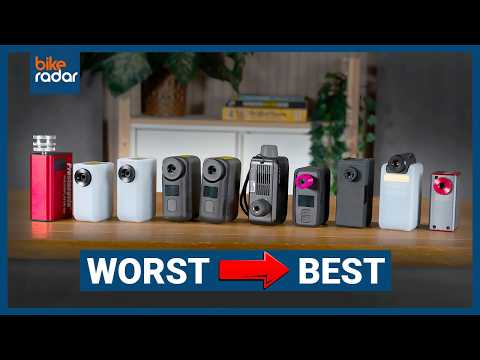
[0:00]Now, I absolutely love portable electric mini pumps and I've tested a whole load of them this year, and I get that lots of you might be skeptics. But let's face it. Most mini pumps are terrible. They've got flimsy construction, they're hard to use, they've got low capacity and a short stroke, which means most roadside repairs are sweaty, inconvenient, annoying, and inaccurate. Now, don't get me started on CO2. Yes, they'll get you out of a fix in the midst of competition when they work. Though, I'm sure we've all had cartridges fail to seal, and then there's also just the litter created. When the portable electric mini pump arrived, it was a Godsend, and I was a proud early adopter with the first and original design. Now, Pumper's quality pump was powerful and reliable, but it was rather expensive and it is rather large. I've used this pump for the last five years. Admittedly, mainly for gravel where I can stow it in a bar bag or when I'm commuting where it easily slots into a panier. On the road, it's just a bit too bulky to slip into a jersey pocket. So, I've had to persist with inferior inflators on tarmac. But now, we have a whole range of new micro-sized electric pumps, and I'm ready to recommend the top 10 plus the one I'd buy. Before that, a quick look at how I tested them as fairly as possible. Skip forward using the chapters below if you just want to get to the first pump. All of our inflators were tested using a Zip 303 SW wheel, because that's got the clever built-in tire pressure sensor. I use the 35 mm Zip Good Year Vector R Z 35 SW tire and it was set up tubeless. Now, according to SRAM's tire pressure guide, the rear tire needed to be inflated to 51 PSI to suit my setup. The inflator gauge were set to this and monitored on the Axis app for comparison. Those without gauges were inflated using the Axis app for guidance, and I also measured the recorded sound output, that's above ambient noise, and each inflator was continuously run until empty. All the units were run continuously to measure the heat level. If they got too hot to handle, they were left to cool down before continuing the test. Finally, I recharged them all and that time was also recorded.
[2:03]Okay, then. In tenth place, it's Silker's Electrico micro. This is a very, very well-made and very compact pump. It's quick to inflate and it's fast to charge, but it doesn't have a large charge capacity and it doesn't have a gauge. It's the only pump here that's also limited to 72 PSI, that's 5 bar. The rest can all manage much more at 120 PSI, that's 8.27 bar. In all, it's a smart emergency replacement for a CO2 cartridge, but it comes at a much more expensive price than the competition. Before we go any further, let me tell you about the Ribble Ultra Grip, the British brand's top-level Aero Gravel race bike. Tested at some of the biggest races in the world, including unbound, Dirty Reaver and the Tracker, the Ultra Grip already has proven pedigree, winning UCI level and Gravel Earth Series events in 2025. Inspired by the aero designs of Ribble's quickest road bikes, complete with internal cable routing and an integrated cockpit, the Ultra Grip is designed to get you to the finish line as fast as possible. The frame is made using ultra-lightweight and stiff Toure M46 carbon fiber, and the flex seat stay smooth out lumps and bumps. Comfort and confidence is assured when running 50 mm wide tires, while there's a neat down tube storage port to pack away your tools, plus provision for a third bottle and a bento box for those long days in the saddle. The Ribble Ultra Grid starts at £2,599 or $4,035 and can be purchased through Ribble shops nationwide and online. Plus you can customize the spec and color to your needs using Ribble's online configurator, or while benefiting from a lifetime warranty on the frame and fork. Head to Ribblecycles.co.uk or click on the link in the description to find out more.
[3:31]At number nine, it's the Topeak E-Booster Digital. In typical Topeak style, the E-Booster has plenty of features, lots of accessories, lots of functions and it's well priced. The generous battery means seven inflations, though it's fairly large and it does take over 45 minutes to recharge. The smart head works well, and the extension hose flips between presta and shrader valves at the turn of a trigger. The draw string protective bag is a touch of quality, and in all, it's a top quality inflator, easy to use and a large display and illuminated buttons make it a great choice for commuters and night rides. It is, however, quite bulky and will take up a lot of space in a seat pack. In eighth, we have the MagicShine Aero. The Aero's got a large capacity battery, which is good for seven full inflations. It's a cool little pump with crystal sides so you can see the inner workings and the smart gold anodized motor fan. That does, however, make it a little bit more fragile than the competition. So it's great that they've included a thick silicone case. In all, the Aero is a top-performing mini electric pump. It's generous battery capacity and compact size make it a great choice for larger volume road, gravel and mountain bike tires. In seventh, it's the Muc-Off AirMac Pro. Muc-Off's offering is impressively efficient, though it does get hot. After four inflations, I needed to put it down to cool, but once it had, it managed another full five inflations with almost nothing to spare. The head is quite slim, so it needs a bit of care to attach to your valve. The textured casing and well-placed buttons make it easy to use, and it's compact and pocketable. It comes fully loaded with accessories including the all-important extension hose to make it compatible with resin valves often found on TPU tubes. It's a great pump, and it's only the relatively high price that sees it stall in seventh. In sixth, it's the Air Rush Mini Electric Pump. Trek's offering brings in a bit of extra tech, not only do you get a fancy color screen, but it also has a mini torch built into. It's a nice add-on for dark winter night trail or roadside repairs. It's got a good head for a great connection, lots of accessories, including a canvas protective bag. It also charges fast, though it is one of the noisier pumps I've tried.
[5:36]In fifth place, it's the Topeak TB2 Pro, followed by Flex Tail's tiny bike pump Pro. Now, I've lumped these two together because they are essentially the same pump. Both inflated nine times, they both have the same case, the same battery size, and the same number of accessories, including the all important TPU safe extension hose. Price-wise, the official retail on the Flex Tail is £11 cheaper than the Topeak, although in US dollars, it's $15 more. What I would say is to shop around on either of these, as they can be both found much, much cheaper. Both have accurate gauges, but the Topeak was a few decibels louder. Now, I recommend either of these, especially at the much cheaper prices I found. In third, it's the Cycle Plus AS2 Pro. Now, this is a pocket-sized powerhouse. It's lightweight, it's good for a full six inflations with a rapid recharge time, accurate gauge, and all the vital accessories, not forgetting a great price. In second place, it's another from Cycle Plus with the AS2 Ultra. Now, this is a new, tiny, lightweight but fully featured option from Cycle Plus. Based on the AS2, but it gets a smaller case, a digital gauge, and an ultra lightweight magnesium skeleton. That helps it save 30 grams over the AS2 Plus. It's a powerful inflator that's compact and low weight and should appeal to roadies looking to save weight without compromising their repairs. Top of the tree and the pump I'd buy is the Prestacycle PrestaFlator Go. Now, whereas most inflators feel like they've come out of the same tech heads that build phones and gadgets, the PrestaFlator feels like it was born out of a workshop. The tough alloy casing has a proper standard thread for the head, so it's compatible with any aftermarket adapter. It's also TPU tube safe about hose, and that's thanks to the oversized 6061 C6 alloy head and the large urethane grommet that isolates heat build-up. But it's the large capacity battery that's good for 11 inflations, so you've got lots of capacity there. This will make you popular on group rides, and though it's bigger than some of our rivals here, it's still pocket-sized. But it's the availability of lots of spares and the workshop quality build that makes this my favorite and the pump that accompanies me on all my rides. So that's it, my top 10 round up, and this is the pump I'd actually buy. Now, let me know in the comments below what you think about electric pumps. Are you a fan or do you prefer to keep it old school? So, thanks for watching. Don't forget to like and subscribe, and if you want some more super exciting videos like this one here, we'll see you again soon.


