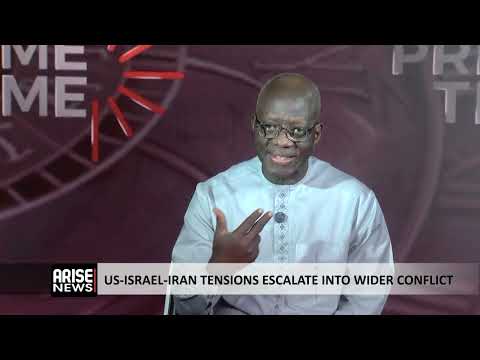
[0:05]Now, let's turn our attention to one of the most consequential geopolitical crisis of unfolding in the world today, the escalating confrontation involving the United States, Israel and Iran.
[0:17]What began as targeted military strikes has rapidly evolved into a wider regional conflict with profound humanitarian, economic and strategic implications.
[0:30]The conflict has already triggered missile exchanges, cyber operations and disruptions to global energy supplies, particularly around critical routes like the Strait of Hormuz.
[0:40]But today, we're more concerned with the effectiveness of global governance, particularly the role of the United Nations in preventing wars, enforcing international law, and mediating between powerful states in an increasingly polarized international system.
[0:56]We'll examine the geopolitical stakes, the role of international institutions, and what all this could mean for Nigeria and Africa.
[1:06]Well, joining me now is Ambassador Bulus Lolo, who is a former Permanent Secretary at Nigeria's Ministry of Foreign Affairs.
[1:15]Glad to have you join me. I hope I got that correct. Very correct. Thank you for for being in the program here. Before before we talk about the UN and all that, what what's the immediate, I mean, you've been following events, what's the immediate and if you like, long run global consequences of the US, Israel, Iran war and narrowing it down, what's the ripple effect of war on other nations?
[1:43]If you ask the effects, look at the devastation that takes place, destruction and loss of development gains, which was what informed in 1945 the establishment of the United Nations.
[2:02]Having had two wars back to back, 1914 to 1918.
[2:07]So in 1945, after the bitter war and the victory that was quite narrow, but significant, when the United Nations was established, the charter specifically said to save mankind from um its succeeding generation from the scourge of war.
[2:34]That is inscribed in the charter of the UN. So, when you look at the coach of war, take the numbers in human lives that have been lost.
[2:45]Take the disruption in your background report to normal life, the global economy, and of course, you would say, on no account, if man can avoid war, should man fight a war, because peace is always better than war.
[3:04]And so, we don't need to go and say what are the consequences, the consequences are seen and lived every day.
[3:13]Plus, the victims of war are human beings like you and I. And we learn to look at them from that frame.
[3:22]Then, the pension to rush to war because we refuse to negotiate and negotiate in good faith.
[3:30]We refuse to exercise restraint because we have might and power, and all of it then will feed that instinct.
[3:41]That brutal instinct in man to kill.
[3:46]And someone said, animals kill for food, but man kills himself to do himself no good.
[3:53]So, that's the background that I want you to look at war and its effects.
[3:59]All right, you you just you just said it there. The UN was formed to prevent future global conflicts.
[4:07]maintain international peace and security and foster cooperation among nations. Right. Now, the way things have panned out or he's spanning out now, what do you make of the UN in relation to why it was formed, where we are today and what is happening presently?
[4:24]I will draw just very briefly because I know we don't have the time.
[4:29]All right. I had the privilege to serve at the United Nations during my active days as a diplomat.
[4:37]I spent five years debating development at the United Nations.
[4:44]Then another one and a half years debating peace in the Security Council.
[4:51]So I've seen the both ends of what the UN tries to do.
[4:56]The UN of yesterday, and I'm talking yesterday because I lived the UN in 2011, but I first went there 2020, I mean 2002.
[5:07]Even in 2002, the world was talking about development goals in which to reduce poverty by 50%.
[5:17]We did not attain that, then we moved to sustainable development goals.
[5:23]2030 is around the corner.
[5:27]There is nothing inside that gives me hope that the SDGs will be attained.
[5:32]But then you have a United Nations now that is completely paralyzed.
[5:38]In fact, the UN is facing financial crisis.
[5:44]The last projection I heard, I hope I'm wrong, but that unless something was done, perhaps by July, the UN will have a serious shortfall in its finances.
[5:54]That is July. Yes, as a result of what?
[5:58]The member states not doing what they're supposed to do.
[6:01]What are they supposed to do? America for instance, has been the highest donor, but any time you have a Republican administration in Washington, they knock on the UN.
[6:11]Today the Security Council cannot sit and adopt a resolution in line with its core mandate of maintaining international peace and security.
[6:21]Russia is might and caught up in Ukraine.
[6:25]Today the United States is caught up in in Iran.
[6:29]And if you combine the effect of Russia in Ukraine, America in Iran.
[6:40]There is just no way under the sun, because I sat through the Security Council and I know the processes in the Council, how you arrive at a consensus in a resolution.
[6:51]19 resolution 1973 of 2011 that allowed the events in Libya that we are facing the consequences even today.
[7:00]At least in 2011, Russia and China did not block the adoption of resolution 1973.
[7:12]You cannot adopt a modicum of that resolution today because the permanent members are divided.
[7:18]And there is no chance under the sun that you will get them as mature beings to sit in the room and say, we are burying our differences and therefore, let us do this for the sake of peace.
[7:29]It never does happen. I mean, just the other day, China and you're talking about security.
[7:35]China, Russia have abstained as UN Security Council demands Iran holds attacks on Gulf states.
[7:44]Exactly.
[7:47]China and Russia have abstained.
[7:50]They're asking for uh uh uh the the Council is demanding Iran holds attacks on golf states.
[7:58]One is wondering, why is he one-sided?
[8:04]Why not ask that Israel, also ask that Israel and US stop attacks on on Iran, and this raises the question of dispute resolution.
[8:21]Can we stop saying that?
[8:26]has UN has UN become useless? I don't know, I don't know how to. I will not use the word useless. And I'm not strong. No, you the the UN has been rendered rendered incapacitated, important.
[8:43]Important, okay. Yes, the US the UN today is an important organization.
[8:48]Is it possible we can turn it around? Is it possible the world can turn it around? If if if there is the will to do so and indeed, the potential to turn it around is there, but the reality today today is such that there is growing nationalism around the world.
[9:02]Don't forget that we have also moved from a multilateral system to a multi-polar in which you are localizing the center of power.
[9:14]And when you localize that power, it depends on how that power then is used.
[9:22]There has not been any better opportunity for Israel to do what it is doing in Iran then now.
[9:32]It's been a long-term thing Israel has been itching to do.
[9:37]But other administrations including Republican administrations would not give them the leeway to go as far.
[9:41]Until Trump. Israel's best friend, it is said, who looks the other way and says, BB, hit them hard.
[9:51]Send them to hell. And that's what they're doing. And there's a talk that it is a war of choice that Trump was actually, I mean, because there was there stopped that uh Israel instigated Trump to enter into this war.
[10:02]He'll always do it. If you throw a bone at a dog, what will the dog do?
[10:06]It will go for the dog. It'll go for it.
[10:12]And so, because Israel, don't forget that in 2016 when Trump won his election, Obama had just negotiated that painstakingly agreement with Iran.
[10:24]That brought in five plus one, the one being Germany, right? And they reached an agreement.
[10:31]Trump tossed it out. Israel said, better a bad deal, then no, I mean, better no deal than a bad deal.
[10:41]That was the way they described it, and Trump equally said, no deal, then a bad deal.
[10:50]And so, it is Trump even promised that he will negotiate a better deal.
[10:57]He had four years 2016 to 2020, and then now he's back.
[11:05]They were negotiating. On the Thursday before the Saturday that he struck, the word and reportage was what? They had agreed on certain principles.
[11:21]The Iranian Foreign Minister even said, they will resume maybe in two weeks, not knowing that within hours, his country will suffer a barrage, and only today, Israel is saying they have carried out the most unprecedented attack in Iran.
[11:43]So, when you talk of dispute resolution, who will sit to resolve the dispute, rather than the barrel of the gun?
[11:53]But, here is where the risk and the real danger is.
[12:00]By the time you decimate Iran, you will weaken the country, but will you annihilate them completely?
[12:12]The answer here is no.
[12:18]What about those who will remember that this was how without a clear, clear provocation.
[12:31]There have been times when you would say, you know what, this country really provoked, but this time, we didn't see any smoke rising, other than the rhetoric about snow smoke coming.
[12:45]There were talks going on before for.
[12:49]They've hit and they are still hitting and will continue to hit.
[12:56]How much are you buying petrol today if you buy petrol in Nigeria?
[13:00]Yeah, because I was going to talk about that.
[13:03]You know, the straight is closed. The first announcement was statement attributed to the news supreme leader is about what? The closure of the straight of Hormuz.
[13:11]And he's saying that oil, if the war continues, because I I I was going to ask you here if this war, uh is prolonged, now, uh how will it prolonged, surge in oil prices, because he's saying he may get to $200 a barrel, how will that reignite global inflationary pressures and how will it tax businesses and consumers?
[13:46]In fact, the opposition party here in Nigeria is saying is asking the government to do what they call time cap on petroleum prices.
[13:51]Yes. You know, IEA has just released 400 million barrels.
[13:57]Precisely. From its reserve because of the effect of the war.
[14:03]But 400 if you look at the daily consumption and demands, look at that also from the point of view of weak and month and see is the reserve being released by IEA going to really make a long-term difference?
[14:26]The answer is no.
[14:29]And for us in Nigeria, it only reminds one that we should have fixed our refineries yesterday, not even today, talk less of tomorrow.
[14:47]And without that refining capacity, in fact, we owed Dangote a debt as a nation.
[14:55]But he still imports oil. I mean, for example, as a mid-2025, the Dangote refinery reportedly imported between 9 and 10 million barrels of crude oil per month to sustain operations amid supply.
[15:15]And so, so what's the downstream?
[15:19]Let the point I was making about Nigeria owing Dangote a national debt is the fact that he has redeemed us from our shame.
[15:31]Well, to give us a refinery that is one of its kind.
[15:38]And it is equally contributed beyond our imagination to meet if not the 100% that we need to refine locally, but at least he has taken you from zero, near zero.
[15:58]Even though the question of some are talking the question of a monopoly, I don't go on.
[16:05]Would you rather have someone who exercises monopoly but gives you the product, or you have importation of quality that is questionable and harmful to people's health?
[16:25]You know, we talk about all this and and one wonders where do we go from here, what does UN need to do? What does it need to really do, because the world needs to reinvent the UN.
[16:43]And give it the power that it needs.
[16:51]Bring in people who are willing to sit and face the reality that we have a common threat if life is disrupted, regardless.
[17:05]And so we should address it.
[17:08]Thank you so much, Ambassador Bulus Lolo, former Permanent Secretary at Nigeria's Ministry of Foreign Affairs.
[17:23]I hope that the world gets around to doing what you just said. I present to you. Thank you so much, and that's it for this edition of Arise Prime Time.
[17:39]Do join us again tomorrow from me and the entire team here in Abuja.
[17:46]Goodbye and thank you for watching.


