[0:00]So what we're going to talk about today is James Marsha's theory of adolescent identity development. Um and the reason that we talk about it is, um it's a really good way to explain to people why they might not know what they're majoring in college. Um you know, most people come to college and they say, oh, I don't know what I'm majoring and they sort of they're ringing their hands and like, they feel bad about it. They talk to their parents and everybody says, hey, you're going to college. What are you going to major in? And it's like, I have no idea what I'm going to major in. Um and what I'd like to explain is there's a theory that suggests that you shouldn't know yet. Um and so the theory is James Marsha's theory. Um and a really good way to explain it is to draw it um as a four-blocker. Um and this is something that I've done for lots of people. There aren't very many theories in psychology um that I talk about in my personal life when I'm outside because people have a pretty low tolerance for that. Um but I have drawn this in the sand at the beach. I've drawn it on a napkin at a cocktail party. Um it's a really useful thing. And so I'd like you to be able to draw it. It's going to be on the final exam. So, um so get your pens out. Um I don't care how you label it. You don't have to label it exactly the same way I do. As long as um the intersections of the things that you draw are correctly labeled within it. Um so across the top, um we're going to put, um crisis. Um and crisis in psychology is not a bad thing. So when you think about a crisis, um it's like, oh, I'm having a crisis. Like, yay, I love crisis. Um no, in psychology, a crisis is a period of active exploration. So when, uh, Erikson, for example, said there was a crisis of trust versus mistrust, you're working through something. Um so crisis is a period of active exploration. Um and then on this side, what you've got is commitment. A commitment to a particular course of action. So, um, once you have committed to something, you say, I'm going to major in engineering. I'm going to major in animal science. Um that would be a commitment. So over here you've got commitment. Um and either of these things can be high or low. So we'll make it really simple and we'll say it's low here. and high here. Um if crisis is low, it means you're not spending any time. So think about um uh high school senior trying to decide what to major in, what to do next. If crisis is low, that student is not doing anything. They're not thinking about it. They're laying on the couch. They're um watching TV. They're in the woods behind the school, chatting with their friends. Um crisis is low. They're not, they don't, you know, outwardly they might be doing something but it doesn't look like they're doing anything. If you ask them, it's like, I haven't thought about that. They also haven't committed to anything. And that identity status is called diffusion. Um and I'm going to give that one a frowny face because you don't get out of that. If you're not doing any work, um and you're not committing to anything, you're just going to stay there. You're stagnant, there's no progress being made. On the other hand, if commitment is low, you haven't decided what to do, but you're spending a lot of time uh thinking about it. So this uh uh crisis period, this active exploration is high. It's like I, you know, I took some tests. I went and visited somebody at work. I've done all of these other things. When crisis is high and commitment is low, that's something that we call moratorium. Um and moratorium sounds horrible. It sounds like something you would find at a funeral home, but it's actually a really good place to be. So I'm going to give that one a smiley face. And the reason for that is you're working through things. You're trying things on. Um it's like, wow, you know, I I tried this for a while. I took a couple of classes. It turns out geology is not my thing. I thought it was going to be. I thought I would be a geologist. Um and here I am, you know, after a couple of courses, I need to sort of step back and do something else. Or I'm that high school student who says, you know what, I'm just going to do my GED classes first and see what speaks to me. So moratorium is a really good place to be. Um and that's where people should stay as long as they need to. So why rush through that? Life is long. Like you're not, you know, what's the rush? You're going to be working for decades. Um and so, um you want it to be something that you like, you know, and not, you don't want to get to be in your 30s and say, ah, I don't know if I like this so much. Um so that's um when commitment is low and crisis is high. When commitment is high and crisis is low, that's what we call foreclosure. Um and foreclosure means you have foreclosed on your other options. Um so, um, you know, your mother was a nurse, your father was a nurse, your grandparents were nurses. You'd like to go into the field of nursing, or um some, you know, you've got a family business and it's always been expected that you would go into the family business. Or you come from a long line of people who do chemical engineering or law, or whatever it is. Um and you've decided really early in life, that's what I want to do. Um and that sounds like it would be fairly rare, but it's not as rare as you would think. You know, you think about a child. Um I know a child who, um, had some medical difficulties when she was young. Um and she got really good nursing care. And so as a 10-year-old, people said, you know, what do you want to be when you grow up? It's like, I want to be a nurse. Um and as a 14-year-old, you know, what do you want to be? You know, like, I want to be a nurse. And every time you say that, you get a little bit more pat on the back. Um people say, wow, that's great that you know what you're going to do. Um and so the idea is that high school senior that has a, has an answer, like, I'm going into nursing. I'm looking at schools that have nursing. I'm going to major in nursing. That sounds awesome. And that's the thing that everybody wishes their kid did or that wishes that they were doing. Um but in fact, that student is going to get to college and start taking courses like statistics and chemistry and, um, you know, biochem. It's like, whoa, like, I got to C in that. I am in no way going to get into the nursing program. And I don't even like those courses. So you've, your commitment was high, but you foreclosed other options without doing enough exploration. Um so foreclosure, um, I'm going to say, it's not a huge frowny face. It's not quite as bad as diffusion. Um but it's not a great place to be because what will happen is you get to be 40 years old and it's like, wow, I've been doing this job for 20 years. I never really liked it. I have all of my fun after hours. Um, well, that's not great. Wouldn't you like to have fun at your job and say, I love it, you know, even on my worst day, I'm still glad to be there because I'm working things out. I'm doing things. That's what you want. Um and that's where moratorium might get you, but foreclosure won't. Um so you've foreclosed other options, not a great place to be. When commitment is high, crisis has been high, and commitment is high, that's what we call identity achievement. Um and with identity achievement, that's just what it sounds like. It's like, of course, that's the ideal. Like you want to spend enough time. However, you know, for some people that will be a short amount of time. I took this course. I loved it. I want to go into that field and I've never looked back and I've never been sorry. That's great. But they explored other options, um and got there from moratorium rather than um these other, these other two options, which are not awesome. Now, there's one last thing that I want to say and that is life is long. Um so you get to be 40 and just because you were in achievement and you've got this great career in, um, you know, underwater basket weaving. And it's been your thing and it's been your jam. And you've loved it for the whole time. Um there's a cycle that's called mama, um that um, that we talk about um moratorium achievement, moratorium achievement. And that's that idea that you went through moratorium initially. Um then you achieved an identity and you, um, you went with that. And then at some point, you're 40, 45 years old and it's like, you know what, this has been a great run. But I've always also been interested in architecture. I'm going to go back into moratorium. I'm going to explore other options again. I'm going to think about other things. Um sometimes it looks like a midlife crisis, but really what is happening is this a midlife review. So midlife crisis, actually in psychology, not a bad thing. Crisis is not a bad thing. So you go back, you explore other options, go back into moratorium and then you go back to achievement again. So that's the ideal. Um that is James Marsha's theory of adolescent identity development.
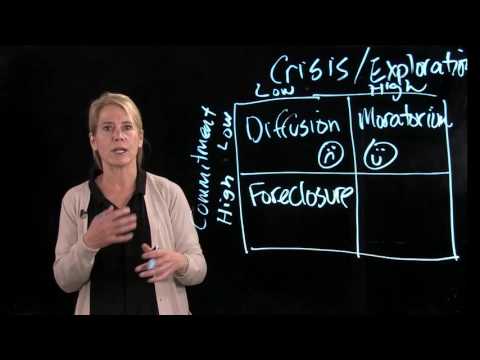
James Marcia's Adolescent Identity Development
Kim E
10m 39s1,737 words~9 min read
YouTube auto captions
Transcript source
YouTube auto captions
This transcript was extracted from YouTube's auto-generated caption track. The transcript below is server-rendered so it can be read, searched, cited, and shared without opening the original YouTube player.
Pull quotes
[0:00]So what we're going to talk about today is James Marsha's theory of adolescent identity development.
[0:00]Um and the reason that we talk about it is, um it's a really good way to explain to people why they might not know what they're majoring in college.
[0:00]Um you know, most people come to college and they say, oh, I don't know what I'm majoring and they sort of they're ringing their hands and like, they feel bad about it.
[0:00]Um and what I'd like to explain is there's a theory that suggests that you shouldn't know yet.
Use this transcript
Related transcript hubs
Watch on YouTube
Share
MORE TRANSCRIPTS


