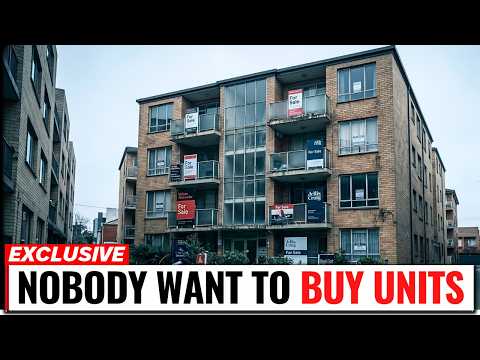
[0:00]Times are tough for investors trying to offload units and apartments here in Melbourne, as Chris Callard discovered. One in five is now selling at a loss. There was a bit of a glut in supply, particularly in the mid to late 2010s. On the demand side, there used to be a lot of investor demand, but that was punctured by changes to lending conditions in 2017. And even more recently with increases to investment property levies.
[0:28]You've got better protection if you buy a toaster than if you buy a unit. If something does go wrong, there's really nobody to turn to. We have an asset worth 1 and a half million dollars that right now is worth nothing. We've just hit a brick wall, and I can't see a way out of this at the moment. The spread of residential towers has grown, especially in Sydney, Melbourne, and Brisbane, oversight and quality have lagged behind. Build it quick, build it fast, sell it quick and move onto the next one. And the government has allowed that to happen. Well, welcome home. This is, uh, my beautiful apartment, my home, um, in Opal Tower. Here's what nobody's telling you about Melbourne's apartment market. And right now, thousands of apartment owners across Melbourne are caught in a trap with no way out. They can't sell because 43.7% of apartment resales in the City of Melbourne recorded a loss in Quarter 3, 2024. And 8,000 completed apartments sit unsold across the city competing with them on price at a steep discount. They can't hold because land tax thresholds have been slashed, body corporate levies are doubling, and cladding remediation bills of up to $90,000 per owner are landing without warning. And they can't refinance because no bank will lend against a declining asset when the loan to value ratio has blown past 100%. You kind of have to laugh where you just spend the whole day crying because this is killing us. Continue to grow and and it's become an insurmountable task. I think for our share it's over 800,000, and our mortgage is 900,000. It's just not on that we have building regulations like this in place that allow for these things to slip through the cracks. Today, I'm going to show you the three traps that are destroying Melbourne apartment owners. The selling trap, the holding trap, and the strata trap with verified data from the RBA, CoreLogic, Charter Keck Cramer, ASIC, and real stories from owners who are living through this crisis right now. Let's get into it. Right, let's start with the first trap. The one that hits you when you try to leave. As the spread of residential towers has grown, especially in Sydney, Melbourne, and Brisbane, oversight and quality have lagged behind. Theality pain and gain data confirms that 43.7% of all property resales in the City of Melbourne Local Government Area recorded a loss in Q3 2024. Nearly half. The national average is 5%. Melbourne's inner city is running at nine times the national loss rate. And the losses aren't small. The March 2025 Pain and Gain Report confirmed Melbourne's unit loss-making sales rate at 21.3%. The highest since the late 1990s. The median loss nationally sits at $50,000, but in Melbourne's worst affected suburbs, the damage is far deeper. Fire prevention systems in nearly 1,000 Victorian apartment buildings have been scrutinized. The report finding just 13% had been maintained and complied with regulations. We'd welcome collaboration with the government and local government, uh, to try and improve safety. The government's new building legislation that's just come out in the last couple of weeks should really go a long way to sort of supporting and improving that. Domain data from February 2026 shows South Yarra at 41.9% loss-making, Prahran at 34.9%, Windsor at 25%, and Malvern at 22.7%. And the price stagnation is the engine of the trap. JLL confirmed that Melbourne's inner precinct saw just over 2,000 apartment completions in 2025, a 10-year low. And yet the median apartment sale price finished 2025 at $615,000 and has remained broadly stagnant since early 2023. Oh, it's been devastating. I mean, financially it's been huge. Um, there have been people in the tower who have wanted to sell, and of course cannot sell. And so, you can imagine you're going to the bank, you're saying the bank I'd like to borrow money, they say, okay, let me look at your assets, one of your assets is Opal Tower. One bedroom apartments specifically fell 2.5% year on year. That is three straight years of zero growth, while mortgage repayments, body corporate levies, and land tax all climbed. PropTrack data goes further, showing 80 Melbourne suburbs where unit values have actually decreased since 2020. That's five years of negative returns. So PropTrack Senior Economist Angus Moore confirmed home prices were tracking sideways or falling. And Domain data identified 28 Melbourne suburbs with double digit unit price declines over five years. Chadstone dropped 25%, a fall of $167,000 in median value. Maidstone dropped 23.1%. West Melbourne dropped 21.6%. And behind these percentages are real people making real decisions with real money. event in the lifetime of the Australian construction industry. Uh, not a fortunate event, but certainly caused everybody to to step up. One poster on the Aus Finance subreddit in February 2025 wrote, Hi, I'm struggling with a bad financial decision I made last year to buy an apartment in Melbourne. It cost $570,000 and the mortgage repayments are higher than I anticipated ($3,500 monthly) plus body corp ($6,000 a year). That post trails off, but the meaning is clear. This person bought at what they thought was a reasonable price and the repayments are now crushing them. They're trapped. Can't sell without crystallizing a loss. They can't hold without the repayments eating them alive. dollars worth of work this project and uh several years of construction over about 14 separate phases. I would say that the building industry generally in Australia is actually world class and I'd go as far as to say in some circumstances, the the uh, you know, quality and safety uh that we're world leading in many respects. And the off-the-plan buyers face an even crueler version of the trap. One poster on the Oz property subreddit described buying off the plan and discovering at settlement that the bank valuation came in 10% below the purchase price. That means if they'd paid $600,000, the bank said it was only worth $540,000, and they needed to find tens of thousands of dollars in additional cash overnight just to settle, or lose their entire deposit. And while they were scrambling to cover the shortfall, the developer had simultaneously listed identical apartments in the same building at 20% above the original purchase price. The developer is marking up the building, while the bank is marking it down. That's not a functioning market, that's a trap disguised as a property transaction. It's everything that you've worked for, that you think is safe, and that is protected. I feel like it's a black hole with a never-ending siphon of money into it, and how we're going to get out of it is is the worrying thing. And another poster on Oz Finance captured the broader disbelief back in 2023 when they wrote, Have I made a mistake? $600,000 apartment bought off the plan in 2021. Won't be completed until mid-2024. My worry is that by the time we come to settle in 2024, the unit will be worth far less due to rising interest rates and falling house/unit prices. That poster's worst fears came true. By the time settlement arrived, Melbourne apartment values had been flat for over a year and one bedroom prices were declining. The off-the-plan model, buying something that doesn't exist yet, at a price set years before delivery, has become a wealth destruction machine for Melbourne buyers. Well, we did everything that I believe a responsible person would do. We absolutely did due diligence in inspecting the books and uh inspecting the doing a visual inspection of the building. Apartment owner Brian Tucker is a surveyor, but even his knowledge of the building industry didn't protect him when he bought into Mascot Towers. Eleanor Creagh, senior economist at PropTrack, may put Melbourne's position in devastating context. Melbourne's housing market has been relatively weak for much of the past four years. Since the pandemic, it has been the weakest-performing capital city market, with prices rising only a little over 13% in that period. In contrast, smaller capitals like Brisbane, Adelaide, and Perth have seen much stronger price growth. Even Sydney, despite its affordability challenges, has recorded an almost 40% increase. Andrew Barrell and his partner Alex Chan can't see how they will afford the payments. It's just have bundled together, like we are sort of like on a Titanic. We are sinking together. We have no way to actually escape. The worst come to the worst, I think the only way I can find the way out is declare bankruptcy. But here's what nobody is telling you. The selling trap is only the first layer. Even if you decide to hold your apartment and wait for the market to recover, there are two more traps waiting for you. A tax regime that is bleeding landlords dry every single year. And a strata defect crisis that is hitting apartment owners with bills of $61,000 to $100,000 with as little as five days' notice. I can prove both of them with government data and documented case studies from real Australians. And when you see the numbers, you'll understand why the word trapped is the only word that fits. Now, if you want to go deeper than what I can cover in these free videos, I've launched a channel membership. Members get exclusive videos that don't go public. You can ask what I cover next. You get a member's badge so I can spot your comments first and I'll prioritize replying to you. Just click the link in the description or scan this QR code right now. contract price. In Melbourne, it's closer to the 50%, about 53%. That means that for more buyers the apartment is worth less on the day they settle than when they signed the contract. So you can't sell without taking a loss. The next question is, can you afford to hold? For thousands of Melbourne apartment owners, the answer is increasingly no, because the cost of holding has been deliberately increased by three policy decisions hitting simultaneously. The first is the land tax restructure. The State Revenue Office confirms the tax-free threshold was slashed from $300,000 to just $50,000, an 83% threshold cut. The absentee owner surcharge pushes the effective rate to between 4 and 6.65% on top of regular land tax. And from January 2025, the vacant residential land tax expanded statewide.
[12:44]Meaning if your apartment sits vacant for more than six months while you're trying to sell it, you pay an additional 1% of capital improved value per year, rising to 3% by year two. And the holding trap is catching people in real time. You've got defective buildings that are coming up and what's it going to take? Does a wall have to fall on someone and injure human life in order for them to turn around and realize that we now need to regulate our industry? Changes need to happen. One investor posted on the Oz property chat subreddit in February 2026 describing a property that had been listed since September 2025 with no buyer. Their words, This property has been consistently rented since we bought it in 2020, but after the tenants left, it has remained unoccupied. They're now facing a vacant land tax liability on top of regular land tax, while simultaneously unable to find a buyer. They can't sell fast enough to avoid the tax, but holding the property costs them more tax every month. It's a circular trap with no exit. The second cost driver is the investor exodus itself. And this is where the trap becomes self-reinforcing. feel for people who are in negative equity. Uh, yeah, I guess I do, and if they need to move um in the next couple of years, it's going to be hard. If your property is now worth less than the mortgage that you've got, and you sell the property, you've still owe the bank. REIV CEO Kelly Ryan confirmed Victoria lost 24,716 rental homes in the 12 months to September 2024. Her exact words, "I guarantee it will be worse because the quantum of properties we saw on the market in September, October, and November was unprecedented." Within just 12 months, 21,712 rental properties vanished from the market. The first decline since records began in 1999. And as more investors sell, listings flood the market, pushing prices down further, making it even harder for the remaining holders to exit. conditions. An over supply of new apartments aimed at investors who no longer want to buy them. And house prices that have come off record highs. New data from Digital Finance Analytics has revealed there are 3,900 households in this post code, where the owner has a mortgage higher than the property's current valuation. Now, to be fair, the NHSC's own data shows that almost all mortgageors benefited from home values that exceeded their mortgage balances. Nationally, fewer than 1% of mortgage holders are in negative equity. But Melbourne's apartment sector is the extreme exception to that national picture, when 43.7% of CBD resales are recording a loss. The national average of less than 1% in negative equity is cold comfort for anyone holding an inner city unit. And the RBA's April 2025 Financial Stability Review singled out Victoria specifically. The Central Bank confirmed that Victoria has seen the sharpest rise in mortgage arrears across Australia, attributing it to a larger than average share of borrowers experiencing cash flow shortfalls. That is the Reserve Bank of Australia officially naming Victoria as the mortgage arrears capital of the country. And the construction industry collapse is removing the possibility of new, better quality supply, replacing the problematic stock. ASIC confirmed 3,596 building company insolvencies in the 2025 financial year, the worst figure on record, with 1,051 of those in Victoria alone.
[17:46]The article included accounts from construction workers describing the emotional devastation. TIACS, a blue collar industry counseling service, reported that 440 of the 1,100 people who used the service in the 2025 financial year were from construction. The headline read, Men in tears: Builders face ruin amid hidden construction crisis. And the community on the Oz Finance subreddit ran the leverage calculation and found that apartments in the Melbourne LGA are selling at a loss 40% of the time with a median loss of $60,000.
[18:25]Their devastating conclusion, since properties are leveraged, it's probably close to 100% loss of deposit. A $60,000 loss on a 10% deposit of $60,000. Your entire deposit, every dollar you saved, gone. And here's the trap I've been saving for last, because it's the one that blindsides owners who thought they'd done everything right. Over 3,400 apartment buildings constructed in the last 10 years contain defects or non-compliant combustible cladding. The total remediation cost, $6.2 billion. Per dwelling, that's up to $165,000 in remediation. And the bills are arriving with as little as five days' notice. You can't sell a building under a disputed special levy. You can't refinance when the strata report shows unresolved structural defects, and you can't walk away because the body corporate will garnish your income to recover the costs. This is the third trap, and it has no exit. Right, so let me show you what the strata trap looks like for real people. The Guardian Australia profiled a buyer identified as Jake. Three months after Jake and his partner purchased their apartment, they were hit with an unforeseen expense exceeding $100,000. A special levy for building defect remediation. Jake took a second job to manage the levy payments of $10,000 per month on top of his existing mortgage. The new daily reported a similar case, a first home buyer identified as Jessica, who received a $61,111 special levy due in five days. Five days. She bought her first property in 2023, done what she thought was proper due diligence, and was blindsided by a bill equivalent to more than 10% of her purchase price arriving with less than a week's notice. And real estate.com.au documented the case of Josh and Emily, whose quarterly strata fees started at a manageable $600, but ballooned to $3,500. Nearly six times the original amount, thanks to defect rectification and cladding replacement work that nobody warned them about at the time of purchase. When they couldn't pay a separate $20,000 special levy upfront, a garnishing order was placed on their rental income. They now receive zero rental income from the property, while still paying the full mortgage, the council rates, the insurance, and the regular body corporate fees. They're subsidizing a property they can't live in, can't rent and can't sell, because who would buy an apartment with a garnishing order attached to it and a building full of unresolved defects? Strata lawyer Amanda Farmer confirmed the pattern in the new daily. I am witnessing an increasing number of buildings needing to raise substantial funds on short notice. Owners are often caught off guard by a hefty bill they didn't anticipate. The legal structure of body corporate ownership means individual owners have no ability to opt out of a levy. If the majority votes for remediation work, every owner must pay their share regardless of their financial capacity. You're locked in by the legal structure of the building you bought into. And the cladding crisis specifically is devastating. One apartment owner posted on the Oz Finance subreddit describing a $90,000 special levy for combustible cladding replacement across the entire building. Their exact words, The strata applied a special levy to the owners to pay for the flammable cladding replacement of the whole building. I'm not sure what to do in financial terms. This is a lot of money.
[22:36]This blew my mind. In order to cover this costs, the strata will take a loan and we will be paying a special levy of like almost $4,500 for many years. That is $4,500 per year on top of your regular body corporate levies, on top of your mortgage repayments, on top of land tax, on top of council rates, on top of insurance. The maths doesn't maths, mate. And another poster on the Oz property chat subreddit described discovering that their building had serious waterproofing problems requiring over $1 million in remediation. Their share, an additional $1,000 per quarter for five years. The top community response was chilling. If you're contemplating selling, I recommend acting quickly. As our special levy led to a noticeable decline in occupancy, which significantly lowered property values. If you want to exit, don't delay. But here's the catch 22. Once a special levy is announced, you can't sell without disclosing it. And once buyers know about it, nobody wants the property. You're trapped. Now, to be fair, not every Melbourne apartment is affected by defects. Well-maintained established buildings with properly funded sinking funds and no cladding issues have generally held their value better. And many owners who bought in owner-occupier dominated buildings, rather than investor towers, are in a materially different position. But the scale of the defect problem is massive. Equity Economics research commissioned by the CFMEU found 3,461 apartment buildings constructed in the last decade contain defects or non-compliant combustible cladding. Total remediation cost, $6.2 billion. Per dwelling, that's up to $165,000. Cladding and water damage alone cost approximately $45,000 per dwelling. And internationally, the scale of Melbourne's apartment specific crisis has no direct parallel. In the United Kingdom, the Bank of England's Q4 2025 data shows mortgage arrears at 1.2% of outstanding balances. And that rate is declining. UK Finance confirmed 92,170 homeowner mortgages were in arrears in Q4 2024, representing 1.06% of all homeowner mortgages. That's a national arrears rate that is actually lower than Victoria's alone. In Canada, Toronto prices fell 3.5% year on year, Hamilton fell 3%, and Vancouver dropped 0.7%. The CMHC reported that the average Toronto renter spends 42% of after-tax income on a one-bedroom unit, comparable to Melbourne's rental stress. But neither the UK nor Canada has a documented concentration of apartment specific losses anywhere near Melbourne's 43.7% CBD loss rate. That level of loss-making resales in a single asset class in a single city center has no equivalent in any comparable Western economy that I can find in the data. The Demographia survey rated Melbourne at a median multiple of 9.7, less affordable than London at 9.1. And noted that for the first time ever, not a single one of 95 housing markets across eight nations was classified as affordable. Australia has five cities in the global top 15. No other country comes close. And the NHSC confirmed that 50% of median household income is now needed to service a new mortgage. The average time to save a deposit has risen to 10.6 years. Only 14% of new dwellings are affordable for median income households, the lowest on record. And one more poster on the Oz property chat subreddit captured the emotional weight of the crisis perfectly. My mortgage takes up most of what I earn and this special levy is crushing me. I feel completely powerless. Strata is so opaque and dysfunctional. That sentence trails off, but the message is clear, completely powerless. That's what being trapped feels like. So what happens next for trapped Melbourne apartment owners? The outlook splits three ways. Best case, rate cuts, improve borrowing capacity. The 8,000 unsold apartments are gradually absorbed over two to three years. And strata defect remediation programs receive government funding that reduces the burden on individual owners. But Richard Temlett of Charter Keck Cramer has proposed that unsold developer stock be purchased by the government for social housing. Removing the price anchor that's keeping values depressed. If that happens, existing apartment values could stabilize.
[28:03]Realistic case, apartment prices continue to flatline, as they have since early 2023 with zero growth for three consecutive years, while the holding costs keep climbing year after year. Land tax, VRLT, and body corporate levies continue to increase annually. Strata defect bills arrive building by building, creating a rolling sequence of price shocks. The most exposed owners, those who bought off the plan between 2018 and 2022 with minimal deposits, gradually sell at losses or default. The market clears over three to five years. May but the wealth destruction for this cohort of owners is permanent. Worst case, the 8,000 unsold apartments are fire sold under VRLT pressure, crashing comparable values across every inner city building. Developers slash asking prices by 20 to 30%. The builder insolvency cascade continues past the 2025 record of 3,596. Strata defect remediation costs escalate as more buildings reach the age where problems emerge. And the RBA's data shows that Victoria's unemployment, already at 4.7% and above the national average, continues to rise. Triggering both legs of the double triggered default hypothesis simultaneously for thousands of apartment owners. Absolutely cooked. So what does this mean for you? If you own a Melbourne apartment, particularly an inner-city unit bought off the plan between 2015 and 2022, the data says 43.7% of your neighboring resales recorded a loss. And 8,000 unsold apartments are competing with you on price. Check your strata report for upcoming special levies. Check your cladding status with the Victorian Building Authority and check your loan to value ratio against current market valuations, not against what you paid. If you're thinking of selling, understand that the longer you wait in a flat market with rising holding costs, the larger the total loss becomes.