[0:01]This is a tale of the future. For centuries, the Sal Hegemon has ruled uncontested the greatest swath of human space in the galaxy. Earth is long abandoned, its great cities reduced to overgrown ruins as mankind has sought new homes and new dominions amongst the stars. But now, the beating heart of the Sal Hegemon has been convulsed by revolution. The rebels claim they fight for freedom and equality, but are they truly any better than those whom they name oppressor? But on the fringe of human space, worlds remain untouched by war and revolt. It is to this region that the crew of the Babylon Rocker have come, seeking peace and escape both from the chaos of revolution and the dark specters of the past. On the fringe, there is hope. On the fringe is freedom and light and opportunity. But with such freedoms and opportunities come many dangers, some of the future, others of the past that they seek to avoid. Such is the nature of the wild edge of human space. There lies adventure. There goes Babylon Rocker. If you like what you've seen or heard, please support us on Kickstarter and help make this story a reality. Thank you.
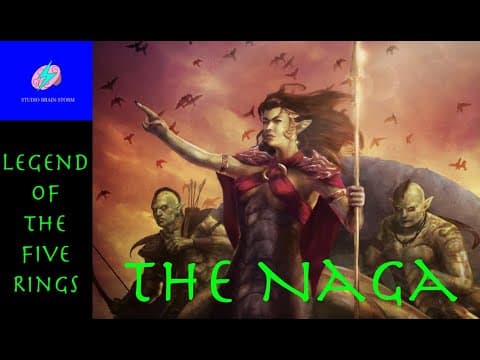
[1:34]Anger is the most invincible enemy. Covetousness is an incurable disease. He who is friendly to all creatures is honest, and he who is cruel is dishonest. Being a fantasy series based loosely on feudal Japan, obviously Legend of the Five Rings focuses primarily on the humans of that setting. But Legend of the Five Rings is still fantasy, and that means there are other non-human races abounding in the world of the Emerald Empire. I've touched on a few of these in earlier videos, mostly those that were persecuted by the Empire during the War with Fuleng. But these were minor players for the most part. The time has come to now talk about one of the major non-human races of L5R. A civilization that not only predates the Emerald Empire, but effectively came to an end just as the Empire began. This is the Naga. Now, obviously, the Naga are based off of the Naga from Hindu mythology, a race of human-serpent hybrids, but there the similarities end. For, in the universe of L5R, the story of the Naga begins just how the story of the Kami began, with the Lord Moon and the Lady Sun. Although, according to the Naga, the two deities are not separate things but merely different aspects of their one God known as Atman. Lady Sun is referred to as the Bright Eye of Atman and the Lord Moon as the Pale Eye of Atman. According to their own stories, the Naga were created when the Pale Eye shed a single tear that fell to earth and became a black stone. The black stone broke open, and from many of its fragments came the first Naga. The black stone itself survives mostly to this day and is one of the most holy artifacts of the Naga race. Indeed, they built a palace city around it and dubbed it The Place of the Fallen. In the ancient days, the Naga would turn their faces in the direction of the Place of the Fallen and pray three times each day. In those early days, the Naga had golden scales and they were all the same in appearance. There weren't just no differences between males and females, but even their facial features were exactly alike. But even in those early days, the greatest Naga of them all was Svarbanu, the first to emerge from the black stone. It was said that not only were his scales golden like all his race, but he had been blessed by the Pale Eye, with hair the color of gold and eyes the color of summer corn. Alas, the good times were very quick to come to an end, for the Naga, despite all looking alike, began to fight among themselves. Many Naga were born in this time of war, and almost as many met their deaths on the battlefield. For the most part, the Pale Eye and the Bright Eye ignored this and continued to create other things to inhabit the world. For his part, Svarbanu tried to end the fighting through peaceable means, for the Pale Eye had imbued him with great power. He healed the lands ravaged by war, he offered gifts of wealth and honor, but this did not seem to satiate the desire for violence among his people. And so, the fighting continued until at last, Svarbanu's eldest son, his pride and joy, was also a casualty of the endless fighting. This was too much. Svarbanu carried the lifeless body of his son to the top of a great hill, and that night, when the moon arose, he called to the Pale Eye, demanding to know what the sources of war were and how he could destroy them. The Pale Eye responded that there were five sources of war. Pride, the desire for wealth, the desire for land, the desire for freedom, and the desire to live. All five of these desires had been sanctioned by Atman, that Svarbanu should wish to destroy these things was sheer folly. But Svarbanu would not listen. To him, anything was preferable to seeing his people bleed themselves white in this constant cycle of slaughter. At last, the Pale Eye assented to Svarbanu's request, sort of, and agreed to strip away four of the sources of war from the hearts and minds of the Naga race. And so he took from them their pride, the desire for freedom, the desire for wealth, and the desire for land. He would not deprive them of the desire to live. Of course, almost immediately, things went wrong. Among the Naga arose a powerful priest-seer known as a Vedic, more on that later, and he proceeded to achieve total dominion over the Naga race, breaking them all to slavery in his name. And the Naga, bereft of pride and the desire for freedom, meekly accepted his tyranny. They did not fight back against their oppression, they did not even object, even as they were forced to endure horrific misery and suffering. And at last, Svarbanu realized his folly. Once again he went before the Pale Eye of Atman, and this time begged him to undo what he had done. The Pale Eye was willing to return the four sources of war that he had taken away, but because Svarbanu had been so foolish as to demand their removal in the first place, he would return the four sources of war only at a price. For the return of pride, the Pale Eye decreed that all Naga shall henceforth look different from one another. Not only as individuals, not only between male and female, henceforth, the Naga race would be forever divided between five sub-races known as the Bloodlines. The green snake, the Asp, the Constrictor, the Chameleon, and the Cobra. For the return of greed, the Pale Eye stripped the Naga of all their golden scales. Henceforth, the Naga would be of many colors, mostly green and brown, but never gold. In return for the desire for land, the Pale Eye caused the earth to heave, mountains to rise and forests to quake. Since the first emergence from the black stone, the Naga had inhabited the forest that they called Shishoman, what the humans of Rokugan would later call Shinomen Mori. In the old days, the forest had been a vast realm, stretching across the continent. Now, the Pale Eye caused it to shrink. It's never mentioned by how much the Pale Eye reduced the size of Shishoman, but by the time the Kami fell from the heavens, Shinomen Mori Forest is described as being a third of the size of what it had once been in the days of the Naga Empire. And this was after the Pale Eye had returned the sources of war. In return for freedom, the Pale Eye decreed that henceforth, the Naga would no longer bear sons or daughters. From now on, all serpent men and women would hatch from eggs. Thus the Naga would never have families, and their children would all be raised communally. Finally, there had been the desire for life. This was the one source of war that the Pale Eye had never taken from the Naga. Because Svarbanu had possessed enough wisdom not to demand that the Pale Eye take that away as well, the Pale Eye of Atman decided that the Naga should receive a small reward for this tiny piece of wisdom. Thus, the Pale Eye decreed that henceforth, the life of one Naga should be the life of all Naga, thus giving birth to the Akasha. A kind of communal hive mind that the Naga had shared ever since. Of course, now that they were all different, the Naga race eventually began to divide socially into castes. These were the Warriors, the Scouts, the Vedics, and the Jacklas. Warriors and Scouts are pretty self-explanatory. The Vedics were kind of a priestly kind of seer cast. While the Jakla were the magic users, essentially the Naga equivalent of Shugenja. As for the bloodlines, the largest and most numerous were known as the Green Snake Bloodline. Green Snakes are real animals in the world of Legend of the Five Rings, and they seem to have a special link with the Naga race as they will obey commands from Naga. Most Green Snake Naga tend to be patient but inquisitive. They have a much easier time of it learning new skills and abilities. Partly because of this, they often function as diplomats and intelligence gatherers for the Naga. As such, they tend to make up a large percentage of the Scout caste. Second largest of the bloodlines are the Asps. They comprise almost the entirety of the Warrior caste. They possess the greatest battle skill and tactical ability, but are far more susceptible than the other bloodlines to the vices of pride and arrogance. The fact that their bloodline is named after a venomous snake is apt, for in addition to being the great combat experts of their race, the Asp Bloodline are also the masters of various forms of venom. Next, the Chameleon Bloodline. As their name implies, they are the most adaptive of the bloodlines. They are also great extroverts and tend to enjoy interacting with others, including those of other races, making them the friendliest of the bloodlines. Most Naga, particularly the Asps, tend to view non-Naga as inferior beings. However, the Chameleons are particularly susceptible to mutations, which are sometimes viewed as a mark of great shame among the Naga people. Over the generations, however, some mutations became stable and thus a part of the Chameleon Bloodline as a whole. This includes the obvious, as their name implies, ability to change the color of their scales and skin to blend in with their surroundings. Rarer but not unheard of is the ability of some Chameleon to grow gills, allowing them to breathe underwater. This has led some stories and sources to claim that the Mingyo, L5R's Japanese equivalent of the Merfolk, are originally descended from the Chameleon Bloodline. Their capacity for camouflage makes the Chameleon ideal Scouts and spies for the Naga race. It also has made them effective hunters and woodsmen. Next, the Constrictor Bloodline, the rarest and by far the largest in terms of individual size. Somber and serious of disposition, the Constrictors make up the entirety of the Vedic caste. They are the closest the Naga have to priests, as they possess a stronger, more intuitive grasp of the Akasha than any other. They are the most spiritual of all the bloodlines and can use their strong connection to the Akasha to perform a limited kind of divination, allowing them to peer into the future and giving them a strong sense of the destiny of their race. On account of their sheer size and physical power, they are the strongest of the Naga Bloodlines and are by far the most expert duelist of their race. Finally, the Cobra Bloodline. Just as the Constrictors are the entirety of the Vedic caste, the Cobra are the entirety of the Jakla caste, the magic users of the Naga. Being one of the non-human races of L5R, Naga magic is unique to them, and it revolves around pearls. The Naga believe that most pearls are the little brothers of the Bright Eye, i.e., the Sun, and they essentially serve as receptacles for spells. With the much rarer black pearls, the so-called little brothers of the Pale Eye containing the most powerful. The way that this works is that the Akasha is not just the hive mind of the Naga, it also serves as a kind of afterlife, where their soul resides before they are reincarnated and reborn into the living world. If a Naga soul enters the Akasha upon death with any impurities, the Akasha, like a living organism, rejects and expels these impurities. For whatever reason, these aforementioned impurities are sent into oysters, and, like a bit of grit in the real world, the oyster eventually forms a pearl around the impurity. Thus, as the Naga believe, from impurity comes purity, and a Naga pearl is formed. The Naga pearl, therefore, acts as a receptacle for a spell, but also is used as a focus for the Naga Jackla will cast his magic by drawing upon their link to the Akasha, using the pearl as the medium by which the spell is unleashed. If the pearl itself has any imperfections or flaws in its makeup, the spell might fail or even blow up in the Jackla's face, literally. The reason why all Jackla are of the Cobra Bloodline is because clutches of Cobra eggs are kept right next to Naga Pearls, allowing the unborn Naga to absorb the latent power from these potent artifacts. But such power comes at a price, and prolonged exposure to a Naga pearl causes mutation. Other bloodlines like the Chameleon are subject to mutation, but in the Cobra, it is the most pronounced. For the most part, the Cobra bear the stigma that comes with their mutations with pride. But in all bloodlines, there are some degrees of mutation that are simply unacceptable. These so-called abominations are cast out into the wild. The Naga people themselves are unwilling to kill the abominations, but they will not tolerate them amongst their number. Abandoning them in this way at least gives them a chance to survive on their own. As for non-abomination Naga, once they've hatched from the eggs, they are usually known by an Ashamana, or egg name, until such time as they achieve their coming of age, which is known as the First Shedding. At which point, the Naga Youth is formally inducted into society and begins training in whatever cast he or she is destined for. Uniquely, after their first shedding, female Naga gain a unique ability. While the Chameleon Bloodline has the ability to alter their appearance slightly, like changing their color or growing gills, females of any bloodline can gain the ability to transform their lower bodies from the classic snake tail into a pair of bipedal legs. The transformation is pretty time-consuming, as it requires five hours of ritual meditation and then a shedding of the old skin to reveal the new pair of legs. This transformation can be reversed, albeit once again through a very lengthy process. However, becoming accustomed to their bipedal form usually means that female Naga are less fast and adept on their tails as male Naga. This usually means that they are less coordinated in using their tails to get about and aren't as fast as the males. On the plus side, having legs allows female Naga to be far more agile than the males, and enables them to ride horses. The timeline is deliberately kept hazy, but sometime after the days of Svarbanu, and when the Naga lost their golden scales, the five bloodlines lived mostly separate from one another in great temple cities. Of course, with all the sources of war restored to their psyche and their spirit, this peace did not last. Unsurprisingly, it was a being known as the Shahismael, the leader of the Asp bloodline, that instigated what became known as the First Bloodland War. In those days, the Naga bloodlines lived separate from one another in five different kingdoms within their forest home. Determined that the Asps should reign supreme, the Shahismael led his bloodline in the subjugation of the Green Snake bloodline and the Constrictors. The Chameleon were able to evade him, but only the Cobra were able to resist him at all. In the end, though, the Shahismael fell not to defeat in battle, but betrayal. Two of his powerful lieutenants, the Shahadet and the Kattol, repulsed by his power madness and his cruelty, turned against him. The Shahadet personally killed his corrupt leader, literally stabbing him in the back himself. So hated and reviled was the Shahismael that the Jaklas of the Cobra Bloodline determined that he should never leave the Akasha again, never reincarnate into the living world. And so, through their pearl magic, they worked a mighty spell, permanently binding the Shahismael's soul to their race's afterlife, literally chaining him in place with the souls of his many victims. Meanwhile, the Kattol went even further. Unusually for an Asp, he had an especially strong connection to the Akasha. And as the war progressed, the Kattol realized that he was able to hear the screams of those enemies the Asps had slain. And so, the Kattol actually turned against his own bloodline, forming an alliance with the Constrictors and the Cobras, ending Asp conquest. At which point, he promptly turned around and began waging a war of his own, not a war of conquest or eradication as his former leader had intended, but of unification. For he was convinced only together could the Naga survive. Peerless in war and statecraft, the Kattol was known to his people as The Warrior of the Bright Eye, for it was believed that the Sun favored him above all others. Then, one day, on yet another battlefield, the Kattol encountered what appeared to be a Naga youth. But it turned out that just as the Kattol had been blessed by the Bright Eye, the youth bore the blessings of the Pale Eye. And the strange, nameless youth offered his hand in friendship and unity to the Kattol. And thus the war finally ended, and the Naga people were unified. Thus began the Naga Empire. For thousands of years the Naga reigned, the most dominant race in all of Legend of the Five Rings at that point. Although much of that time has either been lost to memory or simply was never expounded upon by the creators of L5R. Only three specific events are mentioned.
[25:01]The first of these concerns an entity that the Naga refer to as either the Shadow or the Foul, obviously, the lying darkness. According to the Naga, at some point, the Pale Eye grew jealous of the Bright Eye, specifically because all the living things upon the Earth loved her more than him. Shortly after creating everything in the universe, the two eyes of Atman proceeded to give them names. But the Pale Eye took notice of the Shadow, a being that did not want a name. And so, the Pale Eye made a proposal to the Bright Eye, that he would provide the names, and she would choose which creatures to give them to. Of course, by the end of it all, the Pale Eye refused to give her the name that she might have given to the Shadow. Thus, the Shadow remained free of the dominion of the two eyes, and began causing a lot of problems for the Naga, killing them or twisting them into hideous shapes. Again, the timeline is pretty hazy. No one knows exactly when this occurred. Although some sources do mention that the Kattol led his people in the fight against the Shadow, becoming the first warrior to wield the spiritually pure weapons of Jade against it. The Naga were able to beat back the Shadow for a time, but it was never truly defeated. After all, the lying darkness is an Eldrich cosmic entity, beyond the power of any mortal being to slay. The second known event in the history of the Naga people and their empire was when another magical race in L5R, the Jin, the subject of another video, actually decided to try and wage war against the Sun and Moon. The Lady Sun was so pissed off by this that she unleashed indiscriminate heavenly fire upon the earth, in what the Naga came to call the Day of Wrath. The Jin were of course defeated, and whole swaths of the Earth were set ablaze by the Lady Sun's fury. One region in particular was so stripped of life that it eventually became the desert waste now known as The Burning Sands. For this reason, the Day of Wrath is also sometimes known as the First Burning of the Land. The third and final mentioned event in the history of the Naga was a long and bloody war that the Naga race waged against another magical race of L5R known as the Ashalan. They, too, will have to wait for the subject of a future video. The long and the short of it, though, was that the war was so bloody and so atrocious that the Lady Sun finally forced the two races to stop by placing curses upon both of them. Henceforth, both the Ashalan and the Naga were confined to their respective territories. It was physically impossible for them to leave. After this forced conclusion of the Naga Ashalan War, the Naga race continued to reign supreme within their own territory. Even as the race itself became increasingly stagnant and decadent, and many among the Vedics of the Constrictor bloodline increasingly saw visions of a time when their race would enter what became known as the Great Sleep. That day finally arrived when the nine Kami fell from the heavens to the mortal realm. To the Naga who saw it, it was as if eight stars fell in the North and one in the South. The Kattol, who still led his people even all these millennia later, decided that the time for the Great Sleep was nigh. For the last few generations, fewer and fewer eggs had been laid, and thus fewer children had been born to their race. Unless they did enter the Great Sleep and husband their strength, the Kattol believed that his race would eventually die out. Plus, the Vedics of the Constrictor Bloodline had foreseen a time when a second burning of the land would occur. The strength of the Naga would be needed on that fateful day, the Vedics claimed, and thus the race must hibernate and conserve its strength for when it was most needed. As the Vedics purified the Akasha in preparation for the Great Sleep, and the Jaklas of the Cobra bloodline prepared the mighty spell that would preserve the Naga race through centuries of hibernation, the Kattol gave final instructions to three of his most trusted followers. To his fellow Asp, the Shahadet, he entrusted the task of guarding the Naga people from physical harm. To the Karash, the greatest woodsmen of the Chameleon bloodline, he charged with guarding the treasures of the Naga race so that none should steal them. Finally, to the Abalasha, High Priest of Atman and greatest of the Vedics, fell the responsibility of providing hope and relief from fear for his people on the day that they should awaken. For the Naga race would need to be strong in spirit as well as body for the trials of the Second Burning of the Land. As for the Kattol himself, thanks to his strong connection to the Akasha, which is in turn connected to the land of the dead or Yumeido, he spotted a tenth star, presumably the spirit of the dead tenth Kami, Ryoshun, entering the underworld. Seeing this sign, the Kattol vowed on the spot that he would go into the land of the dead himself, conquer it, and thus purify the Akasha of any taint left behind by the great war between the Naga and the lying darkness. And so, the Kattol, greatest and mightiest leader of the Naga race, passed through the gate of the dead and was never seen again by his people. And so, the Naga race entered the hibernation of the Great Sleep, and the Naga Empire passed from the mortal realm. At that very moment, the eight Kami stood upon Sepuun Hill and began the creation of a new Emerald Empire.


