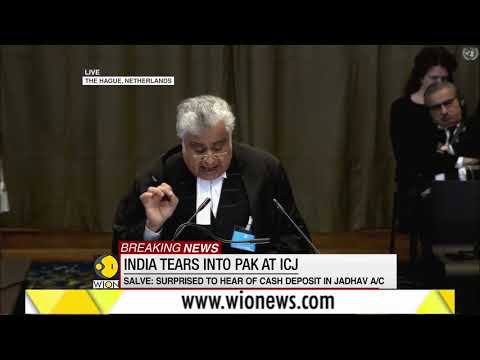
[0:01]away from all of that to the latest story that we're tracking over here, India's Intel sources have told we on World is one.
[0:09]And on to the International Court of Justice, where Kulbhushan Jadhav case is being heard. India's representative Harish Salve tore into Pakistan's tactics pleading with the International Court to draw some red lines.
[0:18]request for additional evidence is declined to accuse the other party of blocking that evidence unfairly is clearly a criticism of the order of the court. Worse is an attempt to place on record through oral submissions the content of evidence, the production of which stands declined by the court. And finally I was surprised to hear a mention of some money lying in Jadhav's account or deposited in Jadhav's account and how the money reached them. Our team has in the time available since yesterday searched the entire material and not found the mention of rupees 90,605 the figure from the transcript. deposited in his accounts by way of pay. This was a statement made in the course of submissions. We checked it is not in his confession. It is not in the available on the material we checked yesterday, if it is on record, I would happy, be happy to stand corrected. I now proceed to deal with the points made by Pakistan in relation to the case, which have a bearing on the case. I have tried to gather these points carefully traversing the mind field of explosives and wanton allegations of shamelessness, disgracefulness etcetera, etcetera heaped on the sovereign Republic of India. The first issue I would like to address is the issue of abuse. In the presentation made to the court, there are three bases on which an abuse of process argument is raised. They were firstly, India had not established that Jadhav was an Indian national and estoppel would not apply. Whatever India did it never suggested estoppel. We keep, at least we don't have to keep reminding ourselves that we are not in a commercial court, we are in the International Court of Justice. that India's refusal to cooperate in the investigation requested in the absence of a mutual legal assistance treaty was mandated by the UN resolution, and its failure to do so and yet insist on Article 36 was an abuse. The third was that India has not proffered any explanation for use of the pass court and thus as a state having issued an illegal document, India had forfeited its rights to invoke Article 36. These are my paraphrase of what I have picked up of Pakistan's points. The first point about Jadhav's nationality, surely cannot be a serious one. I would only remind the court of what I said in my opening and to which I have not heard a reply. On 25th of March 2016, a demarche was issued protesting and I quote, illegal entry into Pakistan by RAW officer. Pakistan is aware that to be an officer of the RAW, the primary requirement is to be a citizen of India. In the first propaganda material issued to the P5 countries on that very date, the allegation was that his biodata has revealed that he is a commander in the Indian Navy. Again this would be an assertion of his citizenship in India. In all the notes verbal issued by India, India demanded consular access in the presence that Jadhav was an Indian national. 13 reminders were sent, Pakistan did not reply, Pakistan did not question his nationality. Article 36 requires counselor access to be given in the first instance upon arrest without undue delay. At the time of his arrest if Pakistan was protesting that an Indian national employed by the Indian RAW or army or navy was carrying on subversive activities, and was using this allegation to malign India before the world, was there a need for India to assert the nationality of the person arrested? Unlike Pakistan, India has never needed to deny the nationality of its nationals apprehended in Pakistan, for Indian nationals are not the kind whose nationality ever needs to be denied. The conduct of Pakistan however is to the contrary, they disown any responsibility for terrorist acts by Pakistani nationals and even deny their nationality. If at the time when Article 36 of the Convention requires consular access to be provided, the receiving state has no doubt about the nationality of a person arrested, it is duty bound to carry out its obligations under the Convention. The respondent seeks to rely on the Avena judgment. It destroys their case. There was a doubt in that case as to how many of the persons who were under arrest and trial were of Mexican origin. but of but US nationals, US claimed it had no obligation in relation to US nationals to inform Mexico even if they were citizens of both states. There was a dispute as to nationality, Mexico acknowledged it had the burden of proof and produced birth certificates. That was in the facts of that case. The legal test however, was set out by the court in paragraphs 63 and paragraphs 88. In paragraph 63, the court held that the detaining authority had the duty to give information to the individual. once it realized that a person is a foreign national, or there are grounds to think that the person is probably a foreign national. Precisely when this may occur will vary with circumstances. The similar thought is echoed in paragraph 88, where the court said, and I quote, there is nonetheless a duty upon the arresting authorities to give that information to an arrested person as soon as it is realized that the person is a foreign national or once there are grounds to think that the person is probably a foreign national. Pakistan had no doubt when they arrested Jadhav that he was an Indian national. And on that basis complained about India to the global community. Pakistan invites the court to treat us true, the confession made by Jadhav to the military, and in that the very first assertion is that he is an Indian national and officer of the RAW. If Pakistan so closely, dearly and fondly believes his confession, why do they doubt his nationality? This point, Honourable President, Honourable Judges, is simply hopeless. Pakistan's suggestion that India failed to comply with its obligations in the UN Security Council resolution of 1373 is equally without merit. Pakistan relies on paragraph two F of the resolution, which says, decides also that states shall afford one another the greatest measures of assistance in connection with criminal investigations or criminal proceedings relating to financing or support of terrorist acts, including assistance in obtaining the evidence in their possession for the proceeding. This decision is reflected in paragraph three C in a call upon the states to and I quote, cooperate particularly through bilateral and multilateral arrangements and agreements, to prevent and suppress terrorist attacks and to take action against the perpetrators of such acts. These actions are taken through criminal investigation, through freezing of funds and the various methods available. Bilateral treaties for investigation into funding of terrorists and investigation into terrorist acts themselves, in order to assist prosecution of those who indulge in such acts, would fall in paragraph two F read with paragraph three C. Pakistan has not entered into any such treaty with India despite repeated invitations, I made this point in the opening and in a reply marked by dire tribe against India. I did not find a contradiction of such an important matter, I E that there is a reason that there is no legal assistance treaty, is that is on account of Pakistan's reticence to enter into any such treaty. Pakistan challenged the figure of 40, saying that it jumped from 18 to 14. I think our figure was right, but let us assume there were 18 requests. Mention in passing about the pending for legal assistance. It's a very large number, 18 is a very large number. And such a large number of requests in relation to acts of terrorism which have horrified the global community, including the Mumbai attack of 2008. There was no answer.
[9:51]Secondly, and I have made this point earlier to which I did not hear a reply. Article 36 does not depend on complying with any requests of mutual legal assistance. Yesterday the court was shown photographs of high functionaries and was told that an investigation into their conduct was sought by Pakistan. A reading of the document for legal assistance, which begins with an investigation into the conduct of the heads of various organizations in India, makes it apparent that this is not a serious document for legal assistance but another weapon in the propaganda armory of Pakistan. Why propaganda? I shall deal with it, towards the end of my presentation. The third point made by Pakistan is that India has not offered any explanation for the use of passport by Jadhav. This point is rhetoric and has no legal basis. Article 36 came into play on the date of the arrest, I E 3rd March 2016 or soon thereafter without undue delay. The rights under Article 36 relate to Jadhav's prosecution for acts which are offenses under the laws of Pakistan. Pakistan rightly contended that possessing a false passport if he did possess one, would possibly be an offense under the Indian Passport Act 1964. Secondly, despite Pakistan's laws that generously award capital punishment, it is unlikely that possessing a passport of this kind would even under the laws of Pakistan involve awarding the death penalty. If Jadhav had been involved in subversive activities in relation to defined incidents, irrespective of the passport he carried, he would have been prosecuted for espionage and acts of terrorism and be liable to awarded the death penalty. If Jadhav was innocent of the allegations of participation in those acts and those activities, then notwithstanding the possession of such a passport, he would have to be acquitted of the charges of terrorism. What Pakistan has been extremely reticent to share with the world and with this court, is the judgment of the court which convicted Jadhav. It is that judgment which will show the offenses for which Jadhav has been charged, his connection with the offenses with the role played by him. The evidence against him for participation in those offenses and the basis for the conviction in relation to those specific offenses. India has repeatedly requested Pakistan for a copy of the judgment, the evidence against Jadhav and the grounds on which he was convicted. After all legal proceedings have come to an end, at least now, there could be no threat to the existence and security of Pakistan if these documents are made available to India. But for good reason, Pakistan is shy of sharing these details.
[13:08]I have little doubt that if there was any substantive evidence of Jadhav's participation in any offenses, 140 minutes of yesterday's 180 minutes would have been devoted to this. All Pakistan has is a passport. On its allegation that the passport was issued by India and bolstered by a report of an expert on which considerable time was spent, Pakistan claims that Jadhav was an Indian terrorist sent by India to Pakistan to indulge in acts of terrorism. This is a flying leap of faith. Pakistan has nothing beyond the extracted confession on which Jadhav has been convicted of participation in the subversive activities. Possessing a passport doesn't make you party to offenses. Your role in those offenses is what gets you a conviction. Not having a passport which enabled you to sneak into a country, assuming that there was such a passport. The confession was extracted for the first time by the armed forces when he was in their custody and even before the first information report was registered on the 8th of April. Embarrassed to share with the world community that possibly like 95% of such other convictions. Jadhav is being sent to the gallows on the basis of an extracted confession. Pakistan seems to suggest that the possession of a passport which it alleges was issued in India is sufficient proof of his being terrorist and a sufficient proof of his having indulged in acts of terrorism over a period of two years. All they have is his confession, but lest I be accused again of misquoting and misrepresenting Pakistan's court. I hasten to add that yesterday they claimed they have clinching and convincing evidence of the case against India and Jadhav. And this is by way of three articles which found place in the Indian press. Substantial praise was heaped upon the journalists who wrote these articles. If one is to proceed on the basis that what is contained in these articles is absolute and complete truth, one must also believe what is written in the quaint by Mr. Swami. The article cited above has the following first paragraph. While Pakistani intelligence has initially claimed he was trapped in Sarawan on the Iran-Pakistan border, a Baloch leader by the name of Sarfaraz Bugti has disclosed that at the time of Jadhav, at that time Jadhav was near Chaman in Balochistan, which is in Pakistan. If this is true then the first information report is false. The story of the army is false, the story of his arrest from the Sarawan border promptly circulated to the world is equally false. The second article cited from the frontline states, quote, following Jadhav's kidnapping from Sarawan, Pakistan sources said a decision was taken at the ISI directorate to link him to acts of terrorism. Notably, however, Jadhav's, the first of Jadhav's videos released by military referred in general terms to acts of terrorism by India but none involving himself.
[16:36]These are articles written by those journalists who are the epitomy of good journalism in Pakistan swears by their credibility. This is what they have to say in those articles. I have my doubts if the witnesses who were allegedly produced in the course of the trial and are referred to in the 14th April statement by Sartaj Aziz, who Jadhav was allegedly allowed to cross examine, those witnesses who Jadhav was allegedly allowed to cross examine included the three revered journalists from India. By hanging its case on a possession of a passport in a false identity issued by India, Pakistan makes the case that India had sponsored terrorism in Pakistan. Pakistan's case against Jadhav on the question of passport is yet to be fully investigated by India. Since two of the three, they call them unimpeachable by their worship journalists, have not accepted his arrest at Sarawan theory. There is not a scintilla of evidence beyond Jadhav's obtained confession to suggest that he was a quote and quote Indian agent or that he participated in any specific activities or was responsible for any specific incidents of terrorism. Pakistan's suggestion that it is established an illegal act on the part of India, therefore is hopeless.
[18:05]But assuming that they are right, Article 36 of the Vienna Convention does not admit of any such exceptions of this kind. Pakistan is wrong in suggesting that because of their argument of customary international law, the plain language of Article 36 should be gripped and confined and an exclusion be created for allegations of espionage. Invariably, a national of another state, court and charged with allegations of espionage would obviously be an agent of the sending state. Allegation would then be made against the sending state of indulging in espionage. To argue that where allegations of espionage are made, the sending state is to be considered a delinquent state and consular access is to be excluded would be to introduce an exception in respect of espionage into the language of Article 36. Finally it is now settled that Article 36 confers a right on the individual and the right on the state and has now been recognized to be a dimension of human rights of the person charged with serious offenses. Such a right cannot be emasculated on an allegation that the sending state is guilty of violation of some treaty or of the conduct incompatible with international law. In the course of the opening suggestion, it was also suggested that India's failure to invoke dispute resolution procedure of Article two and three of the optional protocol was an abusive process. This submission did not deal with the Tehran judgment which clarifies that these articles are not a precondition to the invocation of the dispute resolution under Article one.
[19:50]The argument that is not invoking dispute resolutions under two and three renders the decision to invoke the jurisdiction of the court as an abuse, therefore has to be stated to be rejected. On the construction of Article 36 two broad points have been made by Pakistan. The first is trying to attribute some meaning from a discussion found in the trevo and the second is to suggest that anything contained in the Vienna Convention which is not supported by customary international law should be treated as excluded from the plain language of the Convention. Both points lack any merit. As far as the Travor is concerned, the discussion relied upon establishes, in fact, that espionage was included in Article 36. The two relevant paragraphs read thus, para 47, Mr. Tunken felt it might be best to delete the words without delay. There were cases in which it was impossible to inform the council immediately of the arrest or detention of a national. Sometimes for instance in espionage cases, there might be accomplices at large, it might be desirable that the local authorities should not be obliged to inform the council. Mr. Chairman remarked that a statement of a general principle of law could not possibly cover all conceivable cases. If the commission went into the question whether cases of espionage should be made an exception, the whole principle of consular protection and communication with nationals would have to be reopened.
[23:09]The chairman put to vote the proposal that the receiving state should have automatic responsibility for notifying a council of the arrest and detention of one of his nationals, which proposal was adopted 14 votes to one. This discussion establishes that the authors of the convention expressly treated espionage as also being covered by consular access principles. It is surprising the despite this plain language of this, the point having been made in India's reply, the matter was still pursued. The observations of Sir Gerald Fitzmorris, which were referred to were made in a completely different context. One of the issues was whether the communication with national, and I quote, in areas to which access was prohibited on grounds of national security, should be factored into the treaty. Sir Gerald Fitzmorris, responding to the proposed amendment by Mr. Erem stated, and I quote, the only real objection that has been made to paragraph A of his draft concerned communication with nationals. In areas to which access was prohibited on grounds of national security, there was really no other ground on which the right of a consul to visit his nationals could be in question. No other ground.
[24:40]He agreed that the matter of prohibited zones should be considered, but he thought Mr. Erim's amendment was too broad. These parts of the Trevor are it at all destructive of the premise that the draftsmen of the convention wanted to exclude espionage from Article 36. If the Travel suggests that there is no exception in favor of espionage, then Pakistan's argument has to be that despite the framers of the convention wanting to include espionage in the of rights available under Article 36, if customary international law did not have a consistent practice of allowing councilor access in the case of espionage, then notwithstanding the language of Article 36, it should be read down to exclude espionage from its rement. The two bases for the submission are firstly that the preamble suggests that the Vienna convention crystalized prevailing customary international rights. And secondly, none of the countries to whom invitations were sent by this court have shown up for the hearing. The first submission is completely unavailing. The language of the convention cannot be whittled down because the preamble sets out the backdrop in which the treaty came to be created. Secondly, if this approach to construction is to be accepted, then in every respect where there is a breach of a convention, it would be open for the delinquent state to argue that the breach of the provision is ineffective. Because the conduct of the delinquent state has not shown to be contrary to established practice and customary international law. And if this approach is countenced, then the convention may as well be scrapped. The second argument shows a degree of confidence unusual even by their standards in their submissions. Pakistan invites the court to hold that the that its submission should be accepted unless the global community that has signed the Vienna Convention appears in court and opposes its position. Perhaps Pakistan seems to assume that the interpretation commanded by it for acceptance raises issues of such great moment that until all or most of the signatories to the Convention join in to oppose its position in one voice, it should be assumed that Pakistan's assertions are unable. Leap of faith again. Considerable time was spent in the opening on the construction of the 2008 bilateral agreement. India's case is simple. The 2008 bilateral agreement cannot take away the right conferred by Article 36 of the Convention, for the bilateral agreement will then be rendered effective ineffective on account of Article 73.


