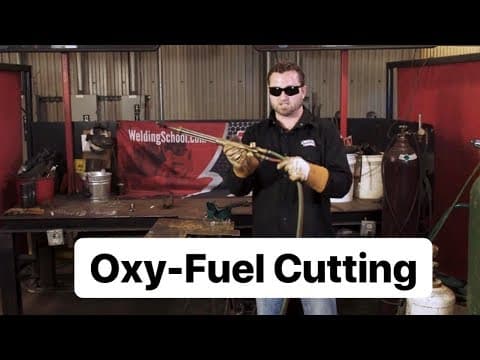
[0:00]Hello, my name is Jack Dull. I'm the Director of Training at Tolsa Welding School. And today, we're going to go over the proper setup of oxy fuel cutting, how to make a proper cut with oxy fuel settings, and also kind of the dos and don'ts.
[0:10]So let's first, let's look at actually the oxy fuel setup. We have an oxygen tank, and right now, at the school, we're running propylene. You can run acetylene. There's map gases, other things that you could set up.
[0:21]But today, we have an oxy fuel set up here with oxygen and we're running propylene. I've went ahead and screwed into our tanks here and got our regulators on. Make sure they are all set up. Make sure anytime on your gas that you're not running over 15 PSI.
[0:35]And so, we've got it set down below that. Then we need your proper PPE on. We're going to have gloves, shirt, you know, long sleeves, boots, jeans. We're also going to have whether you wear cutting goggles, shade five, or cutting glasses of shade five.
[0:50]It's your choice, whatever one you want to use, but I'm going to use the shade five cutting glasses. So let's talk about how to properly set up your your cutting torch.
[1:03]So before you strike your cutting torch, one, make sure there's no leaks. Make sure everything's connected the right way. These are all screwed on. Some of them have quick connects. However your system is, make sure everything's set up the right way and we're not leaking out gas.
[1:14]Once we get it set up, we're actually going to turn our our gas on. We're only going to turn it on about an eighth of a turn, not much. If you turn it on a lot, you're going to hear the gas come out, you'll be able to smell it. When you go to strike up, it's going to make this big ball of fire, maybe even burn your hair off of your hands or off your head.
[1:31]So please don't turn the gas up too high. Just like I said, about an eighth of a turn, we'll take our striker, and we'll get it into place. So once we get our gas on, we'll put our striker, we'll hold it like so, we'll give it a couple strikes, we should get a nice little flame to come out.
[1:45]Once we get our flame coming out, then we'll actually bring some oxygen into it. We'll turn the oxygen on. We'll get us a nice neutral flame. We'll talk about that in a second. So let's fire it up. I'm going to turn it about an eighth of a turn.
[1:59]You can see, I just got a nice little flame, nothing serious. I want to get a little more of a gas going, so I'm going to turn it up just a little bit, and now I'm going to bring in my oxygen. You can see, now, what we're looking for is these tips right up front.
[2:08]Okay? We're going to want them to come out no more than about an eighth of an inch, nice little blue tips coming out. So let's turn our gas up and get some of those tips coming out. You can see them. They've adjusted, they're out now, probably about a quarter.
[2:22]But as I bring on the oxygen, it'll come back to life, and get a little closer. And you can if you can see that, you want to get a nice little tip. You want them blue tips on the end to be nice and sharp.
[2:34]When you pull your gas, your trigger here, to bring your high pressure oxygen to cut it, you want them tips not to adjust, you want them to be nice and same all the all throughout as you're uh pressing the trigger.
[2:45]So now that you've got a nice uh tip set up, you got your oxy fuel mixture right, now you're ready to start cutting.
[2:53]Before you cut, make sure you get set up. Okay, you want to be comfortable. It's basically just like you're welding, your ABC's, you know. Well, same thing with torch cutting, you want to be comfortable as you cut.
[3:06]If you're not comfortable, you're probably going to have some jags and moving all around. And I'll tell you some of the best ways to actually doing it. If you've ever shot pool, you know, when you shoot pool, you're holding it still if you're right-handed, you're holding it still with your left hand, but your right hand's doing the work, however you like to hold your pool stick.
[3:20]Same concept here. We're going to hold it steady with our left, and we're going to let our right do the work. Okay, so what I would like to do is I usually get set up something like so, okay? And you want to preheat your metal before you cut.
[3:30]Make sure you get all the moisture out of your metal, okay? And then I like to get my edge nice and hot. And I don't pull on the trigger right at the edge. I actually take it off of the edge and then pull the trigger, because if you try to pull it while it's on the metal, it's probably going to blow back some some sparks in your face, and that's not good.
[3:49]So let's make a cut here. You want to try to keep it a good, uh, eighth inch to a quarter inch off the metal. We've got it nice and hot. I'm going to pull my trigger, get it going, and then we're just going to ease on to it. We're just going to rotate our hands right on along.
[4:01]All I'm doing is I'm keeping my left hand still. My right hand is the one that's doing all the work. It's pushing away from my body.
[4:27]And that's how you make a nice clean cut. Now, I'm going to show you some of the things that you don't want to do. I'll show you some things and I'm probably going to burn myself on this, but this is for your viewing, to show you what the thing's not to do.
[4:39]So one, I always don't try to cut back across my body. The reason being is I can only go so far. I'm going to hit into my belly, so it's going to limit my cuts. And then two, I'm going to show you here is that don't try to actually get the metal hot and then try to cut onto it. You just try to pop a hole.
[4:56]You're going to see the sparks and stuff fly up. So here's some of the don'ts. We're going to bury it in and we're going to long arc. I'm going to show you both as we do it. So here's popping a hole that you shouldn't do.
[5:06]So watch out sparks. You can see the sparks go flying everywhere. That's not what you want. And then this is too close to the metal. You got it down so close to the metal, you can't even see what you're doing, if you're cutting it or not, if you're even melting your tip to it because you got it buried in there. And you can't follow your line if you're like this.
[5:25]So make sure you keep it up away so you can see a nice line. Also, if you get too far away, you can see I stopped my cut. That's not what you want. You want to keep it in there.
[5:35]But let me show it again, this is too far away to starting to melt away my metal at the front. This is bad, okay? Not what you want. You want to keep it about an eighth to a quarter of an inch away from the metal. And then take it down nice and smooth.
[5:51]You can hear that metal just ripping along. That's what you want to hear. That nice little rip.
[5:56]Okay? Obviously, I didn't cut through over here where I was showing you the errors. Okay, let's talk about another thing. Let's show you when you've got to make a very long cut.
[6:05]So you got to cut going. It's going beautiful, but you got to stop. Okay? You can't go forever. I wish we could, but you got to get to a point to where you got to stop. I'm going to show you how to make a nice little clean tie-in cut and keep it going.
[6:16]So let's do another good cut here. We're going to get our metal hot. We're going to get it going, cutting it along. We got everything going. This baby's cutting nice and smooth. You can hear the ripping sound going. It's going good.
[6:33]All right. We're getting to a point where we need to stop. Okay? You're going to get to a point where you need to stop. Let off the trigger. Okay? That stops you from cutting. Now, what you want to do when you go to cut is you want to get back in that hole just a little bit.
[6:47]And before you cut, ease down onto the pressure of the gas on your trigger. Don't just pull it down, because you're going to send sparks flying again. Get it in the hole, get it hot, and then ease down on your trigger and it will go right on in there.
[7:00]Here we go. Ease down on your trigger, starts to cut, nice and smooth. You're back up and running again.
[7:15]And that's how you make a nice clean cut using oxy fuel, acetylene or propylene. And thank you for watching. If you have questions, please reach out to Tulsa Welding School. Thank you.