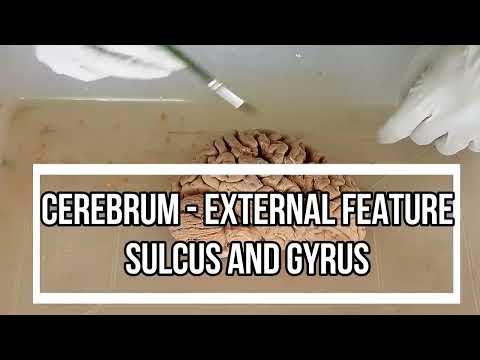
[0:10]Hello friends, welcome to the Viva Voice of Anatomy. Today we see the external feature of the cerebral hemisphere and the different sulky and the gyri on it. The each cerebral hemisphere is having the three pole, three border and three surface. The three pole are the first one the anterior pole is known as a frontal pole which is rounded. The posterior pole is known as an occipital pole which is pointed and between the frontal and the occipital pole in the lower part there is a temporal pole. Now the three border, before that we see the surface, three surface, the first most extensive and the convex is a superolateral surface. This one is a superolateral surface, the second is a flat that is a medial surface. The flat medial surface of the two cerebral hemisphere are approximated with each other. And the last one is an inferior surface, this is a inferior surface. Now the inferior surface is divided into the orbital surface and the tentorial surface, tentorial surface by a stem of a lateral surface. Now we see the border, the first superomedial border. This is the superomedial border which separate the superolateral surface from the medial surface. The second inferolateral border, this is the inferolateral border. The inferolateral border separate the supero-inferolateral border separate the superolateral surface from the inferior surface. Now the anterior part of the inferolateral border is known as a superciliary part, superciliary border. The third border is a medial border, the medial border this one this one is a medial border. It separates the inferior surface from the medial surface. Now it is having two parts, the anterior part which separates the orbital part from the medial surface, is known as a medial orbital border. And the posterior part which separates the tentorial part from the medial surface, which is known as a medial occipital border. So these are the external parts or a feature of the cerebral hemisphere. Now we see the main three sulci of the cerebral hemisphere which divides the each cerebral hemisphere into the four main lobes. These are the first is a lateral sulcus. The lateral sulcus starts at the inferior surface, it lies between the orbital and the tentorial part of the inferior surface, this is the stem of the lateral sulcus. Now the lateral sulcus reaches laterally on the superolateral surface over here. And now here it is divided into three rami. This is the anterior horizontal, anterior ascending and the posterior ramus. So this is the lateral sulcus and its three rami. The second main sulcus lies on the superolateral surface which is a central sulcus.
[4:24]The central sulcus lies approximately 1 cm behind the midpoint of a frontal and the occipital pole. The central sulcus. Central sulcus will go downward and forward and it will end just above the posterior ramus of a lateral sulcus. The third sulcus which lies on the medial surface is a parieto-occipital sulcus. This is the medial surface, this is the posterior part, the parieto-occipital sulcus. This is the parieto-occipital sulcus that lies somewhat 5 to 6 cm in front of the frontal pole. Parieto-occipital sulcus. And the parieto-occipital sulcus will cut the superomedial border and extend on the superolateral surface. Now these three sulci divide the each cerebral hemisphere into four lobes. The these lobes are frontal lobe, parietal lobe, occipital lobe and temporal lobe. The frontal lobe, it lies in front of the central sulcus and above the posterior ramus of a lateral sulcus. So this is a frontal lobe. Now to divide the rest of the three lobes we use the parieto-occipital sulcus that cuts the superomedial border and the pre-occipital notch which lies in front of a occipital pole. So we will make a vertical line which is joining the pre-occipital notch and the parieto-occipital sulcus. This is a vertical line. And the second horizontal line in the line with the posterior ramus of a central sulcus. So these two lines divides the rest of the cerebral hemisphere into three lobes. The part in front of the vertical line and the horizontal line, below the horizontal line is a temporal lobe. The part behind the vertical line is a occipital lobe and the part above the horizontal line and in front of the vertical line is a parietal lobe. Now apart from these four lobes, the fifth lobe is also present but it is hidden from the view. Which is a submerged portion of a brain which is known as a insula. The insula you can see in the floor of a lateral sulcus of a brain.
[8:04]It has been submerged from surface during the development of the brain due to the overgrowth of the surrounding cortical area. And it can be seen only when you can widely apart the lips of the lateral sulcus. Here you can see the fifth lobe and over the surface of the insula, you can see there is a poorly demarcated sulci and the gyri are present. Now we see the sulci and the gyri of the cerebral hemisphere. The first we see the sulci and the gyri of the superolateral surface. In the superolateral surface, first we see the sulci and the gyri on the frontal lobe. Now in the frontal lobe this is a central sulcus. Just in front of the central sulcus, 1 centimeter in front of it, the parallel to the central sulcus lies the precentral sulcus, this is the precentral sulcus. Now the gyrus between these two sulcus is known as the precentral gyrus. Now the gyri and the sulci and the rest of the part of a frontal lobe. The rest of the part of the frontal lobe is having the two horizontal anteroposterior sulcus, that is superior frontal sulcus and inferior frontal sulcus which divides the frontal lobe into the superior, the middle and the inferior frontal gyri. Now the inferior frontal gyrus, important is divided by the anterior horizontal, anterior ascending and the posterior ramus of a lateral sulcus into three parts. The part below the anterior horizontal is known as a pars orbitalis. The parts between the anterior horizontal and the anterior ascending is known as the pars triangularis and the part between the anterior ascending and the posterior ramus is known as the pars opercularis. So these are the sulci and the gyri of the frontal lobe. Now we see on the temporal lobe. The temporal lobe, you can see the two sulci, the superior and the inferior temporal sulcus, sulci which divides the temporal lobe into three gyri. The superior temporal gyrus, middle and the inferior temporal gyrus. Now the sulci and the gyri on the parietal lobe. Just behind the central sulcus, you will have the one more parallel to it. The sulcus which is known as a postcentral sulcus. And the gyrus between these two sulcus is known as a postcentral gyrus. Now behind the postcentral sulcus, the parietal lobe is divided by the one horizontal sulcus which is known as the intraparietal sulcus into the superior parietal lobule and the inferior parietal lobule. Now the last part in the occipital lobe. Occipital lobe is divided by lateral occipital sulcus into superior and the inferior occipital gyrus. Now the superior and the inferior occipital gyrus is separated from the occipital pole by the one more sulcus which is known as a lunate sulcus. So these are the sulci and the gyri of superolateral surface. Now we see on the medial surface. Now on the medial surface, the one main sulcus that starts behind and below the posterior end of the corpus callosum is the calcarine sulcus. The calcarine sulcus is going backwards toward the occipital pole with convexity facing upwards. This is the calcarine sulcus. Now from somewhere from the middle of the calcarine sulcus arises the parieto-occipital sulcus which cuts, which goes superiorly and posteriorly at the superomedial border.
[13:28]Now one important sulcus, the main demarcated sulcus that lies, starts just in front of and below the anterior end of the corpus callosum, that is a cingulate sulcus. Now it will arch above the corpus callosum and then in the posterior part it will ascends up towards the superomedial border. This is cingulate sulcus. Now the gyrus between the corpus callosum and the cingulate sulcus is known as the cingulate gyrus. Now the sulcus which is present between the corpus callosum and the cingulate gyrus is known as a callosal sulcus. Now here you can see one offset sulcus.
[14:38]The offset sulcus which arises from the cingulate sulcus extend above which divides the medial surface into two parts. The smaller posterior part that lies around this sulcus which is known as a paracentral lobule which is corresponding to the area around the central sulcus. And the anterior area is known as a medial frontal gyrus. Now here we have seen this is the calcarine sulcus, this is the parieto-occipital sulcus. Now this is the posterior part of the calcarine sulcus or you can say the postcalcarine sulcus. Now the part between the postcalcarine sulcus and the parieto-occipital sulcus is known as a cuneus, this triangular part is known as a cuneus. Now the part in front of the cuneus, between the cuneus and the paracentral lobule is known as a precuneus. Now you can see the small sulcus in just above the splenium of corpus callosum is known as a suprasplenial sulcus, suprasplenial sulcus. Now the part between the anterior part of calcarine sulcus and the splenium is known as a isthmus, this part is known as a isthmus. So these are the sulci and the gyri of the medial surface. Now we see the sulci and the gyri on the inferior surface of the cerebral hemisphere. The first in the orbital part, in the orbital part towards the midline, below the olfactory bulb and the tract, you will have the straight sulcus, this is known as the olfactory sulcus. Now the gyrus immediately medial to it is known as a gyrus rectus. Now the rest of the part of the orbital surface will show the irregular H-shaped sulcus, which is known as a orbital sulcus. And this H-shaped sulcus divides the rest of the part into the four gyri. Anterior orbital gyrus, posterior orbital gyrus, lateral orbital gyrus and the medial orbital gyrus. Now on the tentorial surface, there are two sulcus, one medial that extends anteroposteriorly, one is medial, which is known as a collateral sulcus and one is lateral which is known as a temporo-occipital sulcus. Now just medial to the posterior part of the collateral sulcus, this part is separated from the calcarine sulcus. This is the calcarine sulcus that we have seen. So this part is known as a lingual gyrus, lingual gyrus. And the lingual gyrus anteriorly it is continuous with the parahippocampal gyrus, parahippocampal gyrus. Now you can see the anterior most part of the parahippocampal gyrus is turned sharply backwards. It will hooked backwards sharply, this sharp turn part is known as an uncus. This is known as an uncus and the sulcus lateral to the uncus is known as the rhinal sulcus, this is rhinal sulcus. Now the gyrus which lies between the collateral sulcus and the temporo-occipital sulcus is known as the medial temporo-occipital gyrus. And the gyrus which is lateral to the temporo-occipital sulcus is known as a lateral temporo-occipital gyrus. So these are the sulci and the gyri on the inferior surface. Now we see the type, the classification of a sulci. The first classification of the sulci is according to its development. According to its development the sulci are of two types, the one is a primary and the second is a secondary. The primary are developed intra utero. So most of the sulci of the cerebral hemisphere are the primary, except the central, the lateral sulcus and the parieto-occipital sulcus which are secondary in the development because the development depends on the other factors. Now the second classification is according to the function. According to the function it is of three types, either limiting, axial or operculated. The example of the limiting sulcus is a central sulcus because the central sulcus, it divides the primary motor area in front from the primary sensory area behind. The second is a axial sulcus. The postaxial, postcalcarine sulcus is an example of a axial sulcus because the around the postaxial sulcus lies the visual area. So the vision area lies in the long axis, along the long axis of the postcalcarine sulcus, that's why it is known as axial sulcus. The third is a operculated sulcus, the example of the operculated sulcus is a lunate sulcus. Because the lips of the lunate sulcus will present the different area and in its wall and the floor is having the third functional different area. So this is operculated lunate sulcus. Now the third classification is complete or incomplete sulcus. The complete sulcus is the sulcus which makes an impression in the cavity of the lateral ventricle of the brain. Such sulci are the calcarine sulcus. This is the calcarine sulcus. The calcarine sulcus, the anterior part makes an impression on the posterior horn of the lateral sulcus in its medial horn and produce the calcar avis. So the first example of a complete sulcus is a calcarine sulcus. The second is a collateral sulcus, which we have seen on the inferior surface. The collateral sulcus will produce the prominences which is known as a collateral eminens in the floor of a inferior horn of a lateral ventricle. The rest of the sulci are known as an incomplete sulcus as they will not make an impression within the cavity of a lateral ventricle. Now the sulci and the gyri are different in the shape and the size in the different individual, because the developmental each individual is different. But some some sulci are in constant in the position that we have described. So this is all about the cerebral hemisphere and the sulci and the gyri. Thank you.


