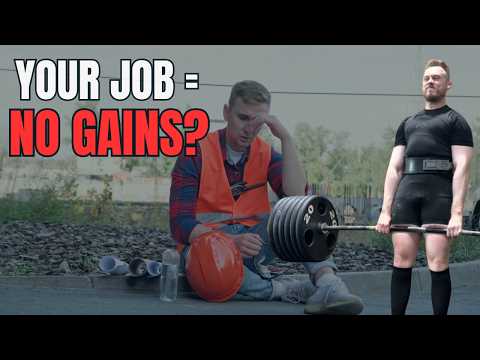
[0:00]A lot of guys work physically demanding jobs and then they find it impossible to get stronger in the gym. They still show up session after session, week after week, but they're always smoked before they even get to the gym. They're tired, beat up, fatigued, their body just hurts all of the time and it feels impossible to actually recover from the training and be able to put weight on the bar long-term. And I know exactly how it feels. I've been in those jobs before. I worked in a warehouse for a long time, lifting stuff all day, then have to show up to the gym afterwards, and I was still able to get pretty strong. So, in this video, I'm going to share with you exactly how I was able to do that. I'll tell you how to improve your training so that you can still manage fatigue and get stronger long-term. And if you want me to just fix it for you, I've done this for hundreds of guys before. Top link in the description, I'll write your training program for you and make sure that you're still hitting PRs in the gym. So, let me get straight into it. A lot of guys will work these physically demanding jobs, and I have them come to me on calls all the time to sign up for my coaching. And it's really, really difficult to actually manage these jobs and still get stronger at the same time. Like, for you watching this video, if you don't work one of these physically demanding jobs, it's still hard to manage fatigue and get strong even if you sit at like an office all day or maybe you're self-employed or something like that. So, imagine when you add on top of that, like working in a warehouse, or you're working construction or or laborer or something like that, it's really, really hard to to manage that because you turn up to the gym and you're just completely smoked already before you even start lifting. And I remember I did a couple of jobs like this. So, when I was younger, I worked in Asda Supermarket, which is like Walmart here in the UK. And I was in the warehouse in the back and, and basically they have these crates that they fill up with the online delivery orders. So, they probably weigh around like 20 kilos or 45 pounds, and I would have a stack of them all day and I would literally be lifting them onto a van, like head height or above head height, all day, and then as soon as I finished, I'd have to go home and I would still have to train. And I started this job at 4:00 in the morning by the way, whilst studying a master's degree, and then I'd have to go and try train and back then, I was training much harder than I do now, like much heavier, much closer to failure. So, you can imagine, like, my back was in pieces all the time. I was only in my 20s and I was still waking up, like, my joints just felt completely fucked. I could barely get out of bed. I was tired all the time. I'd get to the gym and I would just like dread being there. I'd have to take loads of caffeine, I was using smelling salts and stuff like that, really loud music, and still just things felt so heavy because I'm already exhausted before I even get there. Like, there's no worse feeling than than arriving to the gym and already you've got a lower back pump from from your day job. Like, how would you expect to make loads and loads of progress in the gym? It's really difficult. Um, especially if you're a guy who's like in your 30s, 40s, 50s or or even later on in life, it makes it even more difficult. So, I'm going to tell you exactly how to manage that so that you can still actually train productively, still get strong, whilst working this job. Because some of you, you you might not have the the circumstances to immediately change this job. So, we need to change the training a little bit. So, the solution then, the first thing that you need to understand and a bit of a boring concept that you need to understand, but I'm going to simplify it for you in like 30 seconds, is allostatic load. I've mentioned this before. Basically, you can just think of this as like the sum of all the stresses in your life, um, would be classified as allostatic load. Okay? So, it's basically the the sum of all these different stresses because your body can't really differentiate between all these different forms of stress. Like, the stress from your job, from your wife, from your kids, from family, from finances, and then from training as well. They're all forms of stress. And you have a certain amount of recovery that you can draw from, right? So, if we imagine your recovery as like a a cup, all of these forms of stress are just filling that cup, and if work is hard and training is very hard, that cup is going to overflow. And when it overflows, that's typically when you get hurt or you basically stop training because you you can't keep up with the recovery demands. So, hopefully, you can see that if all of these forms of stress are coming together, like from the work and and from training primarily, if work stress is really, really high, we can't just train like an idiot and train with really, really high training stress. You should not be pushing really, really hard, grinding sets of five near failure, doing your volume work at 80%. Because yes, it might feel cool that you complete a work day, you get to the gym and you're like really proud of yourself that you did a really, really hard training session. But, it's not a productive training session if you can't recover from it and it doesn't help you to get stronger. So, basically, we need to balance all these forms of stress. Now, the way that we do this, very, very simply, is with auto-regulation. So, for a guy like you working a a physically demanding job, it's really, really important that you use some form of auto-regulation. And basically what that means is some way of adjusting the weight on the bar or the intensity of the training session based on your preparedness for that day. So, if you go to the gym and you slept like shit, you had a really hard work day, you argued with your wife, you didn't eat very well, you're not very hydrated, you couldn't get many fluids in at work, it makes zero sense for you to go in the gym and then to grind out sets of five close to failure and just try to really, really push things really hard. Because your body doesn't care how hard you worked in that session. If you have a a small amount of recovery resources because of all those life stressors, you go in the gym, you overflow the cup, and you try to push really, really hard, your body's not going to say, well done, yes, we're going to get stronger. Your body's going to say, no, fuck you. I don't have enough resources to to recover from that stress. So, we're just going to go backwards. And the next training session you do, you're not going to be able to put weight on the bar because you're not recovered. And your body doesn't care that you did a really, really hard training session. It just cares that it experienced too much training stress or too much overall stress, and it can't recover and adapt in time for the next training session. So, it's a lose, lose. So, instead, we scale down the intensity of the training by auto-regulating. I like to use RPE, the rate of perceived exertion scale, because it's a really, really simple way. So, for example, if I put on your training program, that today you're going in, you've got a squat day, and your top set of squats is going to be a set of three reps at an RPE7. Okay? Now, that RPE7 doesn't reflect a fixed weight on the bar. So, that means if you go in on a great day, RPE7 could be 150 kilos. If you go in on a shit day, RPE7 could be 135 kilos. And the training stress is adapted based on how you went into that session, based on these external factors. Rather than your training program saying, go in and do a set of three at 80% or at 150 kilos, regardless of how you feel, it doesn't matter how you slept, how you ate, all those other factors that have meaningful, uh, differences on your performance potential, we just hit this certain weight. This is not an intelligent approach to strength training. The way that you get stronger long-term is that you keep applying an appropriate dose of stress to yourself over and over and over again. Now, the key word there is an appropriate dose of training stress. It does not mean as much stress as possible. That's not how we get stronger. You have to be able to go through this process of recovering from that in order for the adaptations to take place and you can actually then put weight on the bar. If you do what you're doing right now, where you have really, really high work stress from your physically demanding job, then you go in the gym and you also try to do a a really hard training session, which reflects a really high dose of stress, you will maladapt, you will get worse because your body has no resources to recover for the adaptations to take place. You will just get worse because that recovery period is not happening, okay? Hopefully, you can kind of understand this process the way I'm explaining it. So, if the work stress cannot be reduced because you don't have so much control over your job, we have to adjust the intensity of the training to compensate, okay? Otherwise that cup is just going to keep overflowing and it's not going to make you any better. And we are here to get stronger. We're not here to just try and train as hard as we possibly can. Because if we were, we'd go in and train like a complete idiot and we would just train to failure every single session, grind out a bunch of hard sets, and that's probably not far off what you're doing currently, and it's not working. So, once we've got this method of auto-regulation in place, one thing I really want you to take from this video is that your approach to adding weight to the bar, you need to put the weight on the bar that should be on the bar, not the weight that you want on the bar, okay? I would highly recommend that you just ride the waves. And I've used this term before, and it basically means that you just need to allow the natural ups and downs to happen because your job is quite stressful, there are going to be more ups and downs than someone who works like a 9 to 5 desk job, and you need to allow that to happen so that we can apply an appropriate dose of stress to you each session. Okay? That's the most important part. So, you need to stop forcing weight on the bar. You need to stop, like, pre-planning the weights that you're going to lift. Like, if all day at work you've got in your head, today I'm going to squat 315 for five, 315 for five. You go in the gym, work was just terrible, you had to work really, really hard, you were lifting shit all day, your back is killing you. You get to the gym, you've got 315 in mind, the program says 315. You warm up. 275 moves like shit, and anyway, just like an idiot, you just put 315 on the bar anyway. You tweak your back, and that's the scenario that keeps happening to you. Whereas, if you would have allowed the the waves to kind of happen and just allow those natural ups and downs, the smart decision would have been, okay, today it's not moving, it's not there. I'm just going to take 275, allow the the recovery and the adaptations to take place, and then because of that, maybe next week I can hit 315. You need to keep the longer-term picture in mind. So, it's really important that you allow those natural ups and downs to to kind of occur, okay? That's what auto-regulation is.
[9:55]Not just adding five pounds each week because some old, fucking, strength coach told you that's the way that you should do things. Now, the final one, and this is really, really important, is that I recommend that if you work a physically demanding job, you go even more submaximal than what I typically recommend in my videos. This is what I did personally, when I was doing my master's and I was working this Asda job lifting these these crates all day, is I went even more submaximal. So, basically, what I would try and do with you, if if you work a demanding job, is I would try and find the absolute minimum effective dose. So, how light can we train and still get stronger? Because for you, fatigue management is so, so important because there's going to be a really fine line between underdosing you and overdosing you and and you're not recovering. So, we just want to find the least amount of work to get the most stimulus out of it, okay? So, typically in my videos I'll recommend like intensities of like 60 to 75% of a one rep max. Start at 60%. You might even want to start slightly lighter than that. Maybe you go like 55 to 60% on your volume work. And if that gets you stronger and you feel fresher, your back feels better, your joints feel better, you also just psychologically like will go and do the training because it looks easier and it looks lighter. Like, you can't understate that either, because after that long work day, the the last thing you want to go do is to grind sets to to fucking RPE10, failure after a really long day of lifting heavy shit. So, see how much you can get out of the least amount of stimulus possible. So, if you can get stronger on 60% and that has your body feeling better, do it for as long as you possibly can, rather than just having 70% on the bar for absolutely no reason at all. So, I would recommend that you start right on the bottom end of the intensities that I recommend. If you don't get stronger on that, bump it up very slowly, maybe a couple of percent, but don't jump to like 70, 75, definitely 80% just because like conventional wisdom says to do so, try and get as much as you can out of the lightest weight possible. Because if we can get you strong doing your volume work with 315, there is absolutely no reason for you to have 365 on the bar. You're just paying more fatigue for that for literally no benefit whatsoever, and you probably won't even want to go to the gym and train anyway because you've just worked really hard at your job. So, I really hope that these steps kind of help you out, especially with your your physically demanding job. Just to summarize, thing number one, allostatic load. So, consider the entire stress in your entire life.
[12:18]All of those stresses are filling the same cup. So, something has to give and training is one thing that we can kind of adjust to to accommodate that. So, scale down the intensity of that, use some form of auto-regulation. RPE is the easiest way to do that to adjust the weight on the bar based on your daily preparedness. Ride the ups and downs. Allow the natural waves to happen. Don't try and force weight on the bar every single week. Don't just add five pounds. Allow those fluctuations to happen. Strength progress is not going to be linear, especially with your job. And then finally, go even more submaximal. So, really lean into submaximal intensities. Try get the most stimulus possible out of the least, um, the least amount of stress, the least amount of sets, the least amount of intensity that you possibly can. So, literally, if if you're doing 65% right now, or 70%, and you're still feeling a bit beat up, scale that down and see if you can still get stronger on 60 or even 55%. It might sound ridiculous, but your life stress is very, very high. So, something needs to give. Like I said, we need to scale down the training intensity, okay? So, if you need a bit more help, I work with guys all the time who work physically demanding jobs. I would say most guys who come to me do work some kind of job that that requires a lot of effort, it's physically demanding. So, if you click the top link in the description, you can book a call with me and basically what I'll do is I'll go through an assessment of your your current life, your job, your program, I'll fix the programming for you, I will write something individualized. I'll actually find the minimum effective dose for you so that you don't have to spend the next few years trying to figure that out. And then obviously, I'll monitor performance, fatigue, and stuff like that, and I'll adjust those variables as we go so that you don't get hurt, you're not beat up, and you actually get stronger long-term. And if you want a free training program to just take, you can start this today. I have a free intermediate one here, you might want to even scale the intensities down on this a little bit more. Thank you so much for watching, and until next time, I'll catch you in the next video.