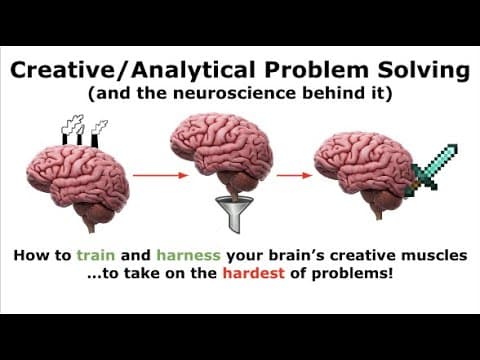
[0:00]Hi, speaking of high, have you ever been high? Strange way to start a video, I know, but it's going somewhere, I promise. So a lot of people, when on drugs, seem to think they're more creative under the influence. And whether this is actually true or not, it's worth looking into. And no, YouTube, I'm not saying you should actually do drugs to enhance your creative abilities. No, what I'm saying is, we can learn from this. We can learn from what drugs do to you without having to actually, you know, do them. So the point I'm trying to get at, beyond drugs, is that looking at creativity scientifically, and looking what's going on in the brain when we receive certain stimuli, whether it be drugs or just a hard problem to solve, can help us understand what we need to do to increase creativity. But before we can talk about the brain, we need to talk about parallel universe, creative problem solving. And that's a pretty broad term, because it can go basically anywhere. Anywhere you have to do some creative task and come up with something new, anywhere in your life, you can frame that as a problem and exercise creative problem solving on it. So really, it can be anything. Some examples include competitive programming, coding interviews, math, chess, real life stuff, etc. And I'll be speaking in general, so this doesn't have to apply to any particular field, it can be basically whatever. So, a little bit about me. You may already know I'm one of the world's best competitive programmers. And as a natural consequence of that, you could say I do a lot of problem-solving. In fact, you could say I'm addicted to problem-solving. In fact, you could say I need rehab. Wow, a lot of drug talk in this video. Anyway, uh, point is, I do a lot of creative problem-solving myself, so I'm fairly qualified to talk about it. And that's why I'm making this video. Now, let me define what I'm going to talk about. What exactly is creative problem-solving? And to get to that definition, we need to start with the basics. So, what is creativity by itself? And scientifically, creativity is the ability to create something that's original, or at least new to you, and also useful. For example, a YouTube video on creative problem-solving is somewhat original and definitely useful. Hopefully useful. And the other basic thing is problem-solving. But that's simpler. It's just taking some particular problem, like a challenge in life or a math problem that requires an answer to a predefined challenge and finding a solution or something that addresses that problem. So putting those two together, creative problem-solving is receiving a task or problem and producing a creative solution to it. That is, given some problem, you have to produce an original solution or one that's new to you, that's useful in the sense that it solves or addresses the problem. For example, consider the creative task of coming up with a joke for this section of the video. In fact, try to come up with three. And now you feel my pain, right? So that's the task at hand. How do we invent new things? How do we take our past experience, the information we already know, and use it to produce something that we don't know? And that's the creative process. So we'll figure out how that works now, and how you can get better at it later in this video. So now, we can get into the good stuff. Let's talk about how creativity works scientifically. And I'm telling you this stuff because understanding how this works will make it a lot easier to figure out how to improve it. So, there's a rough consensus that there are three main parts of your brain that contribute to creativity. First, there's the generator, an idea factory, a part of your brain that mostly just generates a bunch of random ideas, good or bad, and gives them to the rest of your brain. And note that many of these ideas are complete garbage. But often the rest of your brain gets rid of them before you even become consciously aware of them, which is why many people are led to believe that they're so smart. But your brain is actually really dumb, you just don't notice it most of the time. And this part is mostly automatic. It's very hard to control and it almost certainly can't be replicated manually, though it can be stimulated. So mostly let this part do its magic and try to take control of the rest. Then there's the explorer. It takes ideas from the generator and explores them. It looks deeper into them and sees if they have any merit in solving the problem or sees what can be learned from the ideas. Because the generator usually gives you vague, simple ideas, and the explorer's job is to find you the details of those ideas. So they work together quite nicely. And plus, the sword comes in handy if the generator isn't doing its job. And this part is both manual and automatic. Manual in the sense that you can pick a particular idea and choose to focus on it, and automatic in the sense that it can work automatically and unconsciously too. And finally, between those two, there's the filter. The filter does what you expect it to. It filters out bad ideas from the generator before they reach the explorer, so the explorer spends his time on the better ideas. In general, the filter also controls which side of the brain is most active. If you need an idea, the brain focuses its energy on the generator, and if you already have a good idea, it can focus more on the explorer. And this again can be both automatic and manual. It may automatically filter out some random garbage or terrible ideas, but it's also up to you what to consider and what to ignore. And in general, there's both a conscious and unconscious process going on here. The unconscious part is automatic and happens in the back of your mind where ideas are automatically generated and the filter decides whether it reaches your conscious stream of thought or not. And then the conscious part is you manually exploring, looking deeper into ideas that seem promising. You also have the ability to manually filter out ideas that don't look good. So there's this relationship between your conscious and unconscious mind, and you're basically managing the internal chaos of your brain. And it should be clear that each of these parts can be improved. For the filter, it can just get better at filtering ideas and more effectively figure out which ideas are promising and which are useless. Note that both past information and just raw experience can help your filter make better decisions. And for the explorer, it can get better at finding relevant details and get faster so you can explore more things more quickly. Same as the filter, both past information and experience are relevant here. And as for the generator, let's pull up an analogy I've used before in a previous video. Imagine the generator gives you a sequence of random characters. You're trying to find a meaningful idea. Let's say you're looking for a sentence. With random characters, you'll probably find a few words, but it's very unlikely you'll find a full sentence. But now, say you upgrade your generator. Instead of generating random characters, now it's able to generate random words. And now you'll be much more likely to find a sentence. So the tricky part is doing that upgrade, upgrading your generator to create more relevant and useful ideas. And I should note that all the ideas are still random. Your brain will always be generating random noise, some of it useful and some of it not. But most of it won't even reach your conscious awareness. But the reason an experienced person is leagues ahead of a beginner is that their ideas are usually much more relevant because of a better generator. Their ideas are more likely to be correct because of a more refined filter, and they can think more elaborately about more ideas because of a faster explorer. Now, this, this whole thing is a very simple model. Many of you could probably come up with this yourselves. Some of you probably have already. So why am I telling you this? And first of all, this is what science says, even despite it being so simple. So you can trust that this is what your brain is doing and how it's working internally. And knowing this will make it a lot easier to figure out how to improve, since now we know exactly what we're trying to improve. But before we can talk about improving creativity, there's one more definition-like thing we have to get through first. And that's the types of creativity. There are three I'll focus on. And of course, there are way more than three, but the ones I didn't mention didn't seem that interesting to me. So the first type is insight. This is probably what you think of when you think of creativity. This is Einstein. Insight is that Eureka moment, when something sits in the back of your mind for a while, and suddenly, out of nowhere, a new idea pops into existence. It's of course more complicated than that, but the general idea of insight is some new or unknown idea showing up unexpectedly or seemingly out of nowhere. In general, it's probably your unconscious mind generating a useful idea without you actively managing that process. It's somewhat out of your control, that you can focus your unconscious mind by trying the problem with your active mind. And insight may very well be inspired by past information or based on something you're actively thinking about, but it's also often something completely new. And insight is also broadly useful. I mean, just think about it, insight can help you with basically anything. Particularly when a problem is very hard and you have no idea where to go with it. It's rare and it's hard to control, but it can happen with basically anything as long as it's a hard enough problem. Another type, convergent thinking, is combining multiple pieces of information into a single solution. For example, finding a common link between different words, or finding a common idea that shows up in a bunch of solutions to different problems, and applying that idea to a new problem. Or combining even your own ideas together. It's convergent because you're combining many pieces of information into one. And it's useful in creative problem solving when you're tasked with pattern recognition or looking at a bunch of different solutions and trying to find out why they're connected, or combining a bunch of your own ideas into a single solution, or stuff like that. It can also be very useful when trying to use past problems to solve new ones. Because if you can effectively find common ideas between old and the new problem, then you can see which parts of the solution to the past problem can be useful for the new one. It's not as broadly applicable as insight, but it can still be good in various situations. And note that insight can help you here as well with convergent thinking. The common link between the information can come via insight, if necessary. And finally, divergent thinking is taking a single piece of information and generating a bunch of different ideas based on that. When thinking in terms of creative problem solving, it's basically exactly that in many cases. You're tasked with solving a particular problem, and to try and solve it, you generate as many potential solutions as possible. It's divergent because you're taking a single piece of information and expanding that out into a bunch of information. And it's useful in virtually any type of creative problem solving. Again, insight helps here as well. Now, another important thing is the way you look at these. I see these is not necessarily categories of problems, but also as strategies you can use to try and come up with solutions. For example, if directly trying divergent thinking isn't really working, maybe you can try convergent thinking and try synthesizing some related past information into a new solution, or vice versa. Insight is not really something you can trigger, but it's still a background process that can be helpful. So try everything. Don't get stuck in one way of thinking either. That's a huge part of creativity, too, navigating your way out of mental dead ends and looking for something new. More on that later. We can do a quick example here of the whole creative process. Let's answer, how did I make this video? So the first thing I had to do is come up with the idea, or rather, various video ideas. And this is an example of divergent thinking with a bit of insight mixed in. It solves the problem, think of a video idea that will perform well on YouTube, probably in a genre similar to my previous two videos. So I gave the task to my generator and it gave me a few video ideas, including this one, creativity. Some of them were automatically filtered out and didn't even make it to my conscious awareness, while others did make it to my explorer, awaiting more details. And then I briefly explored the details of each idea and thought about how they qualified as a good video. With that information, I manually filtered out the ideas that were bad or inferior to other ideas, and that left me with creativity. And finally, the idea of creativity went back to my conscious explorer, and I started drafting the video and its structure. And drafting consisted of synthesizing research while also adding my own ideas and humor. The research part was mostly convergent thinking, trying to find common ideas within a huge sea of information. And my own additions were again a mix of divergent thinking and insight. And a lot of time and thinking and planning later, the video was set, and here you are, watching it. So hopefully you liked it so far. So now, with all the information we've learned, how can we improve creativity? And there are two main types of improvement that I'll talk about separately. The first is short-term creativity. That is, for a particular problem, how can you optimize your creative process to get as many good ideas as possible for that problem? And the second is long-term. That is, how can you optimize your brain as a whole, forever, to permanently improve your creativity for every problem in the future? Let's start with short-term. And we can finally talk about drugs again. So, again, people seem to think they're a lot more creative when they're on drugs. And we should look deeper into this. With our model of creativity, with our knowledge, what do we think is happening? There are roughly two possibilities. Either it's boosting our generator so we get more good ideas, or it's relaxing our filter, so we just think more ideas are good. Or maybe both. But apparently there have actually been studies on this. And the main conclusions imply that they mainly just relax your filter. But they, they do actually scientifically allow less creative people to catch up to the more creative people, meaning it's not just a perception thing, there's actual performance improvement. So, mainly, don't actually do drugs for creativity. I, I shouldn't need to emphasize that, you, you don't really need them. But at the same time, maybe your filter is too strict. Maybe it needs to be relaxed. Maybe your ideas are better than you think they are. Maybe they need to be explored further. And they say, I don't know who they is, but they, they say to unleash your full creativity, you have to just write down every idea you come across, no matter how bad it is. And that kind of brainstorming is equivalent to completely shutting down your filter for a while. Because when you're really stuck on a really hard problem, it's likely that the idea you need to solve it with is crazy, way out there, completely outlandish. It's likely that this idea is so far away from your normal line of thinking, that your filter would naturally discard it as complete garbage. And that's the point where you want your filter to get out of your way. But you don't know when you've hit that point, of course. So the logical recommendation after all of this info is, the more stuck you are, the more you should relax your filter. The more stuck you are, the more you should consider those crazy ideas that don't seem promising at first. And that way, in the beginning, you're relying mostly on past experience and the ideas that align with solutions you've worked with in the past.
[13:45]Because you want the answer to be past experience. It's easier when it is. It'll let you recognize the answer easier, and you also be able to more easily think about it, since you have experience thinking about it. So if the answer is past experience, you want that, and you'll be able to recognize that with a harsher filter at first that sticks close to the ideas you're familiar with. But as you get more stuck, and as it gets more apparent that this problem is weird and requires a weird new solution, you should naturally become more and more open to newer ideas. And eventually, you can completely shut down your filter and take anything your brain will give you. That's similar to a brainstorming session where you're willing to just take anything your brain can come up with, no matter how crazy it is, because it may just be the thing that works. So that's my advice for managing your filter. But what else can we do? Because it's pretty hard to just short-term improve your generator instantly. But you can still make good use of the generator you currently have. And basically, you want to look for inspiration everywhere. It's possible, but hard to create something from nothing, but it's a lot easier to draw ideas from inspiration that already exists. So, look everywhere. Look into every detail about the problem to see if you can get an idea for it. Try some examples out and see if you can find a pattern. Consider small variations of the problem or simpler versions to see if you can get inspiration from that. Literally look around you to see if there's any information in your life that can be useful to you. And try the different types of thinking, too. There's insight, which comes naturally, and there's convergent and divergent thinking, which are essentially different ways of processing information. So you can try both and get any other ways of thinking, too. Your goal with all that is to look at the problem from as many different angles as possible, to open yourself up to many different ideas and ways of thinking. And sometimes you can get stuck in mental dead ends where you think one idea or group of ideas is very promising, so you keep generating ideas related to that, when it's really just a dead end, it's not going to lead anywhere. And if a lot of ideas are consistently not useful, maybe you are in a dead end. And in that case, you have to convince your brain to get out of that. And the easiest way to do that is to take a step back. Maybe give yourself a very short break from the problem, so you can reset your brain and come back to it with a fresh perspective. Another thing, the brain region associated with memory is also one that supports creativity, so something that apparently works is trying to intensely remember a past experience to get a quick boost to creativity. To activate the same brain region. And one more thing. Past experience is helpful for inspiration, but remember that the solution has to be something new. And if new was past experience, then it wouldn't be new. So let past experience inspire your ideas, but don't stick too closely into it, because there has to be that new element. You have to try to branch out into unfamiliar territory if, if need be. And that's roughly it for the generator. As for the explorer, I don't think there's much to say about it. The best you can do is make it work with the rest of your parts. For example, you can use your generator to generate possible solution paths for an idea you're exploring, or use the results from exploring to help out your filter. Since exploring will tell you if an idea is good, if it needs to be filtered out, and you can use that information to help filter other similar ideas, too. And some other things, apparently focus is very important, not only for productivity, but also for creativity itself. And if your brain is split between multiple tasks, then it seems that it'll be less creative overall. So try to block out other distractions and avoid multitasking when you're trying to focus on one specific thing. It also helps to act as if you don't have time constraints. It's probably the case that you do, most of the time. But if you can work on tuning that out, if you can work on just staying focused on the problem, the task at hand. Your brain will feel less stressed and therefore more open to new and useful ideas. Self-confidence and confidence in your ideas is good, too, for the same reason. So that was a lot. And lucky for you, we're only halfway done. There's also a lot you can do for long-term improvement of creativity. And science is actually fairly uncertain about a general method that can improve creativity and like the brain connections and stuff as a whole. But one thing they are certain about is that practicing a certain thing lets you improve in that thing. So, how should we practice creative problem solving? And to improve in the types of creative thinking, naturally you should practice doing that thinking. For example, to improve insight, give yourself various opportunities for insight to show up by doing hard problems, ones that make you stuck and require ideas from insight. For convergent and divergent thinking, practice on tasks that require those skills. And of course, actually practice using the skills on those tasks. And that's about it. Nothing really interesting to say there. And we can also use the creative model to guide our practice. What can we do to improve each part? For the generator, there are a lot of things we can do. Current science suggests that our generator operates by deconstructing past experiences and using them to construct new ones. So in essence, it draws inspiration from past experience. And how can we improve that? We can give it a lot of past experience to work with. So, one thing you can do for practice is to explore a bunch of different problems to give your generator a diverse set of ideas to work with. But at the same time, past experience isn't enough. Of course, the hardest problems will require something completely new to be invented, and you need to practice that skill, too. So the clear strategy here for that is to throw yourself into situations where something new is required and specifically practice trying to invent something you'd never seen before. If you think of your generator, and in fact, your whole brain, like a muscle that improves over time with exercise, then it's clear why you need to do this. You're just exercising your ability to think outside the box and produce novel solutions to problems, aka creativity. So throw yourself into the unfamiliar. But we can see now that training your generator requires a delicate balance between getting diversity in problems and also getting deep enough into each problem to really get something out of them. And what should that balance be? My advice for this is surprisingly unchanged from like a year ago. Train on a problem until you feel tired of it, or until you solve it. Until you're so far into it that your brain isn't being productive anymore and you just want to do something else. And you don't even have to solve it to do that. And that way, you get to squeeze every last drop of practice out of each problem you do, while also moving on frequently enough that you get a good amount of diversity. And you can easily adjust this method. If you aren't getting that deep into any problem, you should convince yourself to be more interested if you're giving up too early. If you're solving them too quickly, you can pick harder problems. And if you think you're taking too long, you're probably not. But if you think you are, you can spend less time. And this way, you're giving yourself both of the fundamental ingredients for a strong creative generator at the same time. And as for the other parts, you can do some targeted training for them, too. For your filter, you should practice by giving it a lot of things to filter. For example, for a single problem, you can filter the correct idea, and you can come up with a bunch of alternate or wrong or variant ideas and see if they're relevant. Or you can practice on small variants of the problem, changing a single detail and seeing what still works. In general, you can get a lot out of a single problem, and that goes hand-in-hand with spending a long time on one problem training your generator. Because you can also use that single problem to train your filter on a bunch of right and wrong ideas that look similar, so you can teach your filter to tell the difference. And as for the explorer, I don't have much to say about it. Just, you know, give your explorer some practice and practice the short-term technique of forcing it to work with the rest of the parts. Since that can be improved with time. And despite this new information, we're still just doing basic practice on random problems. But understanding how creativity works allows us to do practice that's much more targeted towards how our brains work, and therefore gain a lot more out of it. So now, I talk about this in every video, but I do have new things to say here. What about IQ? What about nature versus nurture? What about inherent ability to learn and improve and just be better? And I have an evolving take on this. As I said before, it's not worth it to think about stuff like inherent ability. You're going to do the things you're going to do anyway, so why bother thinking about it? Why bother feeling bad about things that are out of your control? And the science even says that nurture is a significant factor, too. So a lot of your intelligence and creative ability and whatever is in your control. You know, studying for IQ tests gets you a better score. Any disadvantage you may claim to have from natural intelligence can be made up for by working harder. So you may as well try to just convince yourself that intelligence doesn't matter, so you can put in the work without being distracted. That's ultimately the goal, get rid of the distraction. And a point I wanted to address is that ignoring intelligence allows you to deceive yourself into believing you can have something that's out of your reach because of some intelligence barrier. But I, I just don't think that's true. Intelligence does not put a cap on how successful you can be. It merely influences how quickly you can improve. The amount of success itself is mostly dependent on the effort you put in. As for creativity itself, research seems to indicate that nurture has a bigger influence than nature. So there's definitely a lot you can do for yourself, regardless of whatever inherent ability you have or believe in. And the number one way to feel bad about yourself is to compare yourself to other people. Because then factors like intelligence rear their ugly head. But it's just not fair. A lot of things in life are out of your control. You might as well only worry about the things you can control. You can optimize your practice strategy, for example. And the thing you can control is the effort you put in. So control that well, and you'll probably be able to catch up, too. So yeah, creativity is cool. And understanding how it works makes it a lot easier to understand what we can do to improve it. I do think this has a lot of uses. As I said, you can turn basically any scenario into one that requires problem-solving, so you can use this type of creativity in a lot of places. And I also mentioned it's worth it to try to apply the different types of creative thinking, insight, convergent, and divergent, to each scenario, as each type can be useful in its own way. There are even more types of creative thinking as well, but I didn't think they were that interesting or interesting enough to mention. But of course, feel free to look into them on your own, do your own research, see if any of them can apply to you. And I've also said before that diversity isn't so important in past videos. I suppose my opinion has changed since doing research for this video, but I still maintain that the raw ability to invent new things is even more important. So you have to make sure you're getting as much as possible out of each problem you do.
[26:17]As for the weirdness of this video, I did mention drugs a lot more than I thought I would, but I guess that makes it interesting, so I don't know, whatever. Uh, probably don't expect that again in future videos, but I don't know. I do have to keep it interesting somehow. And yeah, I don't even know what I'm talking about anymore. As for IQ and whatnot, the biggest thing is to avoid comparisons. The second biggest is to believe in your ability to improve, because you do have the ability. As long as you do that, IQ shouldn't be an issue. And I think that's it. Hope you enjoyed, hope this was helpful, etcetera. That's all, goodbye.


