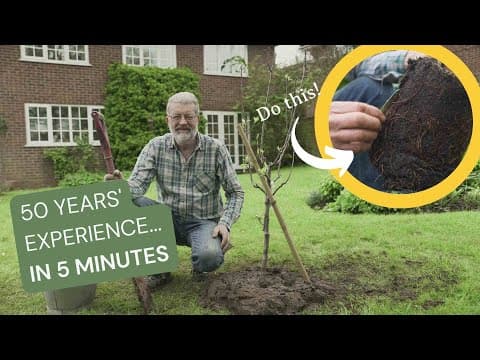
[0:00]We're here this morning to look at how we plant a tree. The aim is to give you many years of healthy, active growth and life with lots of fruit, flowers, whatever you've planted the tree for.
[0:16]In many ways, this is probably the most important single part of the whole exercise.
[0:23]A hole about 18 inches square.
[0:27]couple of spans. The whole normally is about the depth of the spade, but then we go down quite a bit deeper, breaking up the soil, but we don't actually need to get it out the hole.
[0:42]And I'll now going to switch to a fork. All we're looking to try and do now is to mix up the soil with plenty of air, because the roots will find it a lot easier to grow through fully aerated soil.
[0:55]So the next thing to do is to mix in some compost.
[1:03]It doesn't really matter what form of compost you use. I happen to have some spare compost off the nursery here, but I could just as easily use normal garden compost, well rotted manure, something that I bought in a bag from the local garden centre.
[1:21]As long as it's organic, when it mixes in with the soil, it will keep the soil open, lots more air in it, and make it easier for the trees to root.
[1:28]How much compost? A quarter to a third of a barrowful, half a dozen shovelfuls, something like that. Basically, you can't use too much.
[1:36]We do recommend the use of root grow mycorrhizal fungi when planting our trees. It enables the root systems of this and and most other plants to make much better use of the nutrients that are in the soil.
[1:54]And then we'll put some more onto the soil that we're going to be filling in with.
[2:02]So that's basically the soil preparation done.
[2:09]So what we want is for the compost level to be level with the surrounding soil. So we probably need that whole to be just a fraction deeper.
[2:19]We can easily fill a bit more back in. Yeah, that looks about right.
[2:27]Trees have very vigorous root systems, and it is always a danger with container grown trees that the roots grow out to the edge and then go round and round in the pot.
[2:37]And if you suspect that, it is quite important to encourage those roots to grow directly out, because for the long-term health of the tree, we need a radial root system and we want roots growing out from the base of the tree in all directions.
[2:50]What we don't want is it to be circling before it grows out, because then you end up with a giant spring under the tree, and if you get a decent wind even a few years time, the whole tree can rock around and fall over.
[3:02]You just make half a dozen vertical cuts, only about a quarter of an inch, 5 or 6 mm deep, down the edge like that.
[3:12]So now what we've got to do is to fill in this soil and compost mixture into the hole around.
[3:19]Then you make sure it's upright.
[3:22]and then just go round and firm the soil.
[3:26]If you if you waggle that, the root system's pretty solid.
[3:34]Now that's obviously going to leave it quite a bit higher than the surrounding lawn, but the soil that you've aerated so carefully will naturally settle. And what you want at the end is to make sure that the graft union stays above the surrounding soil.
[3:53]If you're planting a bare root tree, the um, the main differences are, first of all, it's likely to be less stable in the soil once you've planted it. So there is more chance that you're going to need to stake it.
[4:05]With a bare root tree, it is always best to soak the root system and more of the tree if you can, but the root system is the important bit for a a few hours or even a couple of days in something like a bucket of water.
[4:22]I will probably be intending to water this um with at least a bucket full twice a week to start with and then easing off to to once a week and then once a fortnight as we go through the summer.
[4:38]Don't put it all on in one go, because it just runs away. You need it to soak in more as where it's needed.
[4:47]I try and make something of a ring around the tree to hold the water reasonably close to the trunk. You don't want it flowing away down either the lawn or the border.
[4:59]So we now use these bamboo canes as as stakes. We don't want to drive the stake down vertically, because that will have to go right through the root ball.
[5:09]So what we're going to do is put it in at an angle.
[5:15]Now these tree ties, you have to put it on to a figure of eight. Ribs against the tree. Feed that through the first of the slots.
[5:26]And and this state would not need to be in place for more than, well, probably one year at the most two. So you then got the figure of eight providing a gap between the the trunk and the stake so that there's no chance of rubbing.
[5:40]And that will keep the tree nice and stable while it uh while it sets some new roots.
[5:48]So there we are. That's our tree planted. All I've got to do now is wait three or four months and I'll be picking the first apples.
[5:56]If you want any more information or tips from me on how to look after your tree, prune it, whatever, over the coming months and years, then just visit rootplants.co.uk.


