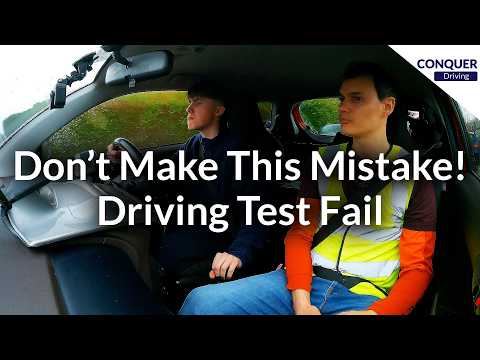
[0:00]Today I'm in East Yorkshire in a town called Bridlington. It has a population of 35,000 and is famous for having the largest lobster port in Europe. There is a driving test center here and it has an above average pass rate of 56.4%. The national average is 48.7%. But, I've tried to pick the most difficult rule I can for this area. And we have Bailey, a bus driver from Newcastle, who's doing his mock test. So, you're a bus driver. Why do you want to do your mock test? Well, I did my actual driving test two years ago, so I've been driving for two years and I've been doing bus driving for half a year. And I just want to see if doing driving as a profession has maybe developed bad habits, anything worth testing and finding out. Okay, well I can have a look. We're in his car. It's a Toyota IQ, 68 horsepower. Indeed, yes. I think it's based on a Toyota Aygo, I think. I'm pretty sure. I'm wrong. Same engine as the Aygo but a different platform. Yes, Cygnus. But I know it was sold as an Aston Martin Cygnet. They were quite a bit of money now, aren't they? They are, yeah. Anyway, I'll go and get your driving examiner and as you are a full license holder and this is your car, I'm not stepping in. If this was my car and you were a provisional license holder, I would step in to avoid any kind of minor damage you could do to the car. So if you hit the curb, damage your wheels, it's on you. It's on me. I'll go and get your examiner. All right.
[1:39]Are you Bailey? And yes. I'm Jason. Hello, Jason.
[1:50]It's a small car, isn't it? Yes, it's comfy. Would you like me to tell you about the test? Yes, please. It'll be between 38 and 40 minutes. It'll take into account various road and traffic conditions. You'll be following the satnav. I'd ask you to do one maneuver and I may ask you to do the emergency stop. Right. During the test, follow the road ahead unless I say left or right if you're not following the satnav, but you will be following the satnav, hopefully, for the duration of this test. Okay. Perfect. All right. I need to ask you a question.
[2:30]Okay. That's a sat nav, can you see it? I can. Right, okay. I think of one I haven't chose recently. Tires. How do you check your tires are safe and legal? You've got to have a look and inspect for any cuts or bulges and you've got to ensure that there is 1.6 mm of tread depth around the circumference of the tire. Good. Okay. Move away when you're ready, please. You're following the sat nav. Indeed. He said the tread needs to be 1.6 mm but he didn't say across the central three-quarters of the tread. However, his answer is complete enough that in my experience he would not get a driving fault.
[3:20]He is already demonstrating good awareness, he is checking his mirrors before going around the parked cars.
[3:35]He checks the relevant mirrors and signals, good approach speed and position and he emerges safely.
[4:17]The traffic lights turn amber when he is already committed to go. It's the correct decision to continue and he clears the junction safely.
[4:29]He is stopping on the bus stop in traffic. Some learner drivers try to leave bus stops clear when they are queuing in traffic, but that doesn't help the bus behind. So waiting on a bus stop when in a queue of traffic is absolutely fine. He even checks the left mirror again just to make sure no one's there before he turns left.
[5:03]A safe approach speed towards the roundabout. He does not risk braking hard for the give way line. He is aware of any vehicles approaching from the right and he is aware of what's ahead also. However, it may not be a good idea to signal to leave this roundabout due to the road on the left. If a vehicle was waiting to pull out of that road, they may pull out in front of us thinking that we are turning into that road. No signal is better than a misleading signal. However, as there is no vehicle waiting to pull out from the road, signaling left here is not actually causing any danger and therefore it's not likely going to be marked on the driving test.
[5:54]He is maintaining a safe position from the parked vehicles. If somebody was to open a door or step out onto the road, he is far enough away that it's safe.
[6:15]As he is turning right at a green traffic light, he needs to give way to oncoming vehicles. It seems that he is aware of this and as he approaches the traffic lights, it looks like he is ready to give way. But as he gets closer to the junction, the green arrow pointing right comes on. That means oncoming vehicles have a red light. He seems to be aware of this and he turns right safely.
[6:48]Again a good distance from the parked vehicles, he is not close to either side.
[6:59]The sat nav is saying turn right, but it's just a bend. He realizes this, which is why he doesn't signal to go around the bend.
[7:12]He judged a good speed for the speed bump, it wasn't too harsh. There wasn't much space up ahead, so it was a good decision to let the oncoming vehicles through. However, there was enough room to go if he wanted to.
[7:37]The destination's just a waymarker. All right. Continue following the satnav when you get to that destination. No problem. Throughout this test so far, he's maintaining excellent awareness of his surroundings ahead and behind via the mirrors.
[8:06]I've asked him to pull over at the side of the road to see how he will pull over and then move away again when there are vehicles around.
[8:37]He moved away safely whilst the vehicle behind was waiting.
[8:49]I deliberately included the next junction in this test route because I was expecting a queue of traffic due to some traffic lights that was likely going to make it challenging to emerge from the end of the road. But the road to the right is closed, meaning no queue. However, a critical error still happens. At the traffic lights, there are two stop lines. It is illegal for a motorist or motorcyclist to cross the first stop line when the traffic lights are red. Look up rule 178 of the Highway Code for more information.
[9:27]But he does cross the first stop line when the traffic lights are red, meaning this would be a serious fault and therefore a driving test fail. I don't think what he did was unsafe, but he did break the law. And if this was a real test, he would not pass.
[9:45]On the hill. Pull over on a safe place on the left, please. No problem. He signals to the vehicle behind and pulls over safely.
[10:01]I then had a problem with the satnav, so I'll skip ahead. Done. Yes. Nice. Anyway. Nice. Back into character.
[10:19]All right. Continue following the satnav. Move away when you're ready. All right. Bear in mind, this hill doesn't look steep on camera, but it's one of the steepest hills in the area. He signals to the vehicle ahead and to the vehicle behind about to emerge from the junction. Then he moves away on this hill safely without rolling back.
[10:48]He signals to the vehicle behind and pulls over safely.
[11:06]I'd like you to reverse back two car lengths, staying reasonably close to the curb. All right.
[11:16]It's good that he's waiting for the oncoming vehicle because he doesn't want to be a moving obstacle for vehicles trying to pass him on this side of the road.
[11:30]It's unlikely that he would have to wait for vehicles coming up from behind driving on the other side of the road because we are not in their way. However, if vehicles approaching from behind were to move into our side of the road, then he should give way. He maintained good observations and a good position. This should be a pass. That'll do. There were two real car lengths as well. Right. Not this one. Not this one. He was about twelve of these. Move away when you're ready, please. All right.
[12:11]It's good that he checked his left blind spot this time as he is moving away from the right side of the road. It's good that he avoids the overrun area on this roundabout because it's really for long vehicles. And if you've been watching this video, you would have realized by now that the Toyota IQ is not a very long vehicle.
[12:39]This is where he makes the car struggle. We are going up a fairly steep hill with low revs in a car that has an engine with very little power. It's struggling, the car is starting to buzz. We're in a 60 mile an hour speed limit now and it's struggling to accelerate. He needs a lower gear and he needs more revs to get up this hill. This would likely be a minor mark for control, gears. He signals too early because he mistakes the lay-by on the right to be the road he needs to take. He realizes this, but he doesn't cancel the signal. He seems it's on. It would have been better to cancel the signal and then reapply the signal at an appropriate distance to the road he intends to take. This would likely be a minor mark for signals, timed. I don't blame him for slowing down too early as he was approaching this oncoming vehicle.
[13:42]Because due to the brow of the hill, he couldn't see his passing place up ahead. When the oncoming vehicle waited at that passing place, he continued and then we could see where we could pass.
[14:36]When the pedestrian moves out the way, he stays very slow for quite some time. This would likely be a minor mark for appropriate speed.
[17:30]When it's safe, show me how you use the horn in this vehicle. Thank you. That's the show me question for this driving test.
[17:44]A common mistake learners make is to stop because there is a red light, but the red light doesn't apply to us because we have a give way line with a give way sign. So we can continue if it's safe.
[18:18]Only one maneuver is carried out during the driving test in Great Britain, and Bailey has already done his. He did reverse on the right. It would be unfair to get him to do another maneuver now. That's why if he parks forwards and doesn't get it in between the lines, this is not going to be a driving fault. This is a difficult one because I definitely think Bailey should have a driving license. I think the passengers on his bus are lucky to get in because he's smooth and safe and I'd happily trust him with my own vehicle. But I can't pass him because he stops slightly too far forwards at a set of traffic lights. He did not stop at the advanced stop line. And you could say he could not stop at the advanced stop line because he couldn't make the turn and then stop, there wasn't enough space. So, if he was to stop at the advanced stop line, he'd be on the wrong side of the road, which is true. You could say, well, he should wait at the end of the road until the lights turn green and then go. But depending on what sort of traffic lights they are, they may stay red if he doesn't drive up to the traffic lights. They may not know he is there and therefore just stay red. Some traffic lights are set up like that. I don't know how those traffic lights are set up. Also, some people actually argue that advanced stop lines don't make the road more safe, they make the road less safe because they encourage cyclists to filter through traffic and it means more vehicles now are going to overtake that cyclist. Filtering through traffic is a hazard. Overtaking cyclists is a hazard. So it increases two hazards. Other people would argue that advanced stop lines make the road more safe because cyclists are now in front of the queue at traffic lights, meaning they are more visible. Particularly to oncoming vehicles that want to turn right at the green light. The oncoming vehicle is more likely to see that cyclist at the front of the queue. They are less likely to see the cyclist if they are behind a vehicle, particularly a van, and if they're less likely to see the cyclist, they are more likely to hit the cyclist. So there are arguments both ways as to whether or not advanced stop lines actually make the road more or less safe. But that doesn't matter because the law is if the lights are red, you must stop at the first line, the advanced stop line, and as he didn't, I can't pass him. Well, I hope you found the video interesting. If you did, please give it a thumbs up. And if you're looking for car insurance, check out the links to Collingwood and confused in the description. If you're learning to drive and want to ensure yourself on somebody else's car, then Collingwood are there for you because you can do so without affecting the owner's policy. And that takes away a big stress from the owner of the car that you're using to practice learning to drive in. And via the link at the moment, it's up to 35% off and a 20 pound gift card. If you want to ensure your own car, check out the link to confused.com because you fill out one quick form and get loads of quotes back from many insurers to compare who's cheapest, and you can change your car on that quote as many times as you like without having to do the whole quote again. So if you're thinking about what car should I buy, you can fill out one quick form and just change the car and compare how much it costs to ensure different cars. Easy. Using the links doesn't cost you anything but it does support the channel, so thank you very much. Subscribe to get my future videos and until next one, cheerio.


