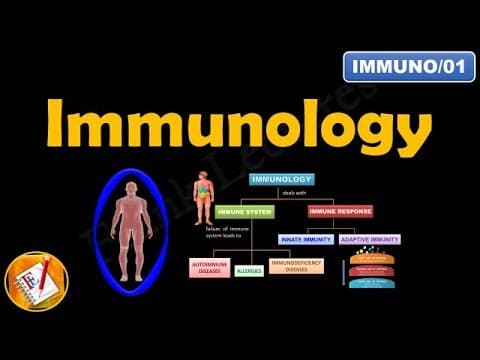
[0:07]Immunology, an overview.
[0:12]In this video lecture, we will understand the terms: immunity, immune system, immune response, immunology. We will also see types of immunity and what if immunity fails?
[0:29]Immunity is defined as the general ability of a host to resist infections or diseases. In Latin, “immunis” means “exempt” i.e. free from burden. So it is immunity which protects us from pathogens and diseases. Immune system. Immune system is the collection of cells, molecules, tissues and organs within an organism. It is the immune system which immediate resistance to infections.
[1:06]These components of the immune system work together to prevent access of pathogens to the body, and if an infection has been established, then it tries to neutralize or eradicate infections. Let us now understand the term immune response. Immune response is defined as the coordinated reaction of the host’s immune system to foreign agent or pathogen. Now the coordinated reaction here it reflects that all the components of immune system are involved. Immune response, it involves recognition and defending strategies against the invader.
[1:49]Let us take an example to understand what immune response is. Phagocytosis. We all are familiar what phagocytosis is. Now, when a phagocyte recognizes a pathogen inside a body such as a bacteria, it ingests it and internalizes it. And then in a separate compartment, microbial killing takes place. The process is simple, but from production of phagocytes, to their activation, all is done by immune system.
[2:24]Immunology. The science which studies all the aspects of the immune system that is, its structure and function, immune responses to infections or diseases and disorders of immune system.
[2:43]Types of immunity. Immunity is of two types: Innate immunity and acquired immunity. Acquired immunity, we also know it as adaptive immunity. Let us first study innate immunity. Innate immunity forms the first line of defense and second line of defense. We will also see what these lines of defenses are. Innate immunity, in Latin, innate means inborn. That means it is present at birth. Innate immunity is determined by genetic factors. For example, skin. Our skin is a barrier to pathogens. The sweat glands and oil glands which are present beneath the skin, they secrete anti-microbial substances.
[3:40]Innate immunity is also known as native or natural immunity. It provides an early defense against infections. Another important characteristic of innate immunity is that it recognizes and provide defense against a wide variety of infectious agents. These include bacteria, fungi, protozoa and viruses. Now, since it recognizes such wide variety of pathogens, there must be some mechanism of strategy to recognize them. So what is it? Innate immunity recognizes structural features shared by microbes. For e.g. LPS of Gram-negative bacteria. Let’s say a, b and c. These represent different species of Gram-negative bacteria, which means these all these three bacteria have a common structural feature that is lipopolysaccharide since they belong to Gram-negative group. Now, this is a defensive cell of innate immunity, for example, phagocyte. Now this single cell, that is this phagocyte, will be able to recognize all these three bacteria. Why? Because this cell is capable of recognizing lipopolysaccharide which is present in all these three bacteria. Thus, the strategy or mechanism of defense of innate immunity is same regardless of pathogen type. So it is also known as non-specific immune response or resistance. Innate immunity responds quickly i.e. within minutes or hours. It has no memory of encounter or immunological memory. That means it does not remember prior contact with the pathogen, if the same pathogen attacks again. As we said earlier, innate immunity forms the first line of defense and second line of defense. To understand what these lines of defenses are, first we have to understand what are the roots of entry for pathogens in human body. The routes of entry for pathogens in human body are: skin, and mucous membranes of respiratory tract, gastrointestinal tract, urinary tract and reproductive tract. First line of defense. First line of defense provides physical and chemical barriers to the invading pathogens. The components of first line of defense are: Skin, Mucous membranes and their secretions. Skin and mucous membrane, they secrete some chemicals which are antimicrobial in function. So, first line of defense prevent access of microbes into the body.
[6:57]Second line of defense. When first line of defense fails, that is, when microbes get entry into the body, second line of defense comes into play. The main components of second line of defense are phagocytes, antimicrobial substances, natural killer cells, inflammation, fever. Their function of second line of defense is destruction or elimination of microbes which penetrate the body. Let us now summarize main points of innate immunity. Innate immunity also known as natural or native immunity. It is non-specific immunity. Immunological memory is absent. It responds quickly that is, within minutes or hours. The main components are skin and mucous membrane, phagocytes, antimicrobial substances, natural killer cells, inflammation, fever.
[8:04]Let us now study acquired immunity. Which is commonly known as adaptive immunity. Acquired immunity forms the third line of defense. Acquired immunity. It is the immunity which an individual acquires during life. That is, it is acquired after birth.
[8:30]Acquired immunity is also known as adaptive immunity. Now when a microbe is encountered by our adaptive immune system, it learns the most effective way to deal with it, that is, it adapts or changes accordingly.
[8:50]Another important feature of acquired immunity is that it is highly specific in action. And therefore it is also known as specific immunity. Let us understand the specific nature of the acquired immunity by taking an example.
[9:11]Let's say X and Y, these represent bacteria. Now when there is an infection by bacteria X, adaptive immune system will activate a set of cells which will be specific to bacteria X only. In case bacteria Y infects, these cells which are produced in response to bacteria X will not be able to defend against bacteria Y. Instead a separate set of cells will be activated which will be specific to bacteria Y. Thus adaptive immunity is highly specific in nature. Immunological memory is present in acquired immunity. That means, it remembers the previous encounter with the pathogen and when the same pathogen attacks again, it reacts more quickly and efficiently. Acquired immunity is a slower response (takes days to develop) but long-lasting immune response.
[10:18]Main components of acquired immunity are B lymphocytes, also known as B cell, T lymphocytes or T cells, and antigen presenting cells. Let us now summarize the main points of acquired immunity. Acquired immunity also known as adaptive immunity. It is specific immunity. Immunological memory is present. It is a slower but long-lasting immune response. Main components of acquired immunity are antigen presenting cells, B-cells, T-cells. At this point of our lecture, we need to understand a term antigen, since we will be using this term often in our coming video lectures. Now, we are saying that immune system recognizes the pathogen. So, does it recognize the whole pathogen? No. Then what does it recognize? To know the answer, let us zoom in the microbial surface. Here, you can see some protruding structures. These structures are known as antigens. So, what are antigens?
[11:38]Antigens are molecules or substances which are recognized by the immune system. They are usually proteins, on the surface of microbes and their by-products i.e. toxins, chemicals etc. So, now we understand that whenever a pathogen tries to invade our body, it is encountered by our immune system. Our immune system provide a series of barriers to the invading pathogens and these barriers are first line of defense, which is formed by skin and mucous membrane, second line of defense, which is formed by phagocyte, antimicrobial substances, inflammation, fever and third line of defense, which is formed by T cells, B cells and antigen presenting cells.
[12:33]Now we understand that how important our immune system is, but what happens if immune system fails? One of the consequence of immune system failure is allergy. In allergy, immune system overreacts. The immune system of some people is very sensitive to the substances which are generally harmless in most people. But the immune system of the affected individual considered that substance as dangerous and reacts. Another consequence of immune system failure is autoimmune disease. In autoimmune disease, immune system attacks self. That means, it attacks and damages its own tissues. Well-known example is rheumatoid arthritis where the immune system attacks the joints. We all are familiar to HIV AIDS. HIV AIDS is an immunodeficiency disease. In immunodeficiency disease, immune system fails to respond appropriately to a disease causing agent. And thus, the patient is now prone to viral and bacterial infections. At the end of this video lecture, let us summarize the main points. Immunology, it deals with immune system and immune response. Based on type of immune response, immunity is of two types: innate immunity, adaptive immunity. The together form barriers to pathogens, which are known as first line of defense, second line of defense and third line of defense. If immune system fails, it leads to the consequences which are allergies, autoimmune diseases and immunodeficiency diseases.