[0:00]The high cost of healthy foods is a major factor pushing Malaysians, especially lower income families to opt for unhealthy choices.
[0:10]This only makes the problem of malnutrition in our society worse. Khazana Research Institute KRI recently released a discussion paper titled Unhealthy but not by choice, Food environment and nutrition, which focuses on this issue.
[0:26]Now to learn more about this report, let's hear from Hafiz Marzuki. Hafiz, what can you tell us about this report about especially the state of nutrition and affordability of food in Malaysia?
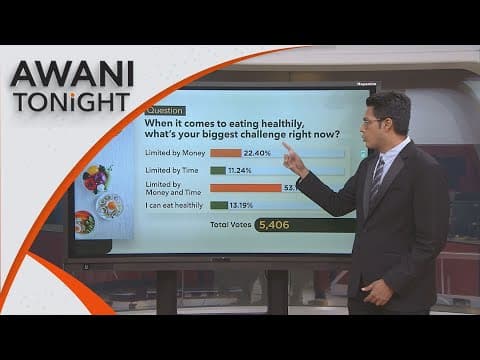
[0:37]Yes, Cynthia, before we delve further into the issue, we at Astro Awani actually published a poll recently earlier this week. And the question we asked was, when it comes to eating healthily, what's your biggest challenge right now?
[0:49]Of course, 22.4% said they are limited by money, 11.24% said they are limited by time, and here, you can see right here, 53% said by both limited by money and time.
[1:03]And the worrying thing, Cynthia, is if we look here, I can eat healthily, the fourth choice, only 13.19%. What it means basically 86 to 87% of us actually believe we can't eat healthy food, or we don't have the choice of eating healthy food.
[1:21]So of course, we spoke to KRI's Associate researcher, Dr. Theo Aini, and this is what she has to say about the state of nutrition and food affordability in Malaysia.
[1:31]We see that there is a rising rates of um food, unhealthy food import over the past decades as as compared to healthy food.
[1:41]This can be problematic because it may imply a growing availability of unhealthy food in our environment within our country.
[1:54]And at the same time, we also see a shift in household consumption expenditure. At the household level, we observe that Malaysian households are increasingly consuming more and more food away from home, which is food prepared at restaurant, hotels, cafes, street food vendors, including that the food we order on food delivery platforms.
[2:11]And this could be an obstacles to healthy eating because these food that we usually purchase away from home are associated with high calorie intake, fat, sodium, and they are also more prone, we are also more prone to overeating.
[2:28]Second, we look at food affordability, an important topic. When we look at the cost of healthy diet in Malaysia, it has been rising over the past few years.
[2:39]Basically, these are all the public health concerns that were outlined by Dr. Theo. First is of course high fast food and sugary drink consumption, basically we can get uh high caloric food very easily,
[2:52]followed by unhealthy food advertising targeting children, and lastly, the rising cost and time constraints for healthy meals, and these are basically the concerns outlined, Cynthia.
[3:04]Right. So, well, these are the areas that was outlined, but I actually do also want to find out that because the issues that you mentioned is not something that is unique to Malaysia, it's faced by many developing countries. So, but are there specific reasons why it's especially tough to get balanced and affordable meals here in Malaysia?
[3:23]You are right about the challenges that they are faced by a lot of countries. Basically, what we can show here are the challenges in Malaysia's food environment.
[3:36]We can summarize it up to four points. Right here what we can see is number one is of course easier access to junk food is what was outlined earlier. The other thing is of course shortage of fruits and vegetables. What it means here is basically you can get fruits and vegetables, but it is at a very uh, I would say, less affordable price.
[3:52]And of course, the final two points are pretty much linked to each other, which is the eating out more, leading to unhealthy diets, and of course, this led to less healthy choices for people with limited money or time.
[4:06]So these are basically the challenges in the Malaysia's food environment. And the more important thing is Cynthia is what do, what can we do to actually intervene and solve this problem?
[4:15]And in fact, Dr. Theo has actually outlined a couple of policy recommendations.
[4:20]What we can do now, um, I mean, low hanging fruits would be at the moment increased availability and accessibility of healthy food, uh such as two policies like zoning laws, by having more healthy options over the unhealthy options.
[4:36]And more importantly, at the same time, make sure that this healthy food choices are equally, if not more affordable than unhealthy food options, through, for example, economic incentive.
[4:50]And at the same time, I also think, um, we also have to make unhealthy options desirable. Desirable as in through um, consumer educations, perhaps with the use of food marketing advertising, if it delivers positive impact, it will become a good approach.
[5:08]So and we are and the most direct approach is actually to have food environment policies, and we are not short of them.
[5:15]We have existing food environment policies such as the SSB tax, healthier choice logo, guidelines on the prohibition of sales of food outside school parameters, and fast food advertising guidelines.
[5:28]These policies in my opinion are good but needs to be strengthened to more adequately respond to the shift in our food environment and also considering the nutrition inequality between for example income groups and ethnicities, occupation and also education level.
[5:46]So we need also additional or more comprehensive package of food environment policies to address this rapid shift and emerging new trends in our food environment such as the persuasive digital food marketing that is unregulated at the moment.
[6:02]Basically, these are the summaries of Dr. Theo's policy recommendations. Number one, combine nutrition programs with food environment interventions. And of course, the second one is to strengthen existing programs like the Healthier Choice logo policy, which is already being run right now in Malaysia, and of course, lastly, address food marketing challenges.
[6:22]And in fact, here, we at Astro Awani thought, it'll be interesting to take this a step further and run it through the AI program as parts of our Ty AI initiative, we want to find out what is the next step and what can we do to improve this further. Let's hear.
[6:38]We need to develop and enforce strict nutritional guidelines that promote the availability of fruits, vegetables, whole grains, and lean proteins.
[6:47]It's crucial that we also train canteen staff to prepare healthy meals.
[6:51]This way, we ensure everyone has access to nutritious options and the skills to make healthier choices.
[6:58]Other than that, we also should offer more options like low-fat dairy products, nuts, fruits, and whole grain snacks, while cutting back on sugary, salty, and high-fat foods.
[7:08]It's all about making healthier choices easier for everyone. And a healthier themed vending machine can work better compared to the existing ones that we know.
[7:18]Consider coming up with reward programs to encourage employees or students to eat healthy. Offer workplace wellness programs that include nutrition counseling, healthy cooking demonstrations, and fitness activities.
[7:30]And finally, it goes without saying, regularly monitor and evaluate these programs to ensure their effectiveness.


