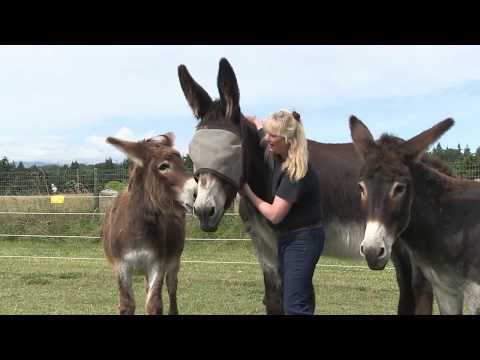
[0:06]Bringing your donkey home. We are here to help you. That's what this video is about. How to have a plan, how to set up your fences, how to pair them up. Yes, donkeys do much better when they're in twos. Gildings with gildings, Jenny's with Jenny's. I'm going to discuss all of these issues with you. Why is this important? Most importantly, do not throw your donkey out in a big open field. As that'll probably be the last time you'll see your donkey unless this is a really old donkey or or a really trained donkey. Donkeys are smart. Donkeys have photographic memories and it takes a little bit of planning in order to learn how to train a donkey. Donkeys are not horses with long ears. Donkeys evolved from the desert. Donkeys are visual learners. There's just so much for me to teach you. But this is the beginning, the most exciting part, bringing your donkeys home. If I'd known all of this 13 years ago, my life would have been so much easier. I did it the wrong way. I brought home a mammoth donkey that was a year old, a 13-year-old mini and a 20-month-old horse. And they all live together for a little while, but it really didn't work out that well. So, what I'm doing for you here today will save you tears and money, so you don't have to make more paddocks and more shelters and all of that. So, welcome to bring your donkey home. My name is Melody Johnson, I'm the trainer of the Donkey Whisper Farm, and I trained owners and caretakers of donkeys worldwide via my videos and my books. Have a plan. Donkeys are not horses with long ears. Donkeys evolved from the desert, meaning donkeys can evaluate a predator, a threat quickly. They can look at a bucket and be afraid to drink out of it. It's interesting, isn't it? So, if we have a plan and we understand donkey behavior and donkey psychology, things will go much easier. Donkeys can have post-traumatic stress just like a human. Triggers, triggers are such things as a hat, a woman, a man, depending on the trainer that abused the donkey. What's the easiest donkey to get and train? That would be a baby donkey that's been weaned from its mother and never abused by a human. Gildings will always be easier than females because of Astrus. We don't do jacks. Again, have a plan. Decide what donkey you want, size, sex, and what you're going to do with your farm, and how you will keep them healthy on the farm. So that's what this video is about, bringing your donkeys home and having a plan. We want you to keep your donkeys in their forever home. So, a little bit of planning and things will go much easier. When a donkey meets a new human for the first time, in a matter of seconds, this is what a donkey thinks. Treat dispenser, I will lead this human. Bully or abuser, I will never follow this human as a leader. I will never choose to come to this human on my own. Sadly, this is where people think donkeys are stubborn. A fair leader. I will follow this human anywhere. I will love this human for life. Yes, donkeys have photographic memories and they remember things forever. Never forget this. A donkey is intelligent, not stubborn, smart. Donkeys evolve from the desert. Donkeys can act different when we first meet them. After we get the donkey home, the true personality will evolve. People do this, too. Donkeys can pretend to know nothing with a new human. This is one of the reasons donkeys are a challenge. Donkeys are seriously into self-preservation. It is important to understand the donkey will demand the new owner proves trust and fair leadership before attempting to train the donkey. This can be frustrating. We need to get the donkey in so we can check the donkey's feet and get the halter on and get ready for the farrier. And if we don't set our farm up correctly, the donkey isn't going to come in. Every animal and human takes time to have a relationship. So here at the Donkey Whisper Farm, I am here to help you with exercises and a plan to train your donkey, and this all begins with setting your farm up for success. How we set up the farm is really important. Never just throw a donkey out in a big field. Never. Number one, the donkey will overeat. Number two, the donkey is so smart, he will decide or she when they want to come in and the donkey has you trained. So please, pair the donkeys up. Size matters. Pair miniature donkeys up with miniature donkeys. Standard burro-sized donkeys work best together with their size or even a mammoth. Mammoth donkeys with mammoth donkeys. Why? Donkeys play rough. Donkeys bite and grab the neck and pull the buddy to the ground, sometimes bleeding. This is not bad behavior if the size is fair and the sex is fair. Diet is easier to maintain when we have the same size donkeys in the pasture paddock. If we put a gelding in with a Jenny, sometimes the gelding will attack her and put her on the ground and penetrate. This is not good. Sometimes the Jenny will quit eating and going in the shelter. So, think about that before you put a Jenny in with a gelding, otherwise, you may have to create another paddock and get another Jenny for your Jenny and another gelding for your gelding. Donkeys get bored easy. This is why having another donkey really helps. It is impossible for us humans to spend 24 hours a day with our donkeys. The donkey buddy will keep your donkey healthy and happy. And do exercise. Donkeys play with toys. It's just really important. And having the REM sleep. Yes, donkeys lie down and get REM sleep when they're in a safe environment and they have a buddy, but if they have to live all alone, they can never lie down. They're looking for the predator. Melody, having two donkeys. I'm worried about the fact that my donkey will bond to the other donkey and not me. Is that true? No. Donkeys bond to the animal that is their buddy for life. Yes. But when a donkey trusts their human, they will push the other donkeys away to get to you. There's nothing like having that special relationship with a donkey when they choose you and they put their head on your shoulder and they run to you when they see you. It's amazing. So don't think that. It's actually healthier to have your donkey in balance and harmony. Think about people that have to live in isolation and how it makes them crazy. Well, that's what happens to donkeys. Donkeys really are much healthier and happier when they have their own species. Here's a few tips to help you with your donkey. Your donkey's home, you've done all the steps in this video and booklet. And you're ready to to get your hands on that donkey and start working with that donkey. I am so excited for you. Nothing is more fun than getting new donkeys. Number one, the donkey handshake is on the withers. It's right above the shoulders. Don't go to the eyes. Donkeys have peripheral vision. So, if you go right to the face in the beginning, they're going to shy away and walk away from you. Go up to the withers and donkeys love a good scratch. Pressure and release. You'll learn all about that. Pressure can be even walking up to a donkey. You want to we want to back away and let the donkey catch us, right? You'll learn all about that in donkey 101 and 102, my video series. So, your donkey's home. What would I do if when I get a donkey home? What do I do? I'm sorry. I try really hard to not mess with that donkey for at least three days. Why? Donkeys are visual learners. Donkeys are watching you to see if the meals are on time, the food, the water, how you interact with all the other animals and people on the farm. Your voice, your energy. Who are you? They're studying you, right? So, if you can give them at least three days. Now, if the donkey is tame and he trusts you and he comes up to you, he chooses to come up to you, then that's when I would begin to move into Donkey 101 and go into my exercises. But give them at least three days unless they come up to you and they're friendly, okay? That's what I was saying about that. I want the donkey to choose you, not force the donkey, right? Environment. When I'm talking to you about the environment, I'm asking you to think about what part of the world you live in. Donkeys evolved in the desert. So, their gift is to to survive on dry hard ground. That's why their hooves are shaped that way. When they have to live in a wet area that stays wet all the time, and green lush brush and grass and tree limbs and leaves, they get sick. Right? So, we have to think about how do we make our farm like the desert as much as we can to keep them healthy. If you live in Nevada or Arizona, your life is easy. You own a donkey and you live in the perfect environment for your donkey. But if you're like the most of us and you want donkeys and you live where it's green and wet and mud and stuff like that happens, you're happy, you're going to be really happy to learn how to make the environment for your donkeys footing and life to be healthy. So what do I do? I get sawdust, a little bit thicker than sawdust, and I put that down every fall before the rainy season. I make the paddock be where I have the sacrifice area. They don't go out on the tracks, you know, unless it's dried out in the winter. And I make sure that my donkey's feet are dry, that there's dry as I can keep them. Why? Because when the foot gets wet, it gets soft, and like I said, debris and rocks and things like that will get into the hoof. It's really painful and the donkey cannot walk. Do not put gravel down in your paddock. I know there's books out there that tell you to do that. I tried it and it did not work. It went into my donkey, my mammoth donkey's foot, and it was a nightmare. The vet had to come out. We could not get the rocks out. It's so painful. So, don't do that. Just don't do it. Think about the fact that you have a donkey and the environment and pick up the poop every day. Make sure that you don't have urine and poop, you know, where they're standing around and rotting their feet out. The environment for the desert equine donkey is so important. Think about your farm, do you have old car parts lying around or metal things? I don't know, garbage on your farm. Pick it up. Make sure your farm is safe. I guarantee you that your donkey will get hurt if you leave things around that they can run and play and push the other one on and and get hurt. So, it's really important that we do a little planning about the environment and have a plan to keep our donkeys healthy and happy. Biosecurity. Preparing your donkey's environment is extremely important. If you have horse poop on the new farm that you just bought or cow manure or whatever, it's important that you do a fecal sample with your vet. What's a fecal sample? We put a little fresh poop in a plastic baggie and the vet looks to see what parasites are in there. Even tapeworms can be found. This is brilliant because now we're ahead of what we've got on our farm and we know what we need to give our donkeys to prevent them from getting it, right? Same thing with shots and making sure we don't have diseases. You want to try to bring in a healthy donkey into the herd. Because if we have a healthy donkey, we just simply put them in without having to wait. Now, if you're rescuing, you must have them in quarantine. And I and I'm sure all of you know about that. The farm itself, you want to make sure that you have set it up correctly. So, follow my procedures on setting up your fences, making sure it narrows into the shelter with a gate that goes out to the track or the bigger pasture. And that way, everything in your farm will run smoothly. But remember, biosecurity is really important and if you you want to learn more, ask your vet. They will have tons of information on biosecurity. Shelter. Shelter for donkeys, donkey, is vital to their health. Please do not think for one moment that donkeys are easy keepers and can adjust to any environment and don't ever need shelter. This is a myth. Donkeys die of pneumonia in the winter due to the wet and cold. Donkeys are desert equine. So, please make sure your donkey has a secure shelter. A stall is preferable so your donkey can lie down, feel safe, eat, get salt. All the food and water should be in the shelter. Have the ability to put your electrical cord for your hot water bucket in there. And understand that donkeys drink more water during the cold season with warm clean water. Donkeys will drink way more water with clean water. Even in the desert, when temperatures reach 80 to 90 degrees, donkeys seek shade. Each donkey in your herd needs to be able to get in the shelter. So pay attention. Do you have a donkey that's kicking a donkey out of the shelter? Then you may have to change your herd and make another shelter for that donkey to get out of the weather and be able to get rest. Think about your shelter also as a sick bay. You want to have a stall ready to go in case of an emergency and the vet says that you need to do stall rest. Also, make sure all of your shelters have doors on them. The doors are really important. They're important for Donkey 101 and 102 where I'm teaching you to train. We want to be in the shelter where they're comfortable and they've gotten used to eating and we can shut the doors. Also, if we have fireworks, we need to lock the donkeys in, have music, a little bit of hay and clean water and make sure they're safe. Don't leave them out in the field with people blowing fireworks over their head. Donkeys can colic quickly and colic is difficult in donkeys because they don't show pain until it's too late. And many donkeys die before the vet gets there from colic. Make sure all of your electrical cords are tucked away from your donkeys. Donkeys use their mouths like humans use their hands. A donkey will grab and bite the electrical cord if not hidden away and can die. We also suggest fans. Fans help in the shelter stall for cooling and keeping insects away. Make sure your fans are up high and use common sense with the cords again. Please remember when you're building your shelter that donkeys are wood eaters. In their natural environment, they browse on wood, bushes and trees. Low sugar, low nutrient browse is the mainstay of their diet. Donkeys are not by nature grazers. Many people we have helped make this mistake when building shelters out of wood. Within a few years, the shelter was barely standing on his post. If you choose to build a pull barn, your donkey will simply make a meal of it. This is not cribbing. Donkeys naturally seek out logs and wood to chew. Please be warned. Wood should never be treated or painted with preservatives due to toxins and chemicals. Your donkeys can die from paint poisoning as well as choke on wood products. I personally choose not to give wood to my donkeys. I've seen people that throw logs out there. In fact, we did it in the beginning. But let me explain what happened. My mammoth donkey, Rio, we would let him go out into a paddock with a track in the woods, in our first farm. And one day he started blowing bubbles out his nose. Bubbles. The vet came and after, I don't know, $1,500 of scoping and tests, we found a large chunk of wood that he had bitten from a log in his throat. And so that took time, time to heal and medicine and it's just, I don't do wood. I don't want my donkeys eating wood. I can't afford the vet bill. I love my donkeys. I don't sell my donkeys, they're here in their forever homes. So, you make your decisions about wood, but I have no wood for my donkeys due to due to that issue and several others with wood. Diet. The desert equine, the donkey must have 10% or lower in sugar and protein hay. Never feed alfalfa, never feed feed sweet feed or oats. Donkeys have a strict diet. They evolved in the desert to live on hardly nothing. Think about what's in the desert when you're thinking about diet. They must live on a dry paddock at least 23 hours a day. Never let them eat all day or for four or five hours out on brush, trees, leaves, green grass. Even even brown grass, we don't know how much sugar or protein is in it. So, your diet is really important. When you're going to look for hay, and you're going to the hay vendor, ask them for laminetic hay. They'll know what that is in the horse world, okay? So, the diet is really, really important. You don't want to have laminitis. You don't want to have insulin resistance, abscesses, fat neck, fat, crusty tummy and butt with fat everywhere. Fat gets into the blood and it makes them sick. The liver gets damaged. The hooves rot out. The white line separates. All of this is due to the diet. You, the owner, are responsible for your donkey's diet. So, please be careful and learn how to feed your donkey. Portion control is really, really important. And probably one of the hardest things that took me time to learn. I've been doing this almost 13 years. I like the hay pillow, the slow feeder. I put that into the plastic slow feeder and I am careful about how much hay my donkeys get.
[21:26]I feed twice a day and that's it. So, please do your homework again and get the best hay you can get, low sugar, low protein. Don't be giving breads, watermelon, fruits and vegetables and thinking that they need a Christmas tree. I recently saw that on social media and don't do it, okay? That's just not healthy for your donkey. If you do all the things that I'm teaching you to do with the diet, your donkey is going to live a long life and you're going to be so happy because you don't have to have the vet out and pay that vet bill. But most importantly, you don't have to cry because your donkey's sick and can't walk, okay? The diet affects everything, just like people, right? Think about people that don't control their diet and that and the doctor tells them they have to do this and do this and they don't and then they cut the foot off. That's the same as in the donkey. So, diet, diet, diet and a dry paddock, okay? Manure Maintenance. This is an essential part of owning a donkey or donkeys. Picking up donkey manure on a daily schedule helps eliminate mud, wetness, parasites, flies, and disease. Checking the manure each day also gives you the full picture of your donkey's overall health. I love to pick up the poop. I love a clean farm. I get to spend time with my donkeys and I can make sure that no one is sick. I'm always looking at the manure to see if I have diarrhea also. That's a tip to health. Diarrhea is a big deal. Diarrhea could be caused from eating too much green grass, too much protein, bushes, who knows, or even the neighbors could have fed your donkey. So, be aware of that. Also, stress, diarrhea can be from stress, but we don't want diarrhea. So, if you see diarrhea, you need to take care of it immediately. Also, if the poop, they're not pooping, right? And if we're not picking up the poop, we don't know what's going on. Impaction. And that can be colic. And with donkeys, donkeys are stoic. With colic, it's usually too late by the time we know they have colic and we get the vet here. So, picking up the poop every day does all of those things above, and we get time to be with our donkeys and have a clean farm and keep our donkeys healthy. Think about where you're going to put that compost pile, right? Put it on your farm. So, when you're building your shelter, think about where the compost pile is going to go. I just put a plastic tarp over my poop compost pile. And my husband uses a the tractor with a fork to turn it. Now, if you have less donkeys, then you can turn it by yourself. It cooks quickly with just a plastic top over the top and I put that on the hayfield, because we have eight equine. And I put it into my garden for food and for flowers. It's really, really nice. The other thing about composting is you won't have flies. Training your donkey. Every time you step into your donkey's world, you are training your donkey to do something. It is important to realize that every moment you are with your donkey, you must be a fair leader. The donkey is watching you. The donkey is evaluating you. Donkeys can feel deeply and will quickly size you up as a fair leader, a treat dispenser, an abuser or a bully. Never betray a donkey. Never let anyone hurt your donkey, not an animal, not a human, while you watch and do nothing. If you make this mistake, your donkey will not accept you as a fair leader. In fact, your donkey will think you're not a leader at all, and they just won't follow you. Everything you do is in printing and developing neural pathways in your donkey's brain. So, be consistent from the day you bring your donkey home. This is vital. Please don't just throw your donkeys in their new environment and expect to catch them in a few weeks when the farrier comes. Everything takes preparation. I'm training you to train your donkey and keep your donkey in his or her forever home. So, you have a lot of work to do to get caught up and understand donkey behavior, donkey psychology, and donkey personality. All of this is in Donkey 101 and 102 with our halters made to fit a donkey and lead lines and our stick and string to touch, not hit. Preparation for the farrier, all of that is covered in 101 and 102. Donkeys feet should be picked out at least every other day, if you can. If you can't do that, then three times a week. That really makes it easier before the farrier comes. But you have to begin somewhere. So, look at Donkey 101 and 102. When you're working with a donkey, you don't want to stress them out or bore them. Remember how intelligent they are. So, I ask you to spend no more than 20 minutes a day, three times a week. If you have more and you want to do five times a week, that's fine, but I wouldn't drill and do seven. Got toys? Toys are essential to keeping our donkeys healthy and happy. Why? Donkeys are intelligent. Donkeys get bored easily. So, toys really help our donkeys to bond with their buddy and stay busy, right? We just can't be out there 24 hours a day with our donkeys. When you're bringing in new toys to your farm, understand many donkeys have never had the opportunity to relax and play. So, it's kind of like people. If we're always on guard and we're stressed out, it's really hard to learn how to laugh and enjoy life, right? Well, for a donkey, it's really about the same deal, only a little bit more intense. The donkey's survival is based on the predator by being alert and not playing that much, but protecting the herd and themselves, right? They do play in the wild, but probably not as much as they do on a farm where they're protected, there's no predators. So, the very first time you put toys out for with a donkey that's never seen a toy, just understand, it's going to take a little bit of time. But pretty soon, one of the donkeys is going to pick it up and then the other donkey is going to want to pick it up, too, and they're going to start playing tug. Yes, donkeys play tug. So, safe toys are really important. Here on the farm, I like a black bowl. A grain bowl, why? It's multitaskable. If I have to have an abscess that I need to work on and fix and create a boot and um, soak the foot, the bowl can be used for that. But the donkeys love them. They love to play with it, fling it, play tug with it. An orange traffic cone, you can just go to Home Depot and get one. They're great just to because they can play tug. A jolly ball, that works too. I like the scented because it smells like apples and donkeys have great senses of smell. What I wouldn't put out for toys are things that would hurt my donkey, like a milk carton or something like that, okay? So, just use common sense and remember, if your donkey's not playing with toys, you may have to give it a little bit of time, okay? And when you see your donkey start to play, that's a really good sign that your donkey is starting to relax, and also, when your donkey is relaxed, that's when they can learn from you in training. Because that's what I teach, training and behavior. Donkeys and toys. Toys are important. Female donkeys are going to be a little bit more not so playful. Not all the time, but just understand, gildings are more clownish and gildings are more playful. Jacks, not so much either. Again, we don't do jacks here on this farm. Jacks are not for the novice, not for the beginner, and even in my world, I don't do jacks. So, stick with Jenny's and gildings. And like I said earlier, pair them up by sex and size. And enjoy your donkeys. Hire a good farrier. How often should a donkey's hooves be trimmed? The donkey's hooves should be trimmed, I believe, every six weeks in the spring and the summer, and every seven in the fall and winter. Why? Donkeys grow much more hoof when it gets hot out. I believe it's from living in the desert, and the desert they need a lot more hoof to walk on all that hard ground, right? So, when it gets hot out, their body is stimulated to grow more hoof. It's really important that you look at Donkey 101 and 102. 102 prepares you to prepare your donkey to pick up the foot when you say the word foot. That's all it is, words, timing, endorphin training. Preparing the donkey for the farrier, please don't bring a farrier in and expect the farrier to trim the hoof and train your donkey. That's not fair to your donkey and it's certainly not fair to the farrier. The farrier's job is to trim the hoof and balance the hoof and leave. So, this is what I teach you in Donkey 101. 102 specifically is over the feet and the farrier. When the farrier comes, I have a conversation with him before he comes to my farm, telling him I train my donkeys. All I want him to do or her is trim the foot and leave, okay? And the other thing I ask the farrier to do is not to pull the leg out too far and give lots of breaks in the beginning. Right? Make it a good experience. Stand donkey time. So, if you do your homework and you do 101 and 102 with the stick and string to touch the donkey, right? Prepare the donkey for the farrier. The farrier will be fun. It's not a big deal. There's no need for drugs. You don't want to give donkeys drugs to do the feet. It's dangerous. Donkeys have adverse reactions to drugs and die. So, just like when we get a puppy, we have to do training. You have a donkey, you need to do training. The other thing is, if you have to rehome your donkey and your donkey comes when called, and your donkey can get the halter on, and your donkey can get the feet done. It's much easier to find a forever home than a donkey that's not trained, okay? So, please, please do Donkey 101 and Donkey 102, and use my halters because they work. They fit the face and they have a connection, okay? And enjoy your donkey. Donkeys. Emergency Preparedness. It's really important that you find a donkey veterinarian and a donkey hoof trimmer. Know this, most veterinarians do not get to go to school and learn about donkeys. They just don't. Most hoof trimmers don't have experience on donkeys or farriers. So, you have to really do your homework. There's no reason a vet or a hoof trimmer cannot learn. There's tons of resources online for them to learn, but you have to ask pertinent questions to be ready. Next, make sure that your vet is your vet and that they come out right away and do a health check, fecal samples, shots. All the things you need to do because the vet will not come to your farm unless they are your vet in an emergency. Blanketing, Donkey 102 goes over blanketing. I view a blanket like a fire extinguisher. I don't blanket just because it's cold outside. I blanket because my donkeys are suffering. They're shaking, they have diarrhea, some of them are older, some of them just have a different immune system, right? Some winters, I don't blanket. Some winters some get blankets. Some winters like last winter in the Northwest, everyone got a blanket. We had a wicked 50-year storm. Make sure that you get Donkey 102 so you understand about blanketing. Always have two blankets for that donkey. Why? No blanket stays dry in the snow weather for a week or more without having to be changed out. We don't want a donkey to wear a wet blanket, okay? So, just common sense. Emergency preparation to have a kit in your barn. Make sure you have some basic wound dressing. You know, donkeys grab the neck in play and in battle, and you need to be able to medicate that. Um, fly spray, things like that, you know, that you can make sure that you're taking care of your donkeys. Uh, cotton wrap, vet wrap for the hoof, antibiotic, antibiotic ointment. These things will make your life much easier, okay? If you're doing all the things we've outlined in in in this video series and PDF booklet, you're not going to have a fly problem. Uh, because you're you're not dragging the poop on the field, okay? And you're composting and all that. The other thing I wanted to just say at the end is consider microchipping your donkey. Ask your vet to do this as it's easy and it's not expensive. Why? If your donkey gets loose or gets out, you can get your donkey home. You can prove that this is your donkey, okay? And all humans can forget to lock a gate. So, it's just one more step to make sure that you get to keep your donkeys in their forever home. I am so excited to meet you and so excited for the journey and living with donkeys and stay on Donkey Time.


