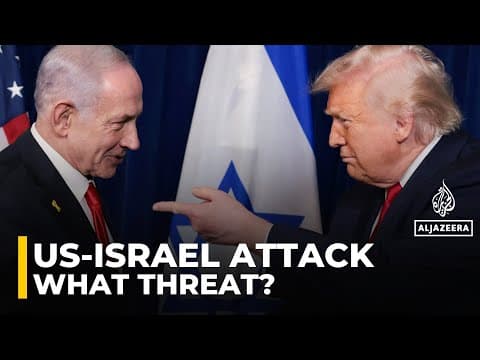
[0:01]Joining us from Doha is Marwan Bishara, Al Jazeera's senior political analyst. Marwan, good to have you back. Last hour we discussed the Gulf, the regional side of this, when I say the regional, I mean the Middle East. You're also an expert on US foreign policy, and you have tracked very carefully what different presidents and administrations have done, especially in the Middle East, especially with these foreign wars. So I'd like your assessment on day four of why this war was launched in the first place. We were just discussing with our previous guest that the, you know, the shifting narrative, the shifting stories between Marco Rubio and then Donald Trump and various figures within the administration of why they started this. And that is the story. That is the story. It's the fact that they're making stuff up. As they go along. They haven't yet agreed on one narrative as to why they are launching one of the most consequential wars of this administration, of this decade. Perhaps since the beginning of the century, this could prove to be worse than the war on Iraq, and they still cannot reach a consensus amongst themselves as to why and when and how. And why is that? I mean, that's why I'm saying this is the story in the sense that it's not it's it's it's not normal, right? And and and and the problem lies not so much of of miscommunication is the fact that they are manufacturing the reason for this war. And as they manufacture it, since there is not one absolute truth about why, it tends to be interpreted in different ways, since they are in different places, coming coming at it from different points of views. And the most controversial aspect of it is the one that the journalist just interrogated, basically Rubio on, which is the role of Israel. Which I which I think is is quite important. As your previous guest said, it's not necessarily the most, it's not necessarily the driver. But it's certainly one of the two most important reasons behind the war. In a sense that, as Rubio said, the timing had everything to do with Israel. Israel wanted to launch the war as soon as it seemed that there was progress in the negotiations. It wasn't because there was a breakdown in the negotiations in Geneva. It was because there was a breakthrough in the negotiations in Geneva, Israel decided to bomb Iran and the United States joined in. Marwan, I listened to you and I'm I'm reminding myself of of notes that I had made a couple days ago since this war started that Israel has attacked three times during negotiations and twice Iran, right? Once they attacked Qatar here in Doha as Qatar was actively mediating between the US, Israel and Hamas, and Israel attacked. And twice they attacked Iran during active negotiations, and I would remind our viewers that the Omani foreign minister said, just a few days ago after the last round of of um between the US and, uh, between the US and Iran, he said, actually, there were making a lot of progress and Iran is presenting a pathway that would never ever have a nuclear bomb. And I think it was the very next day that the US attacked. So what I'm saying to you, Marwan, and I'm curious for your opinion on this, is it looks, if you're attacking active negotiations that could lead to a deal, not once, not twice, but three times, that starts to begin looking like a pattern. Exactly, and the pattern, as I said, is the story. It's the confusion about manufacturing the case for war and the pattern of continuously undermining any potential for peace by launching a war. One of may I add another that for me was a very major, uh, you know, proof of that pattern is when they attacked Iran to kill Ismail Haniyeh, the Hamas leader, right at the inauguration of what could have been and could still be one of the most moderate Iranian elected presidents, which is the present president today. It was then that Israel decided to bomb Iran because they did not want a guy who showed up at the United Nations, right after his elections to say, that we are ready to talk about everything including the nuclear weapon, that we are ready for opening, that Israel that that Iran does not want to be isolated, that Iran wants to open and join the international community, that it's ready to get involved with the United States in talks. That's when Israel attacked Iran. And that's that's really the difference between the position of a small but powerful country in the Middle East called Israel, that continuously is insecure about its existence, about its illegality, about its raison d'être, if you will, in the region. And and and the United States, which is the world empire, which is the most important, the most powerful country in the world today. They don't have the same perception of security, they don't have the same perception of insecurity, they don't have the same perception of threat, and certainly they don't have the same understanding of Iran. For the United States, the idea that what was presented in Geneva, not only resolves all the issues about the nuclear issue, but also apparently proposed to the United States three to $500 billion of investment in Iran's energy infrastructure. For Trump, that's a major breakthrough, that's more important than Israel. For Israel, this is the alarm bell that this could lead to reconciliation, normalization, relationship between the United States and Washington, what's so called, you know, the great deal between Iran and the United States.
[6:23]That in Israel rings alarm bells, and hence Israel had to act to undermine any potential agreement, whether nuclear, economic, or otherwise between Iran and the United States. Marwan Bishara, Al Jazeera's senior political analyst. Thank you very much, as ever, Marwan. Don't miss out, get the full picture, subscribe to Al Jazeera for reliable news, expert insight, like, share, stay ahead.


