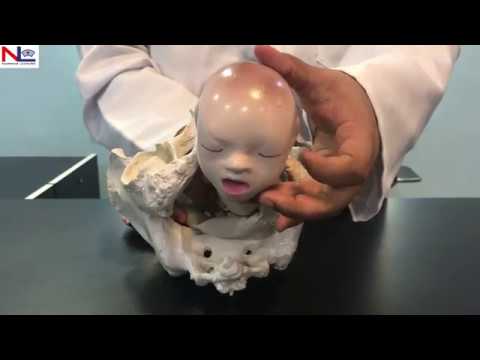
[0:06]Hello everyone. Here in this lecture, I'm going to deal about one important practical based topic that is normal mechanism of labor. Before I start, let's know what is the mechanism. So mechanism is a series of movement that occur on the fetal head in the process of adaptation during its journey through the pelvis. So there are various changes occurs on the fetal head so that it can easily pass through this bony pelvis and come into the outer world. Before I start with the cardinal movement, just have a look on the condition under which the fetus lies. So there are the various parameters and the first one is the lie. And the lie is the relationship between the long axis of the fetus with the long axis of the maternal spine. So here the long axis of the fetus is parallel to the long axis of maternal spine. So the lie is longitudinal. Next comes the presentation, and the presentation is the part of the fetal body which occupies the lower pole of the uterus. And here the lower part is the fetal head, so the presentation is cephalic. In cephalic presentation, there are the three presenting part which occupies the internal nose, and these are the vertex, the pro-presenting part, and the face. So the commonest presenting part is the vertex. Next comes the attitude, and the attitude is the relationship between the body part of the fetus, and here the joints are flexed together, so the attitude is complete flexion. Next parameter is denominator, or denominator is the bony fixed point on the presentation which come in relation with the maternal pelvis. So here in the vertex, the denominator is the occiput. And the last comes the position, and this denominator, or the bony fixed point, come in relation with the eight position on the maternal pelvis. And the commonest position is LOA, that is left occiput anterior. And the another one is ROA, that is right occiput anterior. So this denominators form the eight position on the maternal pelvis, and the commonest one is LOA, on which I am going to deal about the normal mechanism of labor. There are the basic principle through which the basic cardinal movements takes place, and the first one is descent. And the descent is a continuous process, and it starts with the first stage of labor, and it ends with the delivery of the baby. So the descent is a continuous phenomena which takes place throughout the labor, and the second principle is whichever part lead or meet the pelvic floor, will resist and rotate until it comes behind the symphysis pubis. And this resistance is offered by the pelvic floor muscles. So it this resistance help in the rotation of fetal head. So these are the basic two principle which takes place throughout the cardinal movements. Okay, let's start with the cardinal movements, and these are the nine. And the first cardinal movement is engagement. And the available engaging diameter in the pelvic brim is the widest diameter, and this is the transverse diameter. It extends from the two farthest point of iliopectineal line, and it is about 13 cm. And this transverse diameter is parallel with the sagittal suture. And this is termed as synclitism. But the most common position is LOA, that is left occipital anterior. In which the occiput is the leading part which comes in relation with the iliopectineal eminence, and the shoulders are aligned on the oblique diameter of the pelvic brim, that is left side, left oblique diameter. And the engaging diameter of the anterior posterior diameter of the head is suboccipital frontal, which is about 10 cm. In primigravida mothers, the engagement takes place one to two weeks prior to the labor, but in multigravid, it takes place at the onset of labor, or you can say with the rupture of membrane. Then the second step is the descent. And the descent is the continuous phenomena which takes place throughout the labor, and this descent occurs because there is strong uterine contraction with the retraction of uterine muscle fibers. And additionally, there is a bearing down efforts by the mothers. So with all these things, there is a descent of fetal body part. The third cardinal movement is flexion. With the increased uterine contraction and the resistance offered by the pelvic floor muscle, there is a flexion. And the fetal head comes in contact with the chest, and the presenting diameter is now is suboccipital pragmatic, and it is about 9.5 cm. So there is a flexion in third step. To see the further cardinal movements, I'm just letting the pelvis in lying down position. And after the flexion, there is the internal rotation of head. And the head rotate 1/8 of the circle, or you can say 45-degree angle, and comes behind the symphysis pubis. But there is a torsion or there is a twist in the neck which sustains for a while. The internal rotation of head takes place because the pelvic floor muscles are hammock shaped, which offers the downward movement of the head. And after the internal rotation of head, there is the crowning in which the widest diameter in the transverse, the biparietal diameter, that is about 9.5 cm, stretches the vulvar outlet. And as the contraction passes over, the head doesn't recede back into the uterine cavity. So this is the crowning. Next comes the extension of head in which the vertex, then comes the brow and the face. And later on the chin are born by the movement of extension. And after extension, there is a restitution in which there was a torsion of neck that was occurred at the time of internal rotation of head, was released over here. And there is no torsion remained backside. Next comes the internal rotation of shoulder, which was lying on the oblique diameter of the brim, is come behind the symphysis pubis. And it is externally visible by the external rotation of head. And the last cardinal movement is lateral flexion, in which the anterior shoulder sweep the subpubic arch, and the posterior shoulder escape the perineum, and the rest of the body is born by the movement of lateral flexion. So let's have a look on these all cardinal movements, and the cardinal movements are the engagement, descent, then comes flexion, internal rotation of head, then comes the crowning, after that the extension of head, restitution, internal rotation of shoulder with external rotation of head, and the last one is the lateral flexion. So in this video, you have seen the practical based topic that is normal mechanism of labor. And for more practical based video as well as 3D animated video, you can subscribe or like our channel, as well as like our Facebook page. And for more lectures, you can visit our official site. The link is given at the end of this video. Thank you.
9m 13s1,165 words~6 min read
YouTube auto captions
Transcript source
YouTube auto captions
This transcript was extracted from YouTube's auto-generated caption track. The transcript below is server-rendered so it can be read, searched, cited, and shared without opening the original YouTube player.
Pull quotes
[0:06]Here in this lecture, I'm going to deal about one important practical based topic that is normal mechanism of labor.
[0:06]So mechanism is a series of movement that occur on the fetal head in the process of adaptation during its journey through the pelvis.
[0:06]So there are various changes occurs on the fetal head so that it can easily pass through this bony pelvis and come into the outer world.
[0:06]Before I start with the cardinal movement, just have a look on the condition under which the fetus lies.
Use this transcript
Related transcript hubs
Watch on YouTube
Share
MORE TRANSCRIPTS


