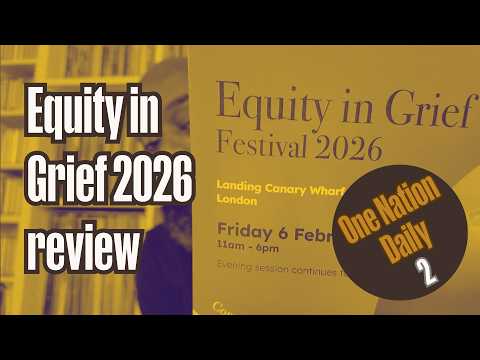
[0:02]Greetings and welcome. I trust you are well. Welcome to day two of this installment of New Videos One Nation Daily. My name is Maurice. Some of you will know me as Croc or DJ Croc, but we're going to keep it Maurice in this space. Um, so, yeah, day two. Welcome back. If you're new here, this is the second video of a 30-day challenge for me to show up every day for 30 days here on YouTube talking about a different topic. If you want to get more context into why I'm doing this and how this came about and all of that stuff, then just check the video before, just check day one's video entitled Heads Up. And I explain all of that there. For today's video, today's video is going to be a review video. Now, some of you might be aware that I've started to do review videos. Um, generally, the reviews are around music shows and live performances. Those are the reviews that those are the reviews that I've done so far. Or album reviews. This review is going to be a bit different because this review is about a conference that I attended recently earlier on this month. The conference was this one. It was called Equity in Grief. I'm not sure if you can see there. It was called Equity in Grief. And it took place at the Landing Canary Wharf in London on Friday the 6th of Feb. And this conference was really about, uh, I guess, it was really about the experience or black people's experience primarily, experience of grief. And I went to this or when I saw this, I was interested in getting to this for two main reasons. One, because I work a lot within the funeral industry by doing live streams of funerals, providing sound systems, music for funerals. So I do a lot of work within the industry. And so I partly wanted to go there to to network with other professionals who also work within the industry and see what I could learn and make new connections and things of that nature. See what I could learn from it. Uh, I was also very curious about it. I didn't really know what to expect. So, I really went there with a mindset of just going to look, listen, and learn. I was very curious.
[3:07]So that was really the mindset, go to look, listen, and and learn and maybe network. The second reason I went to this conference was because of my own personal experience or experiences of grief and bereavement. Some of you may know, some of you who are new to this or new to me might not be aware that I've had a long list of, um, bereavements and some quite horrific experiences of grief and bereavement that I will probably speak about more in a later video. But I went also for personal reasons, is the point I'm trying to make. So I went for professional reasons because I work within the funeral industry, but I also went for personal reasons as well to see what this conference could, I guess, maybe do for me or what I could learn from it on a personal note in connection with my own experiences of of grief and bereavement. So, my thinking was was twofold in getting to this conference and wanting to check this check this out and really see what this was about. I've never seen anything like this before. I've never seen a conference like this before that was that is primarily about grief and bereavement, particularly not from the experiential perspective of of black people. So I was very curious about this conference. So that's why I went. What to say? Let's start with what I felt was good. Normally, this is where I start with my my reviews. I normally start with what was good and then move on to what was not so good, so let's let's do that. Let's start with what was good. So, what was good, I felt, was, first of all, the fact that this conference even happened because, as I said already, I've never seen anything like this before. I've never, yeah, witnessed anything like this before. I should also mention that the conference was organized primarily by Patrick Vernon OBE, uh, Dr. Yancy Rolston and also Debbie Lewison who I'll probably mention later on as well in this video because I I know Debbie quite well and I've worked with her within the funeral industry and I know her on a personal level as as well. Also connected to grieving, grief and bereavement. So they were the main organizers of the event. So what was good? It happened, basically. Was the first thing. I've never seen anything like this before and from my experience within the professional side of the funeral industry and the grief and bereavement industry and also from a personal perspective of my own experiences and and people around me, I know that more conversations needs to be had particularly within the black community about grief and bereavement. I can't really speak to other communities because I'm not a member of of those communities. So I don't know what the culture specifics are within other communities. I can only speak to to what I know, which is which is my own. So I know that there are more conversations that need to be had about death and bereavement and grieving. I know that as a community, these conversations tend to be shied away from, and I know that, again, from experience and being in support spaces as someone who's seeking support and also as someone who's been a co-facilitator in supportive spaces for people who are going through grief or bereavement that a lot of the trauma, pain, anguish, comes from these conversations not being had.
[7:30]So, for example, funeral arrangements is a popular area where discords happen amongst families. And a lot of that is because conversations that needed to be had or should have been had have not been had.
[8:04]In terms of accessing support services or getting support for ourselves around death and bereavement, there's a whole issue with that about whether or not there are enough support services that cater to our experience and cultural understanding or experience of death and bereavement, whether those services are accessible or how accessible those services are to us. And so there's there's that aspect as as well why more of these conversations needs to be had.
[8:44]A lot of people I hear a lot of people talking about men need to speak more about these things, men need to open up more, men need to talk more, and while I think there is an element of truth in that, I believe that generally men are doing a lot better at speaking about these things, particularly since the lockdown in 2020. I feel that one of the few positive things that has come out of that is men have come out of that period being more in touch with ourselves and our thoughts, feelings, and emotions and have got better at sharing all of that with each other. So I think that is already beginning to happen amongst men, but generally speaking, these conversations tend to be shied away from and they need to happen more. So it was good that this conference was happening. I believe this was the first one of its kind.
[9:53]I hope it won't be the last. What else was good? The venue. The venue was beautiful, as I said, it was it was it? Landing Canary Wharf. The venue was beautiful. From I got in there, it was just really, really nice. The staff were really friendly and everything was was was wonderful. It was a really nice venue. Really, really, really nice venue. I think they they did very well getting that venue as a a good shout getting that venue. So, the venue was beautiful, staff were wonderful. It was lovely. Another thing that I felt was good was they had, um, a number of stalls around in the main room. They were mainly book stalls, but they also had, um, a massage stall as well, where you could go and lie down and get your your shoulders and your neck and your back massaged, which was quite cool. I didn't experience that. I did want to, but I was more wanting to listen to the speakers and taking the conversations that were being had. Although the the massage thing looked very inviting. But it was good that they had that. So, they had a number of stalls around the place, which was good. I felt as well. And because it was in the main room where everyone was, it was instantly accessible. You didn't have to go to another space or another room to find the stalls or access to stalls. It was right there in the same main room where we were making those stalls more accessible. Although sometimes the conversations from the stalls was a bit intrusive to what was happening on the main stage, but generally it was good to have the stalls dotted around the room as well, which I thought was also very good. The food was also good. Got to talk about the food. The food was good. The main reason I say that is because they had a good number of vegan options there. Now, I'm not a vegan, I'm not even a vegetarian, but my diet is predominantly plant-based. I don't do dairy, I don't do much sugar, it's pretty much plant-based diet that I have.
[12:39]So I was very happy to see the the vegan options on the menu, and the food was nice. It was presented well, it was served great, it was it was wonderful. So the food was a was a was a plus as well. Definitely, um, because of the the the vegan options, but it was nice, it was good. What else? The speakers. They had some really good speakers at this event throughout the day. Some of them, uh, Patrick Vernon OBE was there, and he spoke a little bit towards the end. Marcia Rigg was there as one of the panelists. Marcia has been campaigning for years, for I think over 20 years now, for justice for the death of her brother, Sean Rigg, who was killed by the Metropolitan Police at Brixton Police Station. She was there speaking about her experience of fighting for justice for Shaun. Always very powerful listening to Marcia speak, but it was wonderful to to hear her there speaking and hear her insights into her experience. Reverend Cassius Francis was there, who's a good friend of mine. We actually studied together at university. It was wonderful to to have him there and see him there as one of the panelists giving his insight. There was a funeral director there, who's name I forget. It's probably in the in the brochure, but the funeral director's perspective was, I found, was very, very good. I'll probably speak a little bit more on that later. There was some there was a youth worker there. Someone who worked predominantly with with young men, boys and young men, and there were some other academics there. There was people who worked in the health industry. I think the public health industry. So there were a number of of panelists who all brought really insightful perspectives to the conference. I thought that was good, and the panel leaders who was Debbie and also uh, Dr. Yancy Rolston. They posed some really insightful questions. I think insightful is the word I'm looking for.
[15:03]Questions to the panelists, and got some really good responses from them as well, and there was space for the the people who were there attending to ask questions to the panelists as well. So, I thought that the choice of panelists was was quite good. The questions posed to them and the answers that they gave was quite good, and the conversations that came out of that was quite good as well. So, the speakers and the panels generally very, very good. I think they did well with that. The sound. This goes kind of more goes back to the venue. Sound and the technicals with the sound was also pretty good. You know, I'm quite those of you who know me know that I'm the soundman in me is is very particular when it comes to sound quality. That's one of the things I'm always looking out for at events and I'm always going to score I always give scores or I always mention the sound quality, whether it's live events or whatever kind of music review I'm doing, I always talk about sound quality, and the sound quality and the technicals at this event was good as well. I saw some of the the the technicians walking around with their iPads making adjustments to the sounds and the microphones as the day went on, as they needed to, and that's what I do with with my sound and my stuff as well. I've posted a video recently showing how I do that, so it was good to see that level of technical proficiency there with the sound. So, sound was good and the technicals were good as well. So, overall, I thought these all of these areas were were were pluses, were positives for the conference. I should also mention, as I mentioned the stalls, there is this book, I should mention this book, Black Grief and Healing, which is also by Patrick Vernon and Dr. Yancy Rolston. Why We Need to Talk About Health Inequality, Trauma, and Loss. Very good book. If you want to get that, I'd recommend you do. And chapter six, uh, the first part of chapter six, which is written by Stuart Taylor in this book, begins with an insight into my parents' story, if you're interested. But anyway, yeah, Black Grief and Healing, a number of different authors in this book, giving different perspectives about the black experience of grief, bereavement, trauma, and loss. And I was also gifted this book at the conference as well, which is called A Woman's Choice: Navigating Early Menopause. And that one is by Natalie Campbell. So I was gifted that at the conference as well. So, yeah, I just think I should I should mention those. What was not so good? What did I find was not so good about this conference? There were three things mainly that I felt weren't so good. Number one was that I felt like the experience, the unique experience of men when it comes to loss, grieving, trauma, bereavement, was largely omitted from this conference, which was largely missing from this conference. Now, even though there were men in attendance and there were men panelists, there were men on the panels. None of them spoke from the perspective of the unique male experience or their experience as men. They spoke as either the professionals in their field or they spoke from other perspectives, more generic, but it wasn't as as men.
[19:00]So there are things that are, I guess, more particular to our experience as men that I feel need a particular level of or or lane of attention, if these conversations are going to be had.
[19:21]For example, I mentioned earlier on that people often talk about the fact that men need to speak more or men should speak up more. Well, for that to happen, you first need to get into an under or overstand the reasons why men don't speak up or men don't speak up as much as a lot of people say that we should. And normally it's women saying that we don't speak up enough. Men need to speak more, but the point is, you first have to have an under or overstanding of the reasons why men don't speak up as much as they perhaps should do before we can get to the point of doing that. You know. And so looking at some of the reasons and and getting to the the the root of what are some of the reasons why men don't speak is one of the things that was missing. Why perhaps men don't access support services enough was missing. Um, just the differences in the experiences of loss and bereavement, for example. I remember I was I was reminded at one point when I was at this conference of when my brother passed. I was 15 at the time. He was 27.
[20:49]And this was my first real experience of of death and bereavement. My grandma passed some few years earlier, but I was really quite really young, too young to really remember much about that experience. The main thing I remember is about her being brought into the house and her body being on display in in the front room. I don't really remember much more about it than that because I was too young, but my brother's death, I was 15. I was I think in my last year at secondary school, and I remember that one vividly, vividly, very, very well. That was my first real experience of death and bereavement.
[21:32]And I remember the house being full, packed up with people for two weeks straight, every day for two weeks. The house was full with people coming to pay their respects to my parents or to to my brother, if you like. And people really I remember that people really rallied more around my mum than they did around my dad. And while I get the I get that the experience of a mother losing their child is different from a father losing their child because the woman has has the experience of that child growing within inside her and giving birth to that child. The man doesn't have that. So I get that that's one area in which the experience is very different. However, my brother's passing was not just my mom's loss. It was my dad's loss. It was also my loss, my brother's loss. But in terms of my parents, it wasn't just my mom that lost her son, it was my dad, who also lost his son, but people didn't rally to him in the same way that they did to my mom. And that's one of those ways in which, you know, the experience is different for a man than for a woman. And so these kinds of experiences, these kinds of nuances, I felt was missing from this conference. And I could go on and give other examples, not just from my own experience, but also from being a facilitator. My experience of being a facilitator in or a co-facilitator, I should say, sorry, in support spaces for men around grief and bereavement. There's a men's group that still runs that meets for I think it's fortnightly. They still meet that is specifically for black men around grief and bereavement, and I used to be a co-facilitator in this space. As well as being a member of another group, which I'll probably speak on later, the Lost Cafe. So, anyway, the point is, the those unique experiences of men, I felt, was was missing, and there was no one that was really speaking, there was no one that was speaking specifically from the experience of men about grief, trauma, and loss and the things that are specific to us and our experience as men. So that was a disappointment for me. That was a big disappointment for me. Another thing that I felt that was not good is that the very first session that I went into in the morning. I felt there was this, um, how should I put? I'm trying not to say anti-men, but I can't think of a a better description. There was a an atmosphere or a rhetoric that was very much against men. It was almost anti-men, and there was a lot of the women speaking was a lot of the women speaking spoke from a a perspective of victimhood, and of men being the enemy. And I'll give an example. Within, I don't know, within maybe about half an hour of me sitting down in the main room, one of the panelists was invited, I think, to introduce herself. And one of the first things, maybe even the first thing, she said was, "I don't know why men hate women. I don't know why men hate women. I don't understand why men hate women."
[25:46]Now, instantly I'm I'm like this. I'm looking around and I'm confused and my back is kind of up a little bit here now because I wasn't aware that I hate women. I wasn't aware that the majority of the male species hate women. I wasn't aware that this was a thing. This is not a thing to to my knowledge and experience of myself or the men that I've grown up with or the men that I associate with. Now, that is not my experience that men hate women. All men or generally most men hate women. That's not my experience at all, at all, at all, at all. I really didn't.
[27:07]The other thing that I felt was not so good, and this isn't so much of a criticism of the event, I felt that there wasn't enough time to really delve into some of the topics.
[27:30]So this was a one-day conference, and as I said, the main session in the morning overran because there was there was so much to talk about.
[27:44]And so we got into the afternoon session and after lunch late, and we finished the the later session later on in the afternoon. We didn't really get to the end of what we wanted to talk about then either. So, I felt like, although it was really good to have a whole day with this conference, I felt like it needed two days. So, if they do this again, and I really hope that they do, I hope that it will run over two days instead of trying to cram all of this into one.
[28:18]So that was it. That's what I felt wasn't so good. So that's my take on this conference, Equity and Grief Festival, it was called Equity and Grief Festival 2026. Uh, overall, I give the festival/conference 8 out of 10. I generally thought it was it was good, and, like I said before, it was great that it happened. It was great that a space had been created to to have these conversations, not just with members of the community, but also with all of these scholars and historians and and professionals and people who can give all these wonderful insights into this area. I thought it was really good that they did this. And I I sincerely, like I said, I said that I sincerely hope they do it again, and hopefully it will go over two days. But I hope if they do it again, or when they do it again, the experience of men will be much more considered. The unique experience of men will be much more considered and there will be less of this anti-men victimhood rhetoric from the women because women don't own grieving. Grieving and trauma and loss is not exclusive to women. We experience all of that, too. We also experience grieving and loss and trauma for my own perspective.
[30:09]And that's my review. Uh, I'm going to wrap this up. I didn't even think I'd speak for this long, but let me just wrap this up by saying that, although this is day two of this process, I'm already starting to learn some of the benefits of doing this. Yesterday's video, I talked about the things that Glo had said, who got me onto this, about some of the things that she'd learned from doing this and how she found that the process of speaking about these things had given her more clarity on those topics just by the process of doing this, and I'm already starting to feel the same. I feel that the process of me thinking about what I was going to speak on today, and the process of even just doing this has given me a greater clarity on my own perspective on that conference and that festival. So I'm already starting to see some of the benefits that Glo talked about in doing this daily video. I feel much clearer in my head about what this conference and festival was, why I went there, what I was looking to get from it, what was good, what was not so good, what I'm looking for in the in the future, if they do it again, just by the process of thinking about what I want to speak about here today and talking openly about it. So I'm looking forward to going ahead with this, and hopefully, getting more clarity on all the different subjects that I'm going to be speaking about for the rest of this 30-day challenge. I'm going to leave it there for now, and, um, yeah, I hope you've got something from this. Oh, one other thing that I want to share is the funeral director who spoke at the conference. I'll I'm going to try and find his name real quick. Oh, I don't have the guy's name. Anyway, there was a funeral director that spoke there. And one of the key things that he said, one of the key takeaways I took from this, which I'm going to relay to you. I've kind of mentioned a little bit already, is he talked about people having these conversations about funerals and what they want to happen for them because this is going to obviously come to to all of us. And he really urged people to have these conversations beforehand because he said if you don't make the decisions about what you want when you pass, other people are going to make those decisions for you, and they may not be what you want. But if you don't tell people and make it clear what you want, then other people will make those decisions for you, and as I said before, this is one of the main areas where I I see and hear that discord happens amongst families is arguments or for or disagreements about what different people believe should and shouldn't happen in the midst of someone's passing, particularly when it comes to funeral arrangements. So I'm urging people to talk to people, talk to your loved ones or your nearest and dearest about what you would like for your funeral or for your final journey, and let it be known now, otherwise, other people, as I said, will make those decisions for you.
[33:45]And as I said before, this is one of the main areas where I I see and hear that discord happens amongst families, is arguments or for or disagreements about what different people believe should and shouldn't happen in the midst of someone's passing, particularly when it comes to funeral arrangements. I'm really grateful that I started to have these conversations with my dad before he passed. I asked him what he would like. I asked him if he would want to be want a burial or a cremation, whether he'd want to be here or be to fly him home to Jamaica. I asked him, we had this conversation. So, when he passed in 2020, I already had a good idea of what he wanted. And I've also begun having these conversations with my eldest son. He started talking to me about what I would like if I became really ill, lost capacity or if, you know, when that time comes when I pass. He started asking me, "Dad, what would you want?" And so he's already becoming clear as well about what I want should I become ill, lose capacity or or pass as well. So, just passing that on, it was a very powerful statement that that funeral director, a very powerful message that that funeral director shared with us and it really resonated with me, so I share it with all of you, and urge you all to have a conversation with your loved ones and do it now because tomorrow is promised to none of us. And as someone who has gone through lots of bereavement and who also works within the funeral industry, I am constantly reminded about the unpredictability and fragility of life. Tomorrow really is not promised to any of us. So have the conversation with someone now, do it today, if you can.
[35:46]Just get your wishes out there and let them be known to someone, one of your nearest and dearest. That is it. I will be back tomorrow with another video. I hope you've taken something away from this one, and, uh, I'll see you tomorrow for day three. Peace.


