[0:00]Dear students, now we are going to discuss bridge rectifier in detail and derive its characteristics. Let's start with the definition of bridge rectifier. It is a full-wave rectifier which is using four diodes to form a bridge circuit. These four diodes are mainly used to eliminate the use of center-tapped transformer in full-wave rectifier. That means in bridge rectifier, no center-tapped transformer is used. It is a full-wave rectifier. That means it can conduct during both the positive and negative half cycles of the AC input signal. So we can get the full-wave rectified output signal in this bridge rectifier. Do you all understand the concept? The next one is circuit diagram and waveforms. So this is the circuit diagram of bridge rectifier. Diodes D1, D2, D3 and D4 form a bridge circuit, this is a bridge circuit. The AC input signal is given to the primary winding of this transformer. Okay? Then the input AC signal applied to the diagonally opposite ends of this bridge circuit, and the load resistance RL is connected between the other two diagonal ends of this bridge circuit. Okay? So by this bridge circuit, we can get the full-wave rectified output signal, because during the positive input signal, D1 and D3 are forward biased. Then we can get the output signal across this RL. During negative half cycle, here D2 and D4 both are forward biased, at that time we can get the output across this RL. Do you all understand this concept? So here it is the input AC signal, we can get the rectified output signal for the full cycles, okay? That's what given here. The input AC signal is applied to the diagonally opposite ends of the bridge. Load is connected between the other two ends of the bridge circuit. Next, the operation of bridge rectifier. So first we can consider the positive half cycle of the AC input signal. So during the positive half cycle of the AC input signal, here in the secondary, we can get the same polarities. At that time, D1 and D3 are forward biased, and here D2 and D4 are reverse biased. Reverse biased means both are in off condition. Then there is a current flow through this D1 and D3 in the same direction. Then we can get the output across this load resistance. Do you all understand this one? So during the positive half cycle, D1 and D3 conduct the current, and both are connected in series with the load resistance. Then the load current flows through the RL. So next one is during negative half cycle, then the diodes D2 and D4 are forward biased. So if you are giving that negative half cycle, what will happen? Here the polarity is also changed. Here it is negative, here it is positive, then D2 and D4 are forward biased, D1 and D3 are reverse biased. Then there is a current conduction through this D2 and D4. Then we can get the output across this load resistance in the same direction.
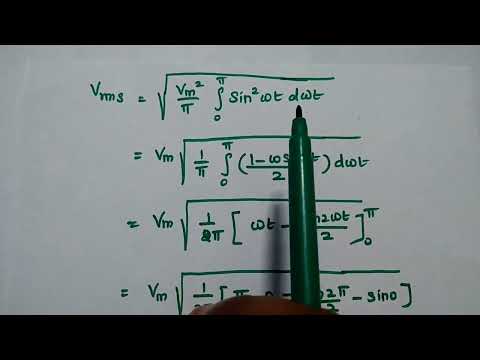
[3:41]We can get the output for this negative half cycle also. So that is called as fully rectified output signal. Do you all understand this one? Next, we are going to derive the important characteristics of bridge rectifier, efficiency, ripple factor, peak inverse voltage, transformer utilization factor. So let's start with this average or DC values of voltage and current. Here average is also known as DC value, okay? So DC voltage can be obtained by taking the integration of output voltage with respect to omega t, from the range 0 to pi, that is divided by the total time period. So here, we can get the output signal like this. This is full-wave rectified output signal. So one complete cycle is this one, the same signal is repeated again and again. So we can consider this part alone. So we can mention the output voltage is equal to what? Vm sin omega t, the range from 0 to pi. Here Vm is nothing but maximum voltage. Similarly, we can get the output current I0 or IL that is equal to Im sin omega t. So in this one, we are going to substitute this V0 value as Vm sin omega t. The total time period is pi. That's why we are dividing this value by pi. Do you all understand this one? Then we can substitute that V0 value here. It is Vdc, okay? DC voltage is equal to 1 by pi, integration from 0 to pi, V0 is replaced with Vm sin omega t d omega t. We can take this Vm from this integration, since it is independent of omega t, okay? Then Vm by pi, integration of sin is -cos, okay? So -cos omega t, the range from 0 to pi. Then we can substitute that limits here, Vm by pi, upper limit is pi, -cos pi - (-cos 0). So cos pi value is what? -1, cos 0 value is +1, okay? Then we can get - * - +1, here it is - * - +1. That is 2, okay? And the DC voltage is equal to what now? 2 Vm by pi. Similarly, we can get the DC current is equal to 2 Im by pi. So next one is RMS values of voltage and current. So RMS means what? Root mean square value. So here we have to take the root mean of that square of the output signal. That is square root of 1 by pi integration of V0^2 d omega t. So here V0 value is what? V0 is equal to Vm sin omega t, correct? So we can substitute those values here. In the next step, we can take this Vm^2 from this integration. Then we can write square root of Vm^2 by pi integration of sin^2 omega t d omega t. For further simplification, we can take this Vm^2 out of this square root. Then it becomes Vm, square root of 1 by pi, integration of sin^2 omega t. That is sin^2 theta is equal to what? 1 - cos 2 theta divided by 2. That is the formula. So we are going to replace the sin^2 omega t as 1 - cos 2 omega t by 2 d omega t. Okay? So this 2 is common one, we can take it outside. Then we can write Vm square root of 1 by 2 pi and then integrate this value 1 as omega t - integration of cos is sin omega t, correct? So cos 2 omega t means sin 2 omega t by 2. Here the limit is 0 to pi. So we have to substitute the upper limit first. So here omega t is replaced with that upper limit pi - 0 - of sin 2 omega t is pi, okay? Sin 2 pi by 2 - of - sin 0 by 2. So whatever it may be, here sin 2 pi is 0, sin 0 is also 0. Okay? Then we can get the value 1 by 2 pi * pi. Then we can simplify this value. We can get the answer as Vrms is equal to Vm by square root 2, Irms is equal to Im by square root 2. Do you all understand this concept? So these values are very, very important one to find out the efficiency and ripple factor, okay? So next we are going to find out the efficiency. It is defined as the ratio of DC output power to AC input power. So first we are going to find out the DC output power. That is equal to Vdc * Idc. That is also equal to Vdc * Idc is replaced with the value Vdc by RL. That is equal to Vdc^2 by RL. As we have already obtained the value of this Vdc, we can substitute that value here. Vdc is equal to 2Vm by pi, correct? Then we can get the DC output power is equal to 4Vm^2 by pi^2 RL. Similarly, we can get AC input power is equal to Vrms * Irms. Then Irms is nothing but Vrms by RL. We can get Vrms^2 by RL. Vrms value is what? Vm by square root 2, okay? Then we can get Vm^2 by 2 RL. That is the AC input power. Substitute both the values here in this efficiency formula. Then we can simplify all the terms here. We can get the value as, here 2 goes to this numerator. 4 * 2 = 8 by pi^2. In general, the efficiency is expressed in terms of percentage. So we have to multiply with this 100, okay? We can get the efficiency is equal to 81.2%. So this value is higher than half-wave rectifier. Do you all understand this one? So next we are going to find out the ripple factor. Ripple is an unwanted AC component present in the DC output. Ripple factor is defined as the ratio of RMS value of AC component to the DC component. So here it is represented as Vr,rms, it is not that Vrms, okay? So this is the AC content present in the output side. It is not purely AC input signal, okay? So we can get this RMS value of AC component in the output is square root of Vrms^2 - Vdc^2. Do you all understand this one? Divided by Vdc. For further simplification, we can take this Vdc outside from this square root. Then we can get Vdc * square root of Vrms by Vdc the whole square - 1 divided by Vdc. Then we can divide these two values. After that, we can substitute the Vrms value and Vdc value in this expression. Vrms is Vm by square root 2, Vdc is 2Vm by pi. Then we can square both the terms and simplify it. We can simplify all the terms here. Here it is Vm^2, okay? So here we can cancel this value and simplify this, okay? Then we can get square root of pi^2 by 8 - 1. That value is 0.482. So this is the ripple factor in bridge rectifier. So in terms of percentage, we can say 48.2% of AC component present in the DC output. This value is lower than the half-wave rectifier, okay? So next one is transformer utilization factor, simply denoted as TUF. So it can be defined as the ratio of DC power delivered to the load to AC rated power of transformer secondary. So here we can simply substitute that AC power and DC power in this expression. Then we can get the answer as 0.812 in terms of percentage 81.2%. We can say 81.2% of transformer is effectively utilized in bridge rectifier. Hence this bridge rectifier is widely used in real-time applications, okay? The last one is peak inverse voltage. It is the maximum reverse voltage that a diode can withstand without destroying the junction. So here the peak inverse voltage for this bridge rectifier is Vm, okay? Next, advantages of bridge rectifier. In this bridge rectifier, no center-tapped transformer is used. It has very high efficiency, that is 81.2%, and the peak inverse voltage is only the maximum voltage, that is Vm. Okay? In normal full-wave rectifier with center-tapped transformer, the peak inverse voltage is 2Vm, okay? So next one is high transformer utilization factor is possible with this bridge rectifier. That means 81.2% of transformer is utilized properly. It can be used for high voltage applications, okay? So next, disadvantages. Here we are using four diodes, okay? So that is the major disadvantage of this bridge rectifier, but it has maximum advantages, okay? So next, applications of bridge rectifier. It is widely used in high voltage applications, power supply circuits, charger circuits, UPS, that is uninterruptible power supply circuits, inverters in home appliances to convert AC to DC, LED TV circuits, etcetera, okay?


