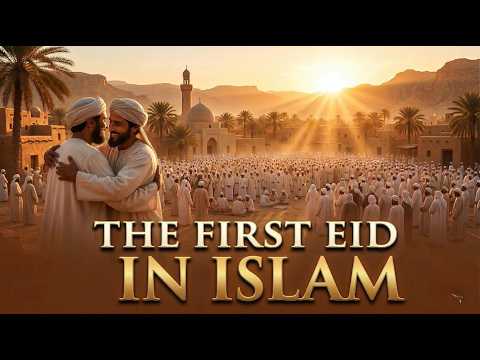
[0:00]Imagine for a moment that you are a refugee. You have been driven out of your home. You have been stripped of your wealth. You have been separated from your loved ones and forced to flee across a scorching unforgiving desert in the dead of night. For 13 agonizing years in the city of Makkah, you were hunted, you were boycotted. You were starved in a mountain pass until you had to eat the leaves of trees. You watched your friends being tortured on the burning desert sands, simply because they said Allah is one. You lived in a state of constant fear, looking over your shoulder, never knowing a single day of true peace, let alone a day of Celebration. Now you have finally arrived in a new city, the city of Yathrib soon to be known as Medina. You are safe, but you are a stranger. You have no money, you have no property. You are sleeping on the hard dirt floor in the courtyard of a mosque. You are what history calls the Muhajirun, the Emigrants. As you walk through the dusty streets of this new city, you see the local people celebrating.
[1:17]They are laughing, they are wearing colorful clothes. They are beating drums, dancing and holding massive feasts. You stop and ask them, what are these days you are celebrating? They tell you these are two days of festivals we used to celebrate in the days of ignorance, before Islam. We call them Naruz and Maharajan. They are days of play, amusement and partying. You stand there a poor, traumatized refugee watching them celebrate. You remember the trauma of Mecca. You remember the blood that was spilled. You remember the brothers and sisters you left behind in chains. You wonder in your heart, when will we have our day of joy? When will the believers, the ones who sacrificed everything for the sake of God, have a reason to celebrate? And then the messenger of Allah peace be upon him steps forward. He looks at the people of Medina. He looks at the refugees of Makkah, and he delivers a profound history altering declaration. He says, Allah has replaced these two days for you with two days that are far, far better. The day of Al Adha and the day of Al Fitrah. This was not just an announcement of a new holiday. This was the birth of an entirely new spiritual civilization. This is the incredible emotional and deeply inspiring story of the very first Eid ever celebrated in the history of Islam. A day of joy that was not born out of meaningless partying, but out of blood, sweat, tears, and the absolute greatest miracle the believers had ever witnessed. You are listening to Iman Aldin TV. Before we step back in time to uncover this beautiful piece of history, take a quick moment right now to send peace and blessings upon our beloved Prophet Muhammad, peace be upon him. And if stories like this touch your heart, please drop a like and subscribe to the channel so we can continue bringing the rich, powerful history of our Ummah to life. Now, let's begin to truly understand the overwhelming explosive emotion of the first Eid al Fitr. We must understand exactly when it happened. It was the second year after the Hijrah, the second year after the Muslims migrated to Madinah. This was a year of massive, earth shattering changes for the Muslim Ummah. For the first year and a half in Medina, the Muslims prayed facing Jerusalem. But in the second year, the Qibla, the direction of prayer was shifted to the Kaaba. In Makkah, the Ummah was taking its distinct shape. Then just a few weeks after that, in the month of Shaban, a new heavy revelation descended from the heavens. Oh you who have believed, decreed upon you is fasting as it was decreed upon those before you, that you may become righteous. For the very first time in human history, the Muslims were commanded to fast the entire month of Ramadan. We need to pause and imagine experiencing Ramadan for the very first time. They did not know what to expect. They did not have the traditions we have today. They did not have air conditioning to cool them down. They did not have massive luxurious buffets waiting for them at sunset. They were living in mud brick houses under the blistering unforgiving Arabian sun. Their suhoor, their pre-dawn meal might have been just two dry dates and a sip of warm water. Their iftar might have been the exact same thing. But their hearts were incredibly alive. They were tasting a spiritual sweetness, a closeness to the Creator that they had never known before. However, this first Ramadan was not going to be a quiet, peaceful month of worship in the mosque. Allah had a very different, terrifying plan. Right in the middle of this very first month of fasting, the ultimate trial descended upon the Muslims. Word reached Medina that a massive, heavily armed army from Makkah was marching toward them. The Quraysh, the very same people who had tortured them, stolen their homes, confiscated their wealth and murdered their families. They were coming with a thousand heavily armed warriors to wipe Islam off the face of the Earth forever. The Prophet peace be upon him gathered his companions. They were not an army. They were just 313 men. They had only two horses and 70 camels. They were taking turns riding the camels because they didn't have enough mounts. They were fasting, they were exhausted, they were poorly armed. Many of them only had sticks or broken swords. And they were marching out to face a military superpower. They met at the wells of Badr. It was the 17th of Ramadan. The believers were fighting for their very existence. If they lost this battle, the Prophet peace be upon him cried out to Allah in his tent. Islam would never be worshipped on Earth again. But Allah did not abandon them. He sent down thousands of angels from the heavens to fight alongside the believers. Against all human logic, against all military odds, the 313 starving, fasting refugees completely crushed the massive army of the Quraysh. Abu Jahl, the pharaoh of this Ummah, was killed. The most arrogant leaders of Makkah were struck down in the dirt. It was the greatest, most miraculous military victory in the history of the world. But victory came at a heavy, heart wrenching price. 14 of the Prophets, peace be upon him, beloved companions were martyred. They laid their lives down in the burning sand of Badr. Their blood watered the roots of the Islamic Empire. When the Muslim army returned to Medina, the atmosphere was incredibly complex and deeply emotional. They were physically exhausted, their bodies were battered, cut and bruised. They were grieving. Wives had lost their husbands, children had lost their fathers, and the Prophet peace be upon him had lost some of his most dedicated followers. But at the exact same time, they were experiencing a profound, indescribable joy. Allah had given them victory. The era of being weak, helpless victims in Makkah was officially over. They were now a real force. They had honor. They returned to Medina, and despite their exhaustion and their wounds, they continued to fast the remaining days of this historic Ramadan. And then the 29th day of Ramadan arrived. The sun began to set over the date palm Groves of Medina. The companions looked up at the Western horizon, and there, cutting through the purple twilight, was the thin, beautiful silver crescent of the new moon. The month of Shawwal had begun. The very first Ramadan in history was over. And a new command echoed through the city of Medina, a command from the Quran itself, revealed in Surah Al Baqarah. And that you must complete the number of days, and that you must magnify Allah for having guided you so that you may be grateful. Magnify Allah. Say Allahu Akbar. Suddenly a sound began to rise in the dirt streets of Medina. It started softly from one house, then another, then it grew louder and louder. Until it echoed off the mud brick walls and rang through the orchards. Allahu Akbar, Allahu Akbar. La ilaha illallah wallahu Akbar. Allahu Akbar walillahil hamd. God is the greatest, God is the greatest. There is no deity worthy of worship but God. God is greatest and to God belongs all praise. Imagine hearing that chant for the very first time in history. Imagine the raw emotion in the voice of Bilal ibn Rabah as he chanted it just a few years ago. Bilal was a slave, being crushed under a massive boulder in the burning sands of Makkah, whispering a had, a had, one, one, while his master beat him. Now he was a free man, a victorious warrior of Badr, walking through the streets of his own city, loudly declaring that Allah is greater than everything. Allah is greater than Abu Jahl. Allah is greater than the Quraysh. Allah is greater than our hunger. Allah is greater than our trauma. Allah is greater than the entire world. The entire night of the first Eid was filled with this majestic, thunderous Takbeer. The city was vibrating with an electric spiritual energy. But Islam is not a religion of empty chants. Islam is a religion of profound social justice. As the sun prepared to rise on the very first morning of Eid, the Prophet peace be upon him instituted a beautiful revolutionary concept. He looked at his community. He knew that there were still refugees in Medina who had absolutely nothing. There were orphans whose fathers had just been killed at Badr a week ago. There were widows who had no one to provide for them. There were people sleeping in the mosque with empty stomachs. How can a community truly celebrate if half of its people are starving? How can you wear new clothes, smile and eat a massive feast while your brother or sister in Islam is crying in hunger right next door? So before anyone was allowed to leave their homes for the Eid prayer, the Prophet peace be upon him mandated Zakat al Fitr or Sadaqat al Fitr. He commanded that every single Muslim man or woman, free or slave, rich or relatively poor, must give a specific measurement of staple food like dates, raisins or barley to the poor. The wisdom behind this command was absolute genius. First, it served as a spiritual purification for the fasting person. If you made any mistakes during your Ramadan, if you lost your temper, if you argued, if you said something foolish, this charity would wipe it clean and purify your fast, presenting it perfectly to Allah. But secondly and more importantly, it guaranteed that not a single human being in Medina would go hungry on the day of Eid. The Prophet peace be upon him explicitly said about the poor on this day. Enrich them so they do not have to ask on this day. Make them so wealthy with food that for just one day, they don't have to beg, they don't have to stress, they don't have to worry about survival.
[13:08]They can just be happy. Imagine the scene in Medina that morning. Early in the morning, people are walking from door to door carrying bags of premium dates, fresh barley and raisins. Handing them out to the poorest families in the city, the orphans of Badr who were crying for their martyred fathers, are suddenly flooded with food and gifts from their community. The widows are taken care of. The refugees in the mosque are handed enough food to last them weeks. The entire community is leveled. The gap between the rich and the poor is temporarily erased. On this day everyone is fed, everyone is equal, everyone is smiling. This is the true beating heart of Eid. Then the sun began to rise. The Prophet peace be upon him, rose from his bed and established the beautiful Sunnahs of the morning Eid. He did not just walk out in his regular clothes. He performed a full spiritual bath, a guzzle. He cleaned himself meticulously. He applied the best fragrance he could find. He put on his finest, most beautiful garments. Historical narrations mention that he had a special Yemeni cloak, a highly decorated garment that he reserved specifically for the two Eids and for the Friday prayers. Islam teaches us that Allah is beautiful, and He loves beauty. On the day of Eid, you do not dress like you are going to a funeral. You dress to show the blessings of Allah upon you. You dress with dignity, honor and immense joy. But before leaving his house, the Prophet peace be upon him, did something very specific, something that carried a massive theological lesson. The great companion Anas bin Malik narrates that the Messenger of Allah, peace be upon him, would never leave his house on the morning of Eid al Fitr until he had eaten some dates. And he would specifically eat an odd number of them, 1, 3 or 5. Why did he do this? Why was it so important to eat before leaving? For an entire month the command of Allah was strict. Do not eat after dawn for 30 days. To eat food after Fajr was a major sin. But today the command of Allah changed. Today the command of Allah was, you must eat. It is strictly forbidden to fast on the day of Eid. By eating those odd numbers of dates before stepping out of his door, the Prophet peace be upon him was demonstrating absolute, unquestioning obedience. We fast when Allah tells us to fast, and we eat when Allah tells us to eat. Our bodies, our stomachs, our desires, our entire lives revolve around the command of the creator. We do not fast for the sake of starvation. We fast for the sake of Allah, and we eat for the sake of Allah. Now it was time for the prayer. But the Prophet peace be upon him did not go to his mosque. Al Masjid an Nabawi was large, it was blessed, it was the absolute center of their lives. But on this day, the mosque was simply not big enough for what the Prophet peace be upon him had in mind. He wanted the entire Ummah to be together in one place. He wanted a display of unity, strength and massive numbers that the world, and specifically the enemies of Islam, had never seen before. So he commanded the people to leave the city boundaries and gather at a Musalla, an open, vast, flat piece of desert land on the outskirts of Medina. And he didn't just invite the men. The Prophet peace be upon him issued a highly unusual command for the society of 7th century Arabia. In pre-Islamic Arabia, women were often sidelined, they were hidden away. Baby girls had been buried alive just a decade prior. But the Prophet, peace be upon him, changed the world. Umm Atiya, a female companion narrates that the Prophet, peace be upon him, commanded them to bring out everyone for the Eid prayer. He said, bring out the young girls and the women who are secluded in their homes. The companions were surprised. They asked, oh Messenger of Allah, what about the women who are menstruating and cannot pray the Salah? He replied with absolute firmness. Let them come out as well. Let them avoid the actual prayer area, but let them witness the gathering of the Muslims and their supplications. This was incredibly revolutionary. On the very first Eid, the Prophet PBUH made it explicitly clear. Eid belongs to everyone. The joy of Islam belongs to the women just as much as it belongs to the men. The young girls, the elderly mothers, the women who could not even perform the physical prayer, they were all commanded to come out, leave their houses and feel the massive, overwhelming brotherhood and sisterhood of the Islamic Ummah. The streets of Medina were flooded with people. Thousands of Muslims, dressed in their absolute finest clothes, walking out toward the open desert. And as they walked, they didn't walk in silence. The air was vibrating with the thunderous sound of the Takbeer. Allahu Akbar, Allahu Akbar. Fathers holding the hands of their children chanting it. Veterans of the battle of Badr, walking with a newfound strength, chanting it. Women and children walking in the back chanting it. The sound was so massive, so majestic, it terrified the hypocrites. Medina was full of hypocrites, people like Abdullah ibn Ubay, who claimed to be Muslim, but secretly hated the Prophet, peace be upon him. There were also the hostile Jewish tribes who were watching this new religion closely. When they saw this massive sea of humanity marching together, chanting in perfect unison, it showed them that Islam was not a dying movement. It was not a weak group of refugees. It was a thriving, unstoppable, united nation. The psychological impact of the Takbeer on the enemies of Islam was immense. They reached the open desert plain. There was no roof, there were no walls, just the endless blue sky above them and the earth beneath them. The great companion Jabir bin Abdullah narrates what happened next. He said, I attended the Eid prayer with the Messenger of Allah, peace be upon him. He commenced with the prayer before the sermon, without an adhan call to prayer and without an iqama. No call to prayer, no waiting, just immediate pure worship. The Prophet peace be upon him stepped forward. In front of him, he planted a harba, a short spear into the dirt to act as a sutra, a barrier for his prayer area. He raised his hands to his ears. Allahu Akbar. He did not just say it once. In the first raka before reciting the Quran, he said the Takbir seven times. Allahu Akbar, Allahu Akbar. With every Takbir, the thousands of believers standing behind him, raised their hands in perfect synchronized unity. It was a breathtaking visual of discipline and devotion. He recited Surah Al Ala, the most high, or Surah Kaf. His beautiful commanding voice echoed across the open plain, reaching the ears of the men and the women. In the second raka, he stood up and said the Takbir five more times. When the prayer was finished, he turned to face the people. He delivered the very first Eid Khutba, the first Eid sermon in Islamic history. He did not stand on a massive elevated wooden pulpit. He stood flat on the Earth, leaning on a companion's shoulder, looking directly into the eyes of his people. What did he talk about? He praised Allah. He reminded them of the incredible, miraculous victory they had just been given at Badr. He reminded them of the sheer mercy of being able to complete the month of Ramadan. He commanded them to maintain the ties of kinship, to forgive one another, to leave behind the tribal hatreds and racism of the past. He urged them to give charity. He reminded them that this world is temporary, and the ultimate goal is the hereafter. And then he did something incredibly beautiful and deeply empathetic. Noticing that the women in the back might not have heard him clearly because of the massive crowd and the open air. The Prophet peace be upon him stepped down from his position. Accompanied by Bilal, he walked directly through the rows of men, until he reached the gathering of the women. He gave them a specialized, private sermon. He reminded them of their duties to Allah, their immense value to the community, and he passionately urged them to give in charity to purify themselves from the sins of the worldly life. The narrator says that upon hearing the words of the Prophet, peace be upon him, the women immediately began taking off their jewelry. They didn't go home to get money. Right there in the desert, they pulled off their rings, their earrings, their heavy necklaces, and they tossed them into the outstretched cloak of Bilal to be given to the poor. There was no greed on this day. There was only an overwhelming burning desire to please Allah and help those in need. The official gathering was over, the prayer was done, the sermon was delivered. Now it was time to return home to celebrate. But the Prophet, peace be upon him, taught us one more profound Sunnah on the way back. Jabir bin Abdullah narrates, on the day of Eid, the Prophet, peace be upon him, would alter his route. He would go to the prayer ground using one road, but he would return to his house using a completely different road. Why did he do this? The scholars of Islam have extracted incredible wisdom from this one simple action. Some say he did it so that both paths, both areas of the Earth would testify for him on the day of judgment that he walked upon them magnifying Allah. Some say he did it to spread the greeting of Salam, peace to as many different people as possible. By taking a different route, he saw different faces, visited different neighborhoods, and spread joy to people who hadn't seen him on the way there. And some say he did it as a show of strength, to let the hypocrites and the enemies hiding in the various neighborhoods of Medina, see the massive, united sea of believers marching through their streets, chanting the greatness of God. When they returned to their homes, the rest of the day was filled with pure, unadulterated halal joy. People visited one another. They hugged, they ate, they drank, they smiled. The Prophet peace be upon him allowed innocent play and amusement on this day. In later Eids, it is authentically recorded in Sahih al Bukhari that the Prophet, peace be upon him, allowed young girls to sing innocent poetry and beat the Duff, a simple hand drum in his house. When Abu Bakar entered the house and got angry, telling them to stop the musical instruments of Shaitan in the house of the Prophet, the Prophet, peace be upon him, turned to him, smiled and corrected him. He said, leave them alone, oh Abu Bakar. For every nation has a festival, and this is our festival. Let them play, let them be happy. Today is a day of joy. On another Eid, he allowed the Abyssinians to play with their spears and shields in the courtyard of the mosque. And he even let his beloved wife Aisha rest her chin on his shoulder to watch them play until she was satisfied. Islam is not a religion of constant sorrow. It is a religion of balance. There is a time for weeping in the night, and there is a time for rejoicing in the day. This was the very first Eid. It was not a day of lavish, wasteful extravagance. It was not a day to show off designer clothes, rent luxury cars and look down on those who have less than you. It was a day built on the foundation of a month of intense spiritual starvation and a miraculous military victory. It was a day that began with giving away food to ensure absolutely no one was hungry. It was a day defined by the loud, fearless declaration that Allah is greater than any worldly power. It was a day where the leader of the Empire stood flat on the dirt, without a throne, without bodyguards, reminding his people of the hereafter. It was a day where men, women and children stood shoulder to shoulder under the open sky, united by a single unshakable belief. When we wake up on the morning of our Eid today, we need to remember this incredible history. When you put on your new clothes, remember the ragged, exhausted refugees who wore their simple dusty garments with the dignity of kings on the first Eid. When you eat your breakfast, remember the immense gratitude the companions felt eating a single odd number of dates after fasting their very first Ramadan. When you say Allahu Akbar, don't just mumble it under your breath while scrolling on your phone. Say it with the absolute conviction of Bilal. Say it knowing that no matter what trauma you have faced, no matter what enemies the Ummah faces today, no matter how dark the world seems, Allah is and always will be the greatest. Eid is not just a holiday. It is a victory lap. It is the celebration of conquering your own desires for 30 days. It is the Celebration of surviving the trials of this life. It is the Celebration of belonging to the greatest Ummah that has ever walked the face of the Earth. This is the legacy of the first Eid, and it is a legacy we must keep alive in our homes, in our communities, and in our hearts until the day we celebrate the ultimate Eid, the day we step through the gates of Paradise. If this deep dive into the beautiful history of the first Eid moved your heart, if you learned something about the incredible traditions of our Prophet peace be upon him today, please leave a comment down below and let us know. These historical events are an amanah, a trust, and it is our absolute duty to pass them on to the next generation so that our children understand the true depth, meaning and power behind the days we celebrate. Don't forget to share this video with your family and friends, hit that like button and subscribe to the channel for more powerful stories and deep dives into Islamic history, Sira and the life of the greatest man who ever lived. Until next time, Assalamu alaikum warahmatullahi wabarakatuh.


