[0:00]Hi everyone, welcome to WeDraw Studio. Today, we are going to talk about Manganese. So now let's get straight to it! Manganese is the first element in group 7 of the periodic table. With an atomic number of 25, a typical manganese atom has 25 protons, 25 electrons, and 30 neutrons. Manganese was first recognized as an element by Swedish chemist, Carl Wilhelm Scheele in 1774, although the metal itself was isolated later that year by his associate, Johan Gottlieb Gahn. Did you know that the name "Manganese" is derived from the Latin word "magnes", meaning "magnet", due to its association with magnetite, a magnetic iron ore? However, manganese itself is not magnetic in its pure form. Manganese is the 12th most abundant element in the Earth's crust, making up about 0.1% of it. It does not occur in a free state in nature but is found in various minerals, primarily in combination with iron. Manganese can also be found in the ocean as manganese nodules, which are rich in manganese along with other valuable metals such as nickel, copper, and cobalt. Manganese is a transition metal known for its hard, brittle, and silvery-gray appearance. It has a metallic luster but tarnishes slowly in air, giving it a duller appearance over time. Manganese has a melting point of 1,246°C and a boiling point of around 2,061°C. It has a relatively high density of 7.21 to 7.44 g/cm3 at 20°C. Did you know that manganese dioxide was used by early cave artists over 17,000 years ago to create the black pigments in cave paintings, such as those found in Lascaux, France? These cave paintings depict various animals and abstract symbols, and the use of manganese dioxide helped achieve the rich, deep colors that have survived for millennia. In ancient Rome, manganese dioxide was used by glassmakers to decolorize glass. Alexandrian glass, named after the famous city of Alexandria in Egypt, was highly valued throughout the Roman Empire for its quality and clarity. By varying the amount of manganese dioxide or under specific melting conditions, ancient Roman glassmakers could create glass with a pink or purple tint. This colored glass was used in vessels, windows, and decorative items. Manganese is a versatile element with a wide range of applications across industries. The steel industry relies heavily on manganese. In fact, about 90% of all manganese produced today, is used in steel. Manganese improves the strength, toughness, and hardness of steel by reducing brittleness and enhancing its wear resistance. As a deoxidizer, it helps to remove oxygen from molten steel, improving the quality of the final product. Manganese dioxide serves as the positive electrode in an alkaline battery. It is also used in lithium-ion batteries, where it contributes to improved thermal stability, energy density, and battery longevity. Manganese sulfate is a common compound of manganese that is widely used in fertilizers. It provides manganese as a micronutrient essential for plant growth and is often used to correct manganese deficiencies in crops. Manganese is responsible for the vibrant purple color of potassium permanganate, a compound often used in water treatment and as a disinfectant. It is a strong oxidizing agent and has antiseptic properties. Did you know that manganese is an essential trace element in human nutrition? It plays a vital role in bone formation, metabolism, and antioxidant defenses. Nuts, seeds, whole grains, and leafy green vegetables are rich in manganese. Well, that's all for today and thanks for watching! If you like our video, please click the Like and Subscribe button below! We'll see you in the next video.
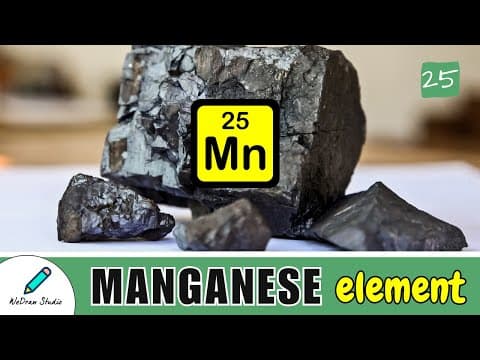
Manganese Element 🌟 - Periodic Table | Properties, Uses & More!
WeDraw Studio
4m 1s596 words~3 min read
YouTube auto captions
Transcript source
YouTube auto captions
This transcript was extracted from YouTube's auto-generated caption track. The transcript below is server-rendered so it can be read, searched, cited, and shared without opening the original YouTube player.
Pull quotes
[0:00]With an atomic number of 25, a typical manganese atom has 25 protons, 25 electrons, and 30 neutrons.
[0:00]Manganese was first recognized as an element by Swedish chemist, Carl Wilhelm Scheele in 1774, although the metal itself was isolated later that year by his associate, Johan Gottlieb Gahn.
[0:00]Did you know that the name "Manganese" is derived from the Latin word "magnes", meaning "magnet", due to its association with magnetite, a magnetic iron ore?
[0:00]Manganese is the 12th most abundant element in the Earth's crust, making up about 0.1% of it.
Use this transcript
Related transcript hubs
Watch on YouTube
Share
MORE TRANSCRIPTS


