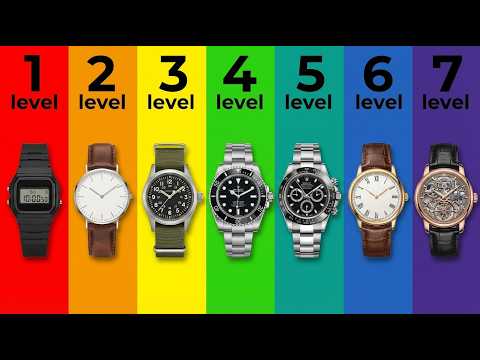
[0:00]Most people think spending more money on a watch automatically means getting a better watch. Most people are wrong. The difference between a $50 watch and a $50,000 watch has almost nothing to do with how well it tells time. It has everything to do with understanding what you are actually paying for at each level. These are the seven levels of watches. By the end of this, you will know exactly where to spend your money and where you are just paying for a name on a dial. Level One - Fashion and Entry Quartz. This is where most people own their first watch without ever realizing it is a watch. A fossil you got for your birthday. A Daniel Wellington someone bought because it looked nice on Instagram. A Casio you grabbed at the airport. These are fashion accessories that happen to display the time. And there is nothing wrong with that, but you need to know what you are holding. The movement inside most of these watches costs the brand somewhere between $2 and $5. The rest of the price is the strap, the case, the logo, and the marketing budget. The names at this level are Fossil, Daniel Wellington, MVMT, Timex at its most basic, and the lower end of Swatch. You are spending between $15 and $100. Here is what most people get wrong about level one. The cheap price does not mean cheap engineering. Quartz technology is genuinely impressive. A basic quartz movement is accurate to within 15 seconds per month. Most mechanical watches that cost 10 times as much cannot touch that number. The problem is not accuracy. The problem is that there is nothing inside the watch that justifies owning it long term. These are disposable objects. The exception is Casio. The G-Shock and the original Casio F-91W do not pretend to be anything other than what they are. They are built to survive. Navy SEALS have worn the F91W on missions because it is reliable, cheap to replace, and does not reflect light. There are G-Shocks from the 1980s still running perfectly today. The best value at level one is not the fashion brand with the minimalist dial. It is the Casio that will outlast everything else in your drawer. Level 2: The Gateway watches. This is where watches stop being accessories and start being objects worth caring about. Seiko and Orient built this level. The Seiko 5 series, the SKX007 and its descendants, the Orient Bambino. These watches contain real mechanical movements with genuine longevity. You are spending between 70 and $500, and you are getting something you can pass down. Here is what changes at level two. The movement inside matters now. Seiko manufactures most of their components in house, which is rarer than it sounds. The NH35 and NH36 movements powering most entry Seikos are workhorses. They are not the most refined movements in the world, but they are accurate enough, repairable, and built to run for decades with basic maintenance. Citizen sits here too, specifically the Eco-Drive line, which runs on light and never needs a battery. What the marketing will not tell you about level two is that this is where the watch community actually lives, not in the boutiques on Fifth Avenue. Right here. The Seiko Turtle, the Seiko Presage Cocktail Time series, the Orient Star. These watches generate genuine passion from people who have owned watches at every level and keep coming back. The best value at level two is the Seiko Presage. For under $200, you get a beautiful hand winding movement you can see through the case back. A dial that looks like it should cost five times as much, and the kind of fit and finish that embarrasses brands charging three times the price. Level 3 Entry Swiss - Tissot. This is where the phrase Swiss made starts carrying real weight. Not because Swiss made automatically means better, but because the regulations around it actually mean something. To put Swiss made on a dial, at least 60% of the manufacturing costs must occur in Switzerland. That bar is not as high as watch snobs pretend, but it does mean you are getting a product with legitimate Swiss oversight. Tissot, Hamilton, Longines, Mido, and Frederick Constant live at level three. You are spending between $300 and $2,000. Here is where beginners make a critical mistake. They assume entry Swiss is just paying for prestige. Some of it is. But the Tissot PRX and the Hamilton Khaki Mechanical deliver movement quality and finishing that entry. Japanese watches genuinely cannot match at the same price point. The Hamilton Khaki Field Mechanical uses an ETA 2801 movement. ETA is one of the most respected movement manufacturers in the world, and that movement will run for 40 years with a service every 10 years. The best value at level three is the Longines HydroConquest. It competes directly with watches that cost twice as much, carries full Swiss manufacture credibility, and holds its value better than anything else at this price. Level 4 - Enthusiast Territory. Now we get into the levels where your taste actually matters. Between $2,000 and $8,000, you are buying watches that have a point of view, a personality. Tag Heuer, Rado, entry-level Omega, and Grand Seiko sit here. The conversation shifts entirely. You are no longer asking, does this watch work? You are asking, what does this watch say about what you value? If you are enjoying this breakdown, hit subscribe. I cover watches and the culture around them every week. Grand Seiko deserves its own paragraph at level four. Most people outside the watch community have never heard of it. Inside the watch community, it is spoken about in the same breath as Swiss houses that charge three times the price. The finishing on a Grand Seiko is done by hand. The Zaratsu polishing technique creates flat surfaces so reflective they look like mirrors. No machine produces that finish. A craftsperson does it with their hands. The movements are decorated to a standard most Swiss watches at this price level do not bother with. Grand Seiko is the worst kept secret in watches, and it will not be a secret much longer. Here is what the marketing will not tell you at level four. A lot of what you are paying for between $2,000 and $8,000 is the brand's history and boutique overhead. Tag Heuer and Breitling sell you a story.
[7:36]The story is real. The heritage is genuine, but two watches can contain the same ETA movement, have the same water resistance, and the same case quality. And one costs four times as much because its logo has more cultural cachet. Know what you are buying before you buy it. Level 5 - The Icons. This is Rolex territory. Omega at its best, IWC, Panerai, Breitling flagship pieces. You are spending between $8,000 and $30,000, and you have crossed a line that most consumers never cross and never need to. At level five, something changes that no amount of specification comparison can fully capture. These watches have presence. Not in a pretentious way. In the way that a well-tailored suit has presence. You feel it before you can explain it. The Rolex Submariner is not the most technically impressive watch you can buy for $12,000. There are movements with more complications. Dials with more artistry. Cases with more elaborate finishing. What the Submariner has is 40 years of cultural weight behind it. Astronauts wore them, divers worked with them. Every Submariner produced today is traceable back to a design language that has not fundamentally changed since 1953. There is a reason it holds its resale value better than almost any object made by human hands. Here is the uncomfortable truth about level five. You do not need to spend this much to have a great watch. You genuinely do not. A Grand Seiko from level four will make you happier on the wrist every single day. But if you are buying your first serious watch and you know you will only ever own one, the Rolex Submariner or the Omega Seamaster Professional will never embarrass you. They will still be relevant in 30 years. They will still be worth money. That combination is genuinely rare. The best value at level five is the Omega Seamaster Diver 300M. It has a co-axial escapement that requires servicing half as often as a traditional lever escapement, meaning lower long-term ownership costs. It has a master chronometer certification, which is the most rigorous movement certification in the industry, and it costs meaningfully less than the submariner while giving up very little in terms of what actually matters. Level 6: High Horology. Now we are in a different conversation entirely. Patek Philippe, Audemars Piguet, Vacheron Constantin, A Lange and Söhne. You are spending between $30,000 and $150,000. And you are not buying better timekeeping, you are buying hand labor and human skill, the kind of craft that cannot be scaled or automated. A watchmaker spent months assembling and decorating the movement inside a Patek Philippe annual calendar. Every bridge is hand beveled, every jewel is individually set. The level of finishing under a loop on a movement that will never be seen by most people who own the watch is a kind of irrational, beautiful commitment to doing something properly. Here is what most people get wrong about level six. The Royal Oak changed everything when Audemars Piguet released it in 1972. Gerald Genta designed it in a single night. It was the first luxury watch with an integrated bracelet made from steel, rather than precious metal. It made industrial design a luxury statement. Today, a stainless steel Royal Oak costs more than $30,000 on the secondary market. Not because of the materials, but because of the idea. The best buy at level six, if you must spend here, is A Lange and Söhne. A German manufacturer from Glashütte, producing movements that make Swiss watchmakers visibly uncomfortable. The finishing on a Lange movement is the finest in the industry, full stop, no debate. Their value retention is strong, and their reputation among serious collectors is unmatched. Level 7 - Collector-Grade and Ultra-Rare. We have officially left the world of wearing watches and entered the world of stewarding them. At level seven, you find bottles that never get opened, except here they are watches that never go on wrists. You see vintage Patek Philippe references, complication pieces from independent makers, and watches from defunct houses whose movements can never be serviced with original parts again. F.P. Journe deserves mention here. François-Paul Journe is a living watchmaker who produces everything in-house by hand, in limited numbers, in Geneva. He started his manufacture in 1999. Today his watches trade at serious multiples of retail on the secondary market. Not because of speculation, but because collectors who understand what they are looking at, recognize something made at a standard that almost no living watchmaker can match. The Patek Philippe 5711, a stainless steel Nautilus, was discontinued in 2021.
[13:09]Its retail price was around $7,000. Secondary market prices immediately exceeded $100,000. That is not about the watch. It is about scarcity, desire, and the irrational beauty of a market built entirely on wanting. Here is the uncomfortable truth about level seven. Most people who own these watches never wear them. They sit in safes, they appreciate, they get photographed for insurance purposes. And sometimes that is fine. The watch market has created real wealth for collectors who understood what they were acquiring 20 years ago. A Patek that cost $15,000 in 2000 is worth $200,000 today in some cases. But if you are buying a watch at level seven because you think it will taste proportionally better than a level four watch on your wrist, you will be disappointed. The law of diminishing returns hits hardest at the very top. So, where does that leave you? The sweet spot lives between levels two and five. From entry Seiko through Icon Swiss, roughly $200 to $15,000. This is where quality and value actually meet. Start at level two or three to learn what you actually like. Do you prefer a mechanical movement you can see working? Do you care more about dial design? Do you need serious tool watch durability, or do you want something that goes to dinner? Answer those questions with a $200 Seiko before you answer them with a $12,000 Rolex. Explore level four when you know your taste. Splurge at level five when you know exactly what you want, and you are prepared to keep it for decades. Unless you are building a collection as an investment, ignore level seven entirely. That money buys 10 exceptional watches instead of one legendary one. 10 exceptional watches worn across different moments, different trips, different decades will give you far more than any watch sitting in a safe. The best watch is the one you actually wear. Everything else is just expensive furniture. Thanks for watching. Subscribe if you want more deep dives like this, and I will see you in the next one.


