[0:00]This film was made possible by a grant from the California Council for the humanities, a state program of the National Endowment for the humanities.
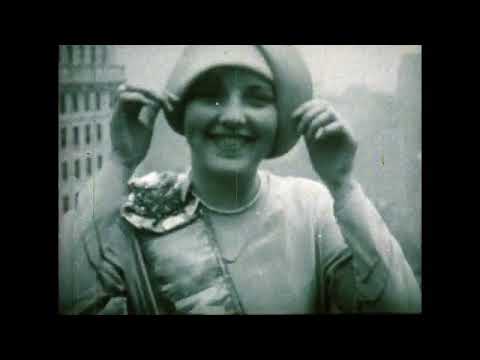
[0:17]It is the dawn of the 1920s. She is about to take flight. A social rebel in a short skirt and rolled stockings. A defiant champion of a new womanhood. She will be called a flapper. This is the flapper story.
[1:15]She wore clothes a little short, a little tight, a little fancy. She drank, she ran around, she slept around. She had a good time. They gathered a great deal of criticism of course from the adult population and there were a great many analyses written in articles about why they, why this and so forth. It was merely a time a time for things to change.
[1:54]The time was the autumn of 1918. World War I, the war to end all wars, had ended.
[2:04]I remember all of the noise and the commotion, the day that word came. All heck broke loose. I think there was sort of a slightly hysterical feeling. It wasn't so acute that we were aware of it as young people, as children then really. But we knew it was over and we got the sensation of it. Oh, it was wonderful, just wonderful. The boys would be back again, that was the main thing. What the international situation, we never even thought about that.
[2:41]After World War I, there was a great change in the country. The young men had been overseas, they had associated with other countries and met other people. There was a song, How you going to keep them down on the farm after they've seen Paris? And the young women had been given more responsibility. They had to do more things for themselves than they'd ever done before. They never went back to being completely dependent on men as they had been. When American men came home, they found a new woman who was determined to hang on to the freedom she had gained during the war. Despite free equality was nothing new, the suffragettes had campaigned for women's rights for over 80 years. Though they attracted the public spotlight, many people considered the suffragettes to be unladylike. I was in high school and I must have been about 14 years old when a woman came to talk to us about the right to vote for women. I thought she was crazy. I felt sorry for her husband to have that kind of a masculine woman to be living with. And we felt that we certainly didn't care for votes for women at all.
[4:02]The vote was won in 1920. Even young women who supported the vote soon disregarded their feminist foremothers. I think that probably my generation just simply took for granted, Well naturally we're going to get the vote. You know, and these women did the dirty work. But we, when we came along, we'd be able to vote. It did work out pretty much that way. But they also took advantage of the fact that they had greater freedom of action. They weren't so dependent on the nearest male. They could earn their own livings. They had had jobs away from home during the war. Some of them worked in factories, women in offices. My sister had some friends from Maryland who got jobs in the government offices in Washington. Never in a thousand years would they have done that, had there not been an emergency, but they kept on with it and they liked it. Most of them retained the way they looked just exactly the same, but a lot of them went completely overboard. And if you were suddenly out of a corset, and out of a lot of tight clothing, it was great. Had a marvelous time.
[5:40]Spirited, worldly wise, self-sufficient, by 1922, the flapper was ready to come on strong.
[6:03]In the 1920s, I was still a young girl living at home, doing doing housework for different people around town. Earning say a dollar a day. Um, housework meant everything from the house to clean the car and clean out the chicken coops. Things of that sort. I was glad to get the dollar a day. I suspect that women who had more money, the wealthier families had always had a lot more freedom. But here were middle class women who had been subject to the middle class morality, I suppose you could say, suddenly with a lot of freedom. This was post-war prosperity, they did have more money. They had charge accounts, the department stores were apparently very middle class conscious at this point.
[7:01]They did all they could to attract people who suddenly never before had money, but now had it. With cold cash and a set of hot wheels, the flapper was on the go. The first order of business was to call attention to herself. The term came from the fact that in the Midwest we all wore galoshes. And if you were a flapper, you never buttoned the buckles, you went and you flapped, flapped, flapped, flapped as you went down the street. Step by step, the flapper confronted constraints of Victorian morality. Step by step, the flapper shocked the modern age.
[7:46]It was about 1924, 25 and when my friend, the lady friend that was with me, lit up a cigarette. Everybody in the place looked at her.
[8:00]It just wasn't done to smoke out in public. It wasn't considered the nice thing to do at all. You know, and then along came my generation and we all wanted to smoke, particularly because it wasn't considered the nice thing to do, I guess.
[8:16]Smoking in public was not the only way the flapper announced her independence. In her dress and manner, she flaunted her rebellion against a stuffy, old-fashioned Victorian womanhood. Everybody had long hair of course, and it was a woman's crowning glory. Now that was real defiance on the part of the flappers cutting it. And many a girl came home with her hair cut to her family's utter disgust. So I kept arguing with my mother until she said one day, if you want, go have it cut. And apparently she didn't mean what she said, but I took her at face value, and I had my hair cut, and believe me, all hell broke loose. There's no other way to put it. Defiant and daring, the flapper delighted in shocking her elders. Gone was the good girl who preserved propriety, the flapper was one of the boys.
[9:24]And the flapper was bad, boldly, bravely, bad.
[9:35]tooping or not tooping, that is not the question. I decided long ago to be.
[9:47]With me it's want to be, Now make things a suggestion, for her bad which is the best for me.
[9:59]When you're after fun and laughter is aggravate you. Some people say a former fly bit her way, she. If it's naughty to rouge your lips, shake your shoulders, shake your hips. Let a lady confess, I want to be bad.
[10:22]If it's naughty to dance the mess. Sleep each morning flapped at 10. Then the answer is, Yes I want to be bad. This thing of being a good little goody is all very well. What can you do when you're loaded with plenty of hell? And bigger when you're learning what it's for. And it's naughty to ask for more. Let a lady confess, I want to be bad.
[11:01]By the 1920s, standards of feminine modesty had changed. And then all at one time, the skirts got up to the knee. And once a year at college we gave a gymnasium exhibit, and the whole town came up to it because it was like the Folies Bergère. They saw legs, which in the long skirt, you didn't see. But now with the flappers, they could see legs all the time. It was a flask stuck in the top of your rolled stocking, and hats that looked like flower pots and came down over your head. Your clothes were so slight that you couldn't possibly wear a girdle. Some women wore canvas bras to flatten out their chests. The clothes were very straight and very slim, and they were to the older generation, they were called very fast. And they held up their hands in horror that no good was going to come of these women. Oh, they thought it was terrible. Just awful, those rolled socks. And there was many a mother that made a girl go to the dance wearing a girdle or a corset, as they used to call it. And of course, it cover, and the girl the first thing she did was take off the girdle, park it in the in the dressing room with her coat or wrap, whatever she was wearing. And because boys didn't want to dance with girls that had stays that held them in. They liked the soft squishy feeling that that they could were experiencing for the first time now.
[13:20]Good-time whoopie was easy to find. The underground speak easy kept the flapper spifligated on hooch, giggle water, bathtub gin. Always going into the speak easy, I always took a bottle of liquor, along that was given to me by a bootlegger. And I would put it up my sleeve. I had big bell sleeves on the fur coat. And I would stick it up my sleeve and carry it in and nobody'd see it. By all these men that were from the legislator, would say, now come on, let's get down to Joe's place or let's go here, let's go there. We'd go upstairs some place and knock on a door, and then pretty soon the little slot would open in the door and then they let us all in.
[14:06]One time one of the assemblymen from San Francisco said to me, We make the laws in the daytime, but we break them at night. The urban flapper who broke loose at the speak easy came in contact with the sizzling sound of jazz, black jazz.
[14:29]In the urban nightclub, black performers played for white audiences. But the flapper gave racial matters little serious thought. She came only to see what was hot, what was new, what was it? The black style seemed dazzling, exotic. The flapper returned to her lily-white world, but she had not forgotten what she had seen. The Jazz Age had arrived, and the flapper had one thing only on her mind.
[15:07]I love to dance. So I went every time. I never turned down a dance invitation. That was what I cared to do more than anything else.
[16:55]But loose and fancy-free, the flapper lived for the moment. I didn't have any goal, let's say, put it that way. I didn't have a goal in mind for anything. When I was a little girl, I wanted to be a missionary and go and go to India or China or some far away place and, uh, I outgrew that very quickly. And then, uh, well, I don't know, there was a I can't really say that there was anyone especially that I admired. We admire the movie actresses, of course, a great deal, though we know we could never be like them. Hollywood in the 20s provided role models galore.
[17:42]Every flapper had her favorite. There was Greta Garbo, there's mentioned, and there was Pola Negri, and Theda Bara, the vamps. The vamps came in with their eyes all made up and and just lying around centrally. What was a vamp? A vampire. A vampire was a woman that could suck the life out of a man practically, destroy him. And that's what these women did as they played the part of Cleopatra, destroying Mark Anthony and so on. Gloria Swanson, I thought she was the last word. And of course, Rudolph Valentino. All the women were crazy about him. He was just a handsome Arab. Clara Bow was really something, because she represented sex wild, as far as I was concerned. Oh, she was somebody. They called her the it girl, and she could project that sex appeal right out there in front of God and everybody. Joan Crawford made a film called Dancing Daughters, in which it was all, there was a lot more smooching and and and touching than there were in all the previous films. A kiss at one time was considered, well, that was just about the living end when you had a final kiss in a movie. And have people who touched each other all the time was really revolutionary.
[19:14]We had gone to the movie, and it was my birthday. And he took my hand and without realizing, he had slipped a diamond ring on my finger. I was trying to think what movie we saw but I don't remember the movie. But it was a fun movie, a happy movie. So that's when I got my engagement ring.
[19:58]Liberated, sophisticated, carefree, the flapper soared high in her newfound enlightenment. Or did she?
[20:09]Well, even in my generation, there was no talk of sex at all. That was something. I don't know how you absorbed it, but some or other things occurred. No one ever explained to me about menstruation, it just happened. Certainly, I didn't really, it was very, very vague about except the theory about the sperm meets the egg. But how the sperm and the egg ever got together, that I really didn't know.
[20:43]And suddenly there got to be a great deal more frankness about things into, uh, free love. Well, that became the great big discussion of the day and all the articles and all the criticisms of it. And then all the free thinking young women were practicing free love. Now they weren't all practicing birth control, because there wasn't that much known about it. There are great many theories. I was a talker more than I was an actor in that my mother had brought me up with the idea that boys would try and kiss you and hug you and so on. But that was only done for two reasons, the pleasure it gave them and so they could go and boast to the other boys what they had accomplished. And she said, they'll always exaggerate, don't give them any opportunity. And that's the way I was. But it's the same double standard as today. Men could go out and we use the expression, hell around, but women were not supposed to. That same old double standard. Well, the bad girls were notorious and frequently popular and at least had lots of men and dates. It was perfectly possible to be good and have a whale of a good time. But the so-called bad girls were the ones who were noticeable.
[24:40]What became of the flapper depended on circumstance. Our first year reunion of my class from Smith and it was I understood it was true for most of the other schools too. About seven out of 10 went into social work, because it we were the depression kids. We came out into a big depression, boy and a job was a job. Even a flapper who traded her freedom for economic security could not be assured of a safe return on her investment. And when I got married, everybody that knew us said, I can't imagine Marie getting married to Norman Hunt because he doesn't like to dance. And I don't imagine how they're going to get along. When we first got married, I didn't have to work. But the depression came along. Then I had to go to work. We worked day and night, both of us, my husband and I. Sometimes it was an unexpected complication that made later life difficult. Oh, how I became a nurse goes way back to, uh this is a sad story, but it's the whole story. My husband walked out on the children and I. I had four children, because he had gotten a woman in Texas pregnant. And I had been a housewife for 20 years raising children, and I hadn't worked since I'd been at the drugstore. Sometimes after a marriage broke up, the flapper realized there were other pursuits for which she was better suited. Now I was lucky because I had a profession to go back to. I was not a good homemaker, I think. I did it, but I think for myself that I prefer the office world. And sometimes it was merely historic events that prevented the flapper from becoming all she might have become. Then after my second child was born, I went back and began work on a Ph.D. I was admitted to Stanford, the war came along, however, and there was no transportation, and I was involved in volunteer war work. So I never went out and I'm very sorry I didn't. The suffragette had hoped that her successors would continue the fight for political freedom. Instead the flapper chose to change society through stylish rebellion and personal gain. It would be another day before the personal and the political would be united. For the moment, freedom was a fashion, a fad, a contest, a party. And when the party was over, it was time to go home.


