[0:00]Four first ballot Hall of Famers, three MVPs, four defensive player of the years and 33 All-star appearances combined. That was the resume of the Lakers starting lineup in 2013, and some people, including their starting small forward, Metta World Peace, believed LA would break the Chicago Bulls record for most wins in a season and win the championship. But they got a season from hell instead. It was a complete nightmare from start to finish, with two coaches getting fired, numerous injuries, constant beefs and failed expectations. Kobe hated Dwight, Dwight was uncomfortable with Kobe, even Steve Nash beefed with Howard, and they all clashed with Coach Mike Brown. This is the story of the 2012-2013 Lakers and the spectacular failure of one of the most stacked super teams in NBA history. After they won the 2010 championship against Boston, the Los Angeles Lakers had two disappointing seasons. In 2011, they got swept by Dirk and the Mavericks in the second round of the playoffs, and the following year, they mustered only one win in the second round against the young OKC Thunder. Kobe was getting older, and at the age of 33, it was clear he needed more help to return to championship glory. And the Lakers, being Lakers, went star hunting. First, they acquired Steve Nash from the Phoenix Suns for two first-round and two second-round picks. Even though Nash was 38 years old at the time, he was still an elite play maker, averaging 10.7 assists, and making the All-Star team during his last season in Phoenix. The next Lakers acquisition was forward Antawn Jamison, who, like Nash, was a former All-Star, who averaged 20 points and eight rebounds per game between 2000 and 2012. But despite being 36, Jamison averaged 17 points per game prior to signing with the Lakers. And getting him for a veteran minimum contract looked like a no-brainer. However, the biggest fish on the trade market was still swimming in Florida, until finally, in the middle of August, he decided to follow Shaq's footsteps and replace Orlando with LA. After four months of speculation, Dwight Howard was finally a Laker in a blockbuster four-team deal that also sent Andrew Bynum to Philadelphia, Andre Iguodala to Denver, and Nikola Vucevic to Orlando, with a total of 12 players changing teams, which was the second biggest transaction of all time. And even though Dwight hadn't played basketball for six months following back surgery, he was widely regarded as the best center and the best defender in the NBA. The Lakers then rounded out their squad by re-signing backup center Jordan Hill and shooting specialist Jodie Meeks. So, everybody believed they had a perfect offseason and were ready to compete for a championship. Vegas set the over/under on their regular season wins at 58, only trailing the defending champions Miami Heat, with LA's title odds set at four to one. During a radio interview before the training camp, Metta World Peace was wildly optimistic, claiming that the Lakers would be undefeatable with the newest additions. We definitely want to beat the Bulls record and go 73-9. That's definitely something that I want to do. Whoever is out there at the beginning of the season, then we got to get it. It's as simple as that. But despite the championship aspirations and the most expensive roster in the league, the first sign of trouble began before training camp even started. First, Dwight Howard was nowhere close to playing, and reports indicated he'd miss the entire training camp and most of the preseason. However, a much bigger issue was that coach Mike Brown announced he'd implement the Princeton offense, which wasn't well received by the players. Princeton offense is a complex scheme of back door screens, cuts and cross-court movement designed to create equal scoring opportunities for everyone, and make offense easier for players who didn't have the ability to create it on their own. But this approach marginalized the one-on-one excellence of Kobe Bryant, the pick-and-roll brilliance of Steve Nash, and the dominant post-up play of Pau Gasol. All throughout training camp, the Lakers gave lukewarm responses when asked about the new offensive system. But when the preseason started, lukewarm was actually a compliment, because the Lakers absolutely sucked. They lost the first four preseason games, all by double digits, despite Kobe and Nash playing in all but one game. Howard made his debut in the sixth game of the preseason, and despite being out of shape, he finished with 19 points, 12 rebounds and four blocks, but the Lakers still lost. Ultimately, LA finished the preseason winless, averaging 14 point deficit, and looking nothing like title contenders. But Lakers fans were dismissive of the poor results, claiming that everything would fall into place once everyone got healthy, especially since Kobe and Dwight had played in only one preseason game together. However, when the regular season started, things didn't get any better. LA lost their first three games, convincingly. To make bad things even worse, they also lost Steve Nash to injury, and even a 40 point game from Kobe couldn't get him over the hump against the Clippers. Mike Brown said it would take the Lakers three more months to fully adapt to the Princeton offense, which seemed crazy, especially since the roster was filled with veterans. Unsurprisingly, after only two more games and a one and four start to the season, Brown was fired. As the Lakers ownership realized they made a big mistake, in what was the third fastest coaching dismissal in NBA history. Assistant coach Bernie Bickerstaff became the interim head coach, and Bernie realized the team was over-coached. So, he simply let the players play with minimal intrusion, and it worked. The Lakers went four and one during the next five games, released from the heavy Princeton shackles, with Kobe and Dwight finally showing signs of a promising one-two punch. But Bickerstaff was never considered a permanent option, and the Lakers were interviewing other coaches. Their first option was Phil Jackson, a guy who'd won five championships with the team, having last coached the Lakers in 2011. Phil requested a 48-hour window to consider the offer, but as he was pondering whether to return to the bench, the Lakers had already decided on a new coach. It was Mike D'Antoni, whose successful stint with the 7 Seconds or Less Suns was followed by four unsuccessful seasons with the Knicks, where he was fired by the end of the 2012 season. Lakers management believed that D'Antoni's fast-paced offense and familiarity with Nash and Bryant would re-energize the offense. But it was another wrong decision. The Lakers were an old team and weren't equipped to run and shoot a bunch of threes. And like Brown, D'Antoni was trying to get the players to fit a system, instead of molding the system around the players. In his first five games, the Lakers were only marginally better than under Brown, with a two and three record, and struggling to get the big men, Gasol and Howard, involved in the new offense. Bryant was also adjusting, running more screen rolls and fewer post-ups than at any time in his career. But then, another setback hit the Lakers, as the backup point guard Steve Blake got injured, which meant that Kobe Bryant would have to take over the point guard duties, since Nash was still rehabbing as well. After the first 17 games, the team, which was supposed to go 73 and nine for the season, had already lost nine games, and with a losing record, they also lost Pau Gasol due to knee tendinitis. And with three of their seven best players out of the lineup, the Lakers sank even further, losing four straight games and dropping to a nine and 14 record, and an embarrassing 12th place in the West. Nash returned in late December after missing 24 games. And with him in the lineup, LA went three and one over the next four games, including a Christmas Day victory against the Knicks. But just as things started to go well, with the start of the new year, it got ugly. The Lakers lost six games in a row, and with a 15 and 21 record, they were five wins away from the final playoff spot, closer to being last than making the playoffs. And if their record was awful, team chemistry was even worse, with Dwight and Kobe getting into an argument and having to be restrained to prevent a full blown fist fight. Before that controversy could grow, Bryant tweeted a photograph of the two play fighting above Mike D'Antoni, alluding to having a good relationship with each other, but nobody was fooled. As the Lakers looked out of sync on and off the floor. Offensively, they were mediocre, but defensively, they were garbage, with a bottom five defense in the league. Nash was never a great defender, even in his prime, but at the age of 38, he was absolutely hopeless against almost every point guard in the league. Kobe, once the best perimeter defender in the NBA, was a shadow of his former self defensively, despite still having an elite offensive season. Metta World Peace was a Defensive Player of the Year when he was still Ron Artest, but he was also on the wrong side of 30, and dealing with minor injuries throughout the season, which limited his defensive production. But all those faults could have been erased if Dwight Howard's defense was on the level of his Orlando days. Back then, Dwight was capable of completely shutting down opposing offenses, and could swallow up opposing point guards when they dared to come through the paint, thanks to his unreal lateral quickness and vertical athleticism we've never seen before from a center. However, due to his back injury, Howard wasn't that player anymore. You know, when I hurt my back, it affected my nerves to the point where my whole left leg just went dead. Basically, I couldn't do a calf raise. And his mobility and explosiveness decreased by 30% from the previous season. After the first half of the season, the Lakers were in 12th place with a 17 and 24 record. After which, D'Antoni moved Pau Gasol to the bench, while the third year forward Earl Clark took his place in order for the Lakers to get quicker on defense. In their first game of the second half of the season, the Lakers lost 106 to 93 to Memphis. Los Angeles was four games behind eighth-place Portland, but only three games ahead of last-place Phoenix and New Orleans. Only five Western teams had ever made the playoffs after starting 17 and 25 or worse. And the Lakers defense and offense ranked only 20th in the league. After that loss, the Lakers had a team meeting, where they decided to drop D'Antoni's offense and play without any system. But the coach also moved Nash off the ball, making him more of a spot-up shooter, while Bryant became the primary facilitator on offense, and seemingly, it worked. Kobe had at least 10 assists in the next three games, and the Lakers won all three. After the Memphis game, LA won six out of their next eight games. But with this team, nothing good ever lasted. On February 10th, during a loss against the Heat, Nash and Howard got into a shouting match in the middle of the floor. And after the game, Steve was dumbfounded when asked about gelling with Dwight. I don't know. It's been really difficult to get him into that game, running into pick and rolls, diving hard, looking for the ball. We really haven't found that rhythm from him yet. On the other side of the spectrum, Dwight was unhappy with Nash and Kobe, complaining about the lack of post touches, sometimes even bringing the stat sheet into the locker room to prove how rarely he shot the ball. By then, the situation had gotten critical, and the Lakers were in real jeopardy of missing the playoffs, with a 25 and 29 record before the All-Star break. On February 18th, the day after the All-Star game, legendary Lakers owner Jerry Buss died after being hospitalized for 18 months with cancer. In honor of their owner, the team wore commemorative patches with the initials JB on their jerseys for the remainder of the season. And when the season resumed, the Lakers finally caught some kind of stride, thanks to Dwight, whose health and defensive effort finally started to improve. But also because of Kobe, who went into playoff mode in the middle of February. The Lakers started eight and two following the All-Star break, and Howard had 10 straight games with 12 or more rebounds, while averaging 15.5 points, 14.8 rebounds and 2.6 blocks. In Howard's first return to Orlando on March 12th, he scored a season-high 39 points, and had 16 rebounds in a 106 to 97 Lakers win. It was only the second time Los Angeles had won four straight all season. Booed throughout the game, Howard made 25 of 39 free throws, setting a Lakers record for free throws made and attempted, while tying his NBA record for attempts. He made 16 of 20 free throws when he was fouled intentionally by the Magic. With Kobe in full Mamba Mode, Dwight regaining some of his old athleticism, and Nash being reasonably healthy for longer stretches, LA was finally above 500 on March 8th, after an overtime victory against the Raptors. The first time they had a positive record since November, when they briefly had a six and five record. With a win against Toronto, the Lakers took the eighth and final playoff spot, after it seemed that their superstar team would suffer a complete embarrassment and not even make the post-season. But then, on March 30th, with the Lakers tied with Utah for eighth in the standings, Steve Nash left the game against the Kings after only two minutes with a hamstring injury. And Kobe then went berserk. Realizing that they might miss the post-season, Bryant vowed to make the playoffs in spite of all the injuries, putting everything he had on the line. Since the All-Star break, Kobe was already averaging 38 minutes per game. But between that March 30th game against the Kings and the game against the Blazers on April 10th, Kobe averaged an unreal 46 minutes per game, scoring 28 points with eight rebounds, nine assists, 2.5 steals and 1.2 blocks. Mamba mentality was running at 110% capacity, and the Lakers went five and one during that insane stretch, but were still only one game ahead of the Jazz, who were in ninth place. On April 12th, the 80th game of the season against Golden State was another must-win for the Lakers. And Kobe was playing every second. The Black Mamba couldn't rest with the season on the line. But with three minutes left to play, his 34-year-old body finally gave out. Driving the ball against Harrison Barnes, Kobe fell to the floor, hearing a pop and feeling a sharp pain in his Achilles. He knew immediately that his season was over and that he would need to have a long recovery. But the job wasn't done. Kobe stepped on the line, and we could see that his eyes were tearing up, but he still needed to make two free throws. Of course, Kobe being Kobe, he nailed them both, tied the game, and then walked off the court on his own, with a broken Achilles tendon. The Lakers managed to win the game, 118 to 116. And in a post-game interview, crying and full of angry rage, Bryant swore that he'll come back. We've watched you tons of personal and professional challenges in your career. Is this at the top of the list? Yeah, you know, but you know it's, it's feeling me. It's feeling me. I can feel it already. But the Lakers still needed two more wins to make the playoffs, and even without Bryant and Nash, they managed to do it, defeating San Antonio and then Houston, which put them in seventh place after 82 games, with a 45 and 37 record. D'Antoni was named Western Conference Coach of the Month after the Lakers went seven and one in April. They finished the season 28 and 12 after dropping to 17 and 25 in January on the day of their team meeting in Memphis. The Lakers expected starting five of Bryant, Nash, Howard, Gasol, and World Peace started together just seven times all season. They didn't win a single game. The offense wasn't that terrible at the end, as the Lakers finished ninth in offensive rating, but their defense was only 20th. And even though they made the playoffs on the last day of the regular season, they lost Kobe, and everyone on the planet knew the Lakers were cooked. Playing against the second-seeded Spurs, the Lakers played reasonably well in game one with the return of Steve Nash, who scored 16 points, while Howard and Gasol combined for 36 points and 31 rebounds. Still, it wasn't nearly enough, as San Antonio cruised to a 91 to 79 victory. In game two, the Lakers cursed season continued, as both of their point guards, Nash and Steve Blake got hurt, along with Jodie Meeks, who was injured after game one, and all three were declared out for the series. The Spurs won game two by double digits, but then in the next game, it got embarrassing. San Antonio won by 31 points, the worst home loss in the Lakers franchise history. Game four was just a formality. And with the Spurs leading by 21 points in the third quarter, Howard decided he'd had enough. So, Dwight picked up his second technical foul to get ejected from the game, which resulted in loud boos from the Lakers fans. Shortly after, the quiet home crowd roared as Kobe Bryant hobbled to the bench on crutches, making his first appearance on the court since tearing his Achilles tendon. But the joy was only temporary, as Kobe couldn't help the team. The Lakers got swept in the first round for the first time since 1967. The 2012-2013 season turned into a nightmare after assembling arguably the greatest starting lineup in the NBA. There's no question that injuries were the primary cause for the Lakers downfall, with Steve Nash, Steve Blake, Jordan Hill, and Pau Gasol missing a combined 143 games. While Dwight Howard nursed a back injury, along with playing much of the season with a torn labrum. The coaching choices didn't help. Mike Brown's Princeton offense was doomed from the start, while D'Antoni wanted to run a fast-break offense behind Steve Nash, but all that did was open up fast break opportunities for the other team. Los Angeles quickly became one of the league's worst teams in fast-break points allowed. But D'Antoni has to get credit for injuries and constant roster turnover that made an already seemingly impossible task of getting these superstars to play together even more difficult. Kobe paid the price of trying to get the Lakers to the playoffs with his body and his career. Since he never properly recovered after the Achilles tear, and despite retiring in 2016, the dominant Kobe Bryant that everybody will remember ceased to exist on that drive against Harrison Barnes on April 12th, 2013. If the Lakers had assembled this exact team just a year earlier, with a healthy Dwight, Nash, and Gasol, they probably would have won the title. But in 2013, they were just too old and too injured. After the season ended, Dwight became a free agent. And even though the Lakers tried to retain him, Howard wanted to get as far from LA as possible. So, instead of waiting on Kobe to return from injury, and playing with an ancient Nash, he decided to join James Harden in Houston, and understandably so. Dwight's fit, even if he wasn't hurt, was questionable with the Lakers, due to Kobe's no nonsense approach to basketball and winning, which clashed with Howard's relaxed, lackadaisical style. I tried teaching Dwight. I tried showing him. But the reality is that when you have a perception of what it is to win a championship and most perceptions of what it's like to win are a very outgoing, very gregarious locker room where you pick each other up, and you're friends all the time... That's the perception. And I think that's what his perception was of what the idea is. But when he saw the reality of it, it made him uncomfortable. Kobe said about Dwight's tenure in LA. In the end, all dynasties must die. And the Kobe Pau Lakers were indeed a dynasty with three finals appearances and two titles. In 2013, they tried to extend the dynasty, but everything that could have gone wrong did. And they became one of the biggest failed super teams of all time.
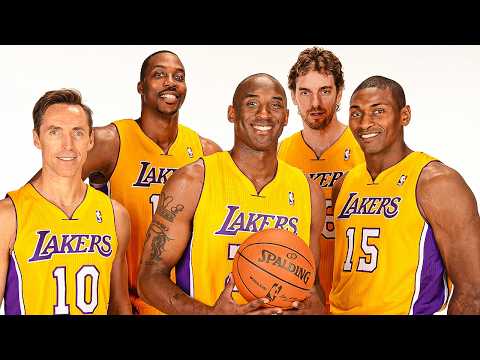
The Biggest Superteam FAILURE of All Time
Nonstop
18m 2s3,517 words~18 min read
YouTube auto captions
Transcript source
YouTube auto captions
This transcript was extracted from YouTube's auto-generated caption track. The transcript below is server-rendered so it can be read, searched, cited, and shared without opening the original YouTube player.
Pull quotes
[0:00]Four first ballot Hall of Famers, three MVPs, four defensive player of the years and 33 All-star appearances combined.
[0:00]It was a complete nightmare from start to finish, with two coaches getting fired, numerous injuries, constant beefs and failed expectations.
[0:00]Kobe hated Dwight, Dwight was uncomfortable with Kobe, even Steve Nash beefed with Howard, and they all clashed with Coach Mike Brown.
[0:00]This is the story of the 2012-2013 Lakers and the spectacular failure of one of the most stacked super teams in NBA history.
Use this transcript
Related transcript hubs
Watch on YouTube
Share
MORE TRANSCRIPTS


