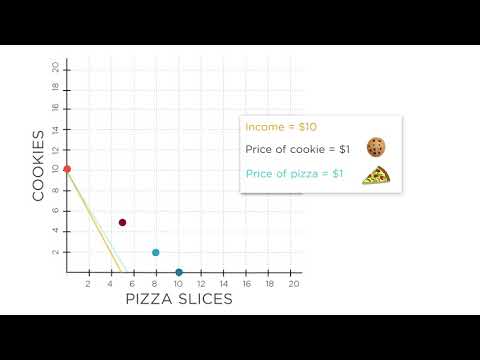
[0:00]We can also manipulate the budget constraint to represent a change in prices or a change in income. Before, we gave you an income of $10 and said that the price of pizza was $2 per slice and the price of a cookie was $1. Your budget constraint started out looking like this. What happens if you double your income? Now you have $20, so let's draw the new budget constraint. If you spend all your money on pizza, you can buy 10 slices. If you spend all your money on cookies, you can get 20 cookies. Or you can spend half your income to get 10 cookies and the other half to get five slices of pizza. Connecting these points, you can see that a change in income is represented by a shift outward or inward of the budget constraint. The new constraint is parallel to the old one, but further out. This makes sense. The slope of the budget constraint is a measure of the price ratio. Here, the prices didn't change at all, so the price ratio didn't change. Only your income changed, so the budget constraint goes outward or inward, but it has the same slope. Now look at what happens if, instead of your income doubling, the price of a slice of pizza drops from $2 to $1. Now, if you spend all $10 of your income on pizza, you can get 10 slices, not five. If you spend all your income on cookies, you can still afford 10 cookies, that hasn't changed. You can go somewhere in the middle too. You could spend $5 on five cookies and $5 on five slices of pizza, or $2 on two cookies and $8 on eight slices of pizza. Connecting all these points, we see that the price decrease looks like rotating the budget constraint outward. That makes sense. Your income hasn't changed at all, so if the price of a good drops, you can afford more of it. And since the price ratio is different, the slope will change. We just illustrated what happens when the price of pizza drops. The budget line rotates outwards because you can afford more. What happens if the price of pizza rises? Let's say the price rises from $2 per slice to $5 per slice. Now, if you spend all your income on pizza, you can only afford two slices. Alternatively, you could buy one slice for $5 and spend the other $5 on five cookies. You can see what happens when you connect the dots. The budget constraint has rotated inward because of the price increase. You can now afford less. To summarize, the budget constraint shows all the bundles of goods you can afford to buy. If your income goes up or down, the entire budget constraint shifts outward or inward. If the price of a good goes up, the budget constraint rotates inward since you can afford less. And if the price goes down, the budget constraint rotates outwards because you can afford more than before. We now have all the pieces to figure out how a consumer makes purchasing decisions. We've graphed preferences with an indifference curve. We've explored utility functions and marginal utility, and we've drawn a budget line. Now, let's pull it all together.
1.6 Budget Constraints Part II
AP Microeconomics with MIT Professor Jon Gruber
3m 2s550 words~3 min read
YouTube auto captions
Transcript source
YouTube auto captions
This transcript was extracted from YouTube's auto-generated caption track. The transcript below is server-rendered so it can be read, searched, cited, and shared without opening the original YouTube player.
Pull quotes
[0:00]We can also manipulate the budget constraint to represent a change in prices or a change in income.
[0:00]Before, we gave you an income of $10 and said that the price of pizza was $2 per slice and the price of a cookie was $1.
[0:00]Or you can spend half your income to get 10 cookies and the other half to get five slices of pizza.
[0:00]Connecting these points, you can see that a change in income is represented by a shift outward or inward of the budget constraint.
Use this transcript
Related transcript hubs
Watch on YouTube
Share
MORE TRANSCRIPTS


