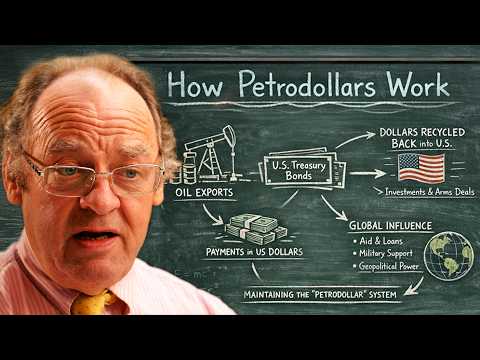
[0:00]Did you know that there's a system running the world, controlling everything from prices to energy, to government policy? And no, it's not the banking system, it's not the stock market, it's the Petro Dollar. For over 50 years, it's been shaping our world. So, what is the petro dollar? To understand the petro dollar, we first need to understand why oil is so important. We use oil to fuel our cars, planes, and ships, to transport people and goods around our countries and around the globe. We use it to make plastics. In some countries, we use it to produce electricity. We even use it to manufacture chemicals, fertilizers, and many other everyday products. Our modern economy depends on oil for basically everything. Because oil is so important, countries are constantly buying and selling it. Some countries produce a lot of oil like Saudi Arabia. Others use a lot, but don't produce much, like Japan. This creates a massive global oil market. So, how did the US dollar come to control this global market? To understand this, we need to go back to World War II.
[1:30]At the end of the war, while most of the world lay in ruins, the US emerged with its economy and manufacturing base intact. This led to countries agreeing to make the US dollar the center of the global financial system at the Bretton Woods Conference of 1944. This would be a new world order backed by the US dollar. The US promised that its dollars could be exchanged for gold, and so other currencies tied their currencies to the dollar. But in 1971, President Nixon decoupled the US economy from the gold standard. This was known as the Nixon shock. This transitioned the world into a fiat currency economy rather than a gold-backed economy. Fiat currency is government issued money that isn't backed by a physical commodity like gold or silver, and instead gets its value from public trust and economic stability. After the US stopped backing dollars with gold, the dollar stayed dominant because the US economy was so huge, and the US government was considered to be stable. Also, many global transactions were already done in dollars. So, the dollar became what's called the world's reserve currency, meaning countries hold large amounts of this currency in their central banks. But in 1973, the world experienced the OPEC oil crisis. This was an Arab oil producing countries stopped selling oil to countries supporting Israel in the Yom Kippur War, including the United States, in order to gain political leverage. This caused oil prices to quadruple, leading to massive shortages and severe inflation in Western economies. In response to this, the US made a major agreement with Saudi Arabia, one of the world's largest oil producers. The deal was simple. Saudi Arabia would sell its oil only in US dollars. In return, the US would provide military protection and support. Since Saudi Arabia was the largest of the oil producing countries, the other ones soon had to follow suit. This meant that you needed US dollars if you wanted to buy oil from most major producers, no matter where you were in the world. This system is what we call the Petro Dollar System. Now, here's the big idea. If every country needs oil, and oil is sold in dollars, then every country needs dollars. Imagine you're a country like Japan. You don't produce much oil. But you need oil to power your economy. To buy oil, you must first get US dollars. Second, keep dollar reserves ready. Third, trade with US or hold US assets. This creates constant global demand for the US dollar, and that demand gives the US major advantages. It keeps the dollar strong because everyone needs dollars. It allows the US government to borrow money more easily and at lower interest rates. And it means the US can use financial systems like sanctions to influence other countries, because so many international transactions go through US banks. In simple terms, the Petro dollar helps keep the US dollar at the center of the world economy. What happens to the oil money that the oil producing countries receive? They don't just store piles of cash. They invest it. This is called Petro dollar recycling. For example, oil countries invest in US government bonds. They buy American companies. They invest in real estate and global markets. This means the dollars often flow back into the US financial system. It becomes a loop. First, countries buy oil with dollars. Second, oil producers earn dollars. Third, oil producers invest those dollars back into US assets, and fourthly, the dollar stays strong. So, what's the future of the Petro dollar system? In recent years, some countries like Russia, Venezuela, India, and Pakistan, have tried to trade oil in other currencies, like the Euro or the Chinese Yuan. This is one of the goals of the BRICS Trade Alliance, which is a partnership of countries that aims to reduce global dependence on the dollar. So, here's the million dollar question. Why are countries that are hostile to the US still trading oil in dollars? Moving away from the Petro dollar system isn't as simple as it sounds. If you suddenly switch currencies, you're not just changing payments. You're disrupting contracts, hedging systems, insurance, and pricing models. The US dollar offers high liquidity, meaning that you can move billions without crashing the market, and it has strong legal protections. It's like when Facebook tried to introduce Threads to compete with Twitter. It's not so easy to suddenly get everyone to move platform when everything's already happening on Twitter. But China and Russia are reducing their dollar use selectively. Recently, Russia has increased oil trade with China in Yuan. It's settled some of its transactions in rubles, and it's reduced its US Treasury holdings. China now promotes Yuan denominated oil contracts, and it encourages trade settlements in Yuan with its trading partners. But, here's the key. They reduce dollar use where it's politically necessary, especially under sanctions, while still using it when it's convenient and efficient. It's a gradual shift, not a revolution. But China's strategy to destabilize the dollar isn't just limited to the Petro dollar system. It's also using the gold market. You can watch our video, just to the left of me, here, to understand how China is using the gold market to break the global financial grip of the US dollar, and how it's causing gold prices to surge to unprecedented levels. Thanks for watching. See you on the next one.


