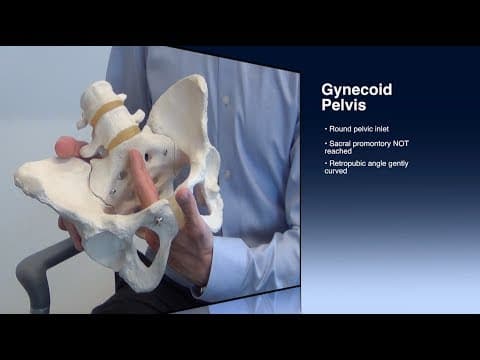
[0:03]Clinical Pelvimetry and Basic Female Pelvic Types. Hello, I'm Chris Morosky, and I'm Andy Polio. Thank you for taking the time to watch this video on clinical pelvimetry and basic female pelvic types. The goals and objectives of this video are as follows: Briefly review the basic bony pelvis anatomy as it relates to clinical pelvimetry. Describe an efficient introductory technique to perform the relevant portions of clinical pelvimetry while maintaining patient comfort. Introduce the four basic female pelvic types and apply a knowledge of clinical pelvimetry to the findings specific to each pelvic type. Okay, so first we'll start with some of the very basic bony anatomy of the pelvis. The three bones of the innominate or hip bones are the Ilium, the Ischium and the Pubis. The pubic bones are joined by the cartilage of the symphysis pubis anteriorly and the wings or alae of the sacrum articulate posteriorly with the ilium. Two bony projections are important when discussing clinical pelvimetry and these are the ischial spines which can be seen on the inner medial aspect of the ischial bone and the ischial tuberosities which are actually part of the bony pelvis that you mostly sit on. And that's more than enough anatomy for one short video, don't you think? The ability to predict cephalopelvic disproportion or labor arrest disorder, based upon clinical pelvimetry, has not been borne out over time. For the most part, every woman should be given a trial of labor. For the obstetrician that desires to offer patients more options than simply spontaneous vaginal delivery or cesarean delivery, clinical pelvimetry is an important part of the patient assessment when considering operative vaginal delivery, rotation of the fetal head and breech vaginal delivery. In the next segment, I will demonstrate an efficient introductory technique for performing clinical pelvimetry, while maintaining patient comfort. Andy will be doing the voice over for us, take it away, Andy. The initial assessment of the pelvic outlet occurs by estimating the bituberous distance. This is done by alerting the patient that you will be pressing your gloved fist against the vulva and gently applying pressure. With a normal or wide bituberous distance, the ischial tubercles will be felt on the outside four knuckles of the fisted hand. With a narrow bituberous distance, the ischial tubercles will be felt on the inside of the four knuckles of the fisted hand. Next, gel is applied to the index and middle fingers of the gloved hand, which is gently placed into the vagina. The wrist is dropped and the examiner palpates anteriorly to attempt to feel the sacral promontory with the middle finger. This allows assessment of the pelvic inlet and the anterior posterior diameter of the pelvis. For a normal or wide AP diameter, the sacral promontory will not be reached. For a narrow AP diameter, the sacral promontory will be reached with the middle or even the index finger. Next, the hand is pronated 90 degrees and the curvature of the sacrum is palpated by moving the fingers inferiorly. The anterior surface of the sacrum is described as being hollow or flat. The mid plane of the pelvis is examined next by slightly removing the fingers from the vagina and palpating at 4 and 8 o'clock in the mid-pelvis. The spines are described as prominent, average or blunt. At this point, a generalized assessment of the bispinous distance can be made, which is helpful in assessing if the transverse plane of the pelvis is normal, wide or narrow. From the ischial spines, the slope of the pelvic sidewall can next be assessed. This can be done directly by holding the internal index finger against the ischial spine and palpating the ipsilateral ischial tuberosity with the thumb. If the tuberosity is lateral to the spine, this is a divergent pelvic side wall. If the tuberosity is in line with the spine, this is called parallel side walls. And if the tuberosity is medial to the spine, then this is called a convergent pelvic side wall. The retropubic angle should not be confused with the pubic arch. That is described next. In examining the retropubic angle, the examiner reaches the two examining fingers up behind the pubic bone and palpates the posterior aspect of the pubic bone and the superior pubic rami. This will allow assessment of the anterior portion of the pelvic inlet. The retropubic angle is described as wide, round, narrow or angulated. Finally, the subpubic arch is examined. This can be performed by palpating the inferior aspect of the pubic bone and estimating if the arch is approaching 110 to 120 degrees, which is wide. Greater than 90 degrees but less than 110 degrees, which is normal, or less than 90 degrees, which is narrow. This is the final assessment of the pelvic outlet. In 1933, Caldwell Malloy developed a classification system for the four basic female pelvic types. They are the Gynecoyd, Android, Anthropoyd and Platypoyd pelvics. The gynecoid pelvis is the most common pelvic type, representing approximately 50% of all pelvic types. The gynecoid pelvis is round and spacious throughout and creates an overall cylindrical shape that favorably allows for the occipital anterior rotation of the fetal head. This pelvic type is the most favorable for vaginal birth. On clinical pelvimetry, the round pelvic inlet of the gynecoid pelvis is associated with the sacral promontory not being reached, and a retropubic angle that gently curves back. The sacrum is well curved, and the ischial spines are not prominent. The pelvic side walls are parallel. The subpubic arch approaches 90 degrees, and the bituberous distance is normally greater than four knuckle breaths. The android pelvis is present in approximately 25% of women. The android pelvis is the most restricted of all the pelvic types, owing to the limited space at the inlet and the progressive funnelling of the mid-pelvis and the pelvic outlet. Arrest of descent is most commonly seen at the level of the mid-pelvis in the android pelvic type. On clinical pelvimetry of the android pelvis, the pelvic inlet is triangular in shape. The diagonal conjugate is narrow and the retropubic angle is sharp and acute. The sacrum is almost always flat or minimally curved. The ischial spines are prominent, and the pelvic side walls are convergent. The super pubic arch is narrow, as is the bituberous distance. The anthropoid pelvic type is found in approximately 20% of women. The anterior posterior diameter is much wider than the transverse diameter. The fetal head often can only engage the pelvic inlet in the occipito posterior position and usually does not rotate. The spacious posterior pelvis accommodates the OP fetal head and these infants can be delivered often easily from the OP position. On clinical pelvimetry, the pelvic inlet of the anthropoid pelvis is oval shaped, with a diagonal conjugate not reached, and the retropubic angle curving back sharply. The bispinous distance is narrow, but the pelvic side walls are parallel. The subpubic arch is less than 90 degrees, and the bituberous distance is more narrow. The platypoid pelvic type is only found in 5% of women, even though it has the coolest name. The transverse diameter is very wide and the AP diameter is very narrow. The fetal head often has to engage the pelvic inlet in the transverse diameter. Rotation of the fetal head does not then occur until the head is on the perineum, and a mid-pelvis transverse arrest is common. On clinical pelvimetry, the sacral promontory of the platypoid pelvis is reached, and the retropubic angle is nearly flat. The sacrum is posterior and more flat. The spines are wide, and the pelvic side walls are divergent. The subpubic arch is wide and flat and the bituberous distance is very wide. And there you have it, clinical pelvimetry and the classification of the basic female pelvic types. With a little bit of practice, you'll be able to identify the landmarks of the female pelvis and start to practice clinical pelvimetry. And with a little more practice, you might just identify your first platypoid pelvis. Always allow your patients the opportunity of trial of labor. But if you begin to incorporate clinical pelvimetry into your routine of obstetrical practice, both you and your patients will have more options available to you when you're faced with malpresentation, labor arrest disorders, and persistent occipital posterior positions. Thanks for watching.
[9:35]Clinical pelvimetry, basic female pelvic types. Starring Andrew Polio. Written and Produced by Chris Morosky, MD. Music from bensound.com.


