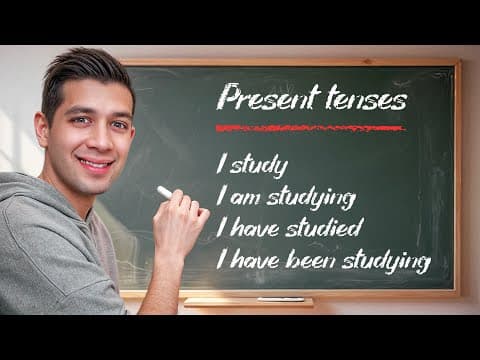
[0:00]Hello, I wake up at 8:00 am every morning. Right now, I'm drinking my cup of coffee. I've answered many emails this morning. I have been working on my new lesson since 9:00 am. What do all these four sentences have in common? All of them are in the present tense. Present simple, present continuous, present perfect, and present perfect continuous. In English, tenses help us talk about when something happened. Past, present or the future. For each of these three times, we have four different tenses. That is a total of 12 tenses. But in this lesson, we're going to focus on the present tenses. Let's start easy. By far, the most common tense in English is present simple, as in, I work. I is the subject and work is the verb. So that is the formula I want you to remember, subject plus verb. But when do we use this tense? We use the present simple tense to talk about facts. Leonardo DiCaprio is a famous actor. Well, this is a fact, right? Everybody knows that Leonardo DiCaprio is very famous. Leonardo DiCaprio is the subject and is is our verb, subject plus verb. Or look at this one. He lives in Los Angeles. Well, this is a fact, everybody knows that Leo DiCaprio lives in Los Angeles. He is the subject and lives is our verb, simple present. We also use the present simple tense to talk about habits. Things that we do every day. He gets up late every morning. This is his habit. He is the subject and gets up is our phrasal verb. He drinks coffee every morning. He drinks, he subject and drinks, verb. Another use of present simple is to talk about hobbies. What do you do in your free time? What does Leo do in his free time? Well, he plays tennis in his free time. He subject and plays verb. He watches documentaries at home. This is another hobby that he has. He subject, watches verb. And one more use of present simple is to talk about schedules and timetables. When are you going to do what? For example, in Leo's case, he works in movies during the year. This is his schedule, this is what his agenda looks like. Or look at this one. He travels for film festivals every summer. This is something he does every summer, it's part of his schedule. So to wrap up, we have four main uses of present simple. To talk about facts, hobbies, habits, and schedules and timetables. Let's move on to the next tense, which is present continuous. You may also see present progressive in some grammar books. Both of them are the same thing. As in, I am working. I, subject, am to be verb, am is, are, was, were and working, verb plus ing. We can use this tense for things that are happening right now, as we're talking. For example, oh look. DiCaprio is filming a new movie right now. He is filming a new movie right now. He, subject, is to be verb, filming, verb plus ing. What's wrong with my voice? Filming, filming, filming, filming. Look, look, he's talking to the director on set. He is talking. He, subject, is to be verb, talking verb plus ing, and it's happening right now, as we are talking together. We can also use this tense to talk about things that happened around now. Not right now, but around now. For example, this evening, this weekend, this year, this month. For example, this year, he's working on several projects. He is working on several projects. Subject, to be verb, verb plus ing. Or look at this one. He's playing tennis with his wife this weekend. Now, you might say this year and this weekend are not around now. I mean this weekend can be, but this year that is far away from us. Here's the point. Whenever you have a time phrase starting with this, such as this evening, this month, this year, this weekend, you can use present continuous. This year, he's working on several projects. This weekend, he's playing tennis with his wife. Another use of the present continuous tense is to describe pictures. Look at this picture of Leo DiCaprio. In this picture, he's wearing a brown suit. He is wearing, pay attention to the sentence. In this picture, he is wearing, subject, to be verb, verb plus ing. Or look at this picture. In this one, he is wearing a black bow tie. All right, so let's recap. When do we use present continuous? We use it for things that are happening right now, things that are happening around now, such as this week, this month, this evening, this afternoon, this year, and describing pictures. Let's move on to the next present tense. Something that a lot of students are annoyed with, present perfect. I have worked. This is present perfect. But what's the form? Subject, have, has, past participle of the verb, I have worked. Now, you might say that present perfect is kind of confusing, but I tell you what. Present perfect is basically a bridge between the past and the present. Something that connects the past to the present. But like, what does that mean? That means something happened in the past and either it continues to the present, or its effect is still here. So either the action is still here or the effect. But what do I mean? Let me explain. We can use present perfect to talk about achievements. Something that you have achieved in your life. For example, he has won an Oscar. This is one of his biggest achievements. He has won an Oscar. He has received many awards for his acting. He has received, subject, have, has, past participle. But why present perfect? Because this is something he did in the past. He won an Oscar, finished, right? But now, he's an Oscar-winning actor. It's in his CV. This is something he achieved in the past, but now he's still known for his great performance in the movie The Revenant. That's what I mean, something happened in the past, but the effect is still here. Now, we can also use the present perfect tense to talk about experiences. He has acted in many great movies. He has the experience of acting in so many movies. Again, notice, this is something that happened in the past, but he has the experience now. He still has the experience, which means something happened in the past, but the effect is still here. There is a bridge between the past and the present. This is why we use present perfect. Or look at this example. He has worked with famous directors like Martin Scorsese. This is part of his experience. Again structure, he has worked. Subject, have, has, past participle. Another use case of the present perfect tense is to talk about lack of experience. Something for which you do not have the experience. You've never experienced it. You've never done it before. And in this case, we either use the negative present perfect or present perfect using never. What do I mean? Look at this. He has never played in a historic movie. Or has he? No, he hasn't. He doesn't have the experience of acting in a story movie. Wait a second, Django Unchained was a historic movie. Yeah. Bad example. But anyway, think about the structure. He has never played in a historic movie. This shows lack of experience. Or look at this. He has never directed a film. I'm pretty sure this one is correct. He has never directed. Subject, have, has, past participle, and we also have never. Sorry. So three uses of present perfect, talking about achievements, experiences, or lack of experiences. Now, here's a very pro tip. Look at this. He has won an Oscar in 2016 for his performance in The Revenant. What's wrong with this sentence?
[9:03]That's right. With the present perfect tense, we never use the exact time. If you want to use the exact time, we use simple past. Present perfect does not focus on when the action happened. It only focuses on the action itself. So we cannot say exactly when it happened. This is a wrong sentence. If you want to make it correct, we should remove the time. We have covered three tenses so far. Before we continue to the last one, let me tell you something. If you want to take a serious step towards speaking English fluently, you can join the POC English Academy. And by joining the academy, you will get four courses for the price of one. The General English course, the IELTS course, the pronunciation course, and the English for leisure course. With the General English course, you will improve your grammar and vocabulary and fluency from beginner to proficiency. From beginner to advanced, with the IELTS course, you can prepare for the IELTS test and you will cover four skills of reading, writing, listening, and speaking. With the pronunciation course, you can learn how to speak clearly and with the correct pronunciation. And English for leisure course is a fun course which will teach you how to understand movies and TV series, music, and native speakers. And for the first time ever, by joining the POC Academy, you can have all four courses for the price of one. If you want to learn more, simply click on the link above my head, go to my website, and read the details. See you soon in the academy. And now, let's continue. All right. So far we've covered three of the present tenses. Let's move on to the last one, present perfect continuous. Present perfect itself is kind of confusing. Let alone present perfect continuous. But don't worry, let me explain, it's pretty easy. Present perfect continuous is like this. I have been working. I've been working. Subject, have, has, been, verb plus ing. That's a long formula, but it's pretty easy. I've been working. When do we use this? We use this for actions that started in the past and are still happening. They started in the past and they're still going on. DiCaprio has been acting for over 30 years. He started 30 years ago, he's still an actor. Something happened in the past and it's still going on, present perfect continuous. He's been acting since 30 years ago. He's been acting for over 30 years. He's been working in Hollywood since he was a teenager. So he started when he was a teenager, he still works in Hollywood, so it's an action that happened in the past and is still going on, present perfect continuous. Did you pay attention to both sentences? In both sentences, time is mentioned. In the first one, we have for over 30 years. In the second one, we have since he was a teenager. In present perfect continuous, we can use for and since to talk about time. But how? We use for to talk about the duration of the time. He's been acting for over 30 years. That's the duration. Now, when do we use since? We use since with the starting point of that action, since he was a teenager. Since 30 years ago. Now, 30 years ago is 1995. Yeah, the year I was born.
[12:41]Boy, I'm getting old. So, since 1995, since 30 years ago. For 30 years, for 55 minutes, for a duration, since the beginning. Now, we also use the present perfect continuous tense for things that have recently stopped. But the effect is present. What do I mean? Something that has recently stopped and you can see the effect. It's like somebody has doing something hard and is now tired. He's been filming all week, so he looks tired. He has been filming all week, finished, he looks tired now. Something that has recently stopped, but you can still see the effect. He's been filming, he looks tired. He has been doing interviews all day, and now he wants to rest. He's been doing interviews, and it recently stopped like 10 minutes ago. He's done with that. And now he's tired and now he wants to rest. An action that has recently ended, but you can still see the result, present perfect continuous. That's it. We have covered all the present tenses. But wait, I have a story for you, which is about Leo DiCaprio. Let's hear it. Leonardo DiCaprio is a famous actor. He plays in many great movies and travels a lot. He often goes to parties and works on new films every year. Right now, he is filming a new movie. In this photo, he is wearing a black jacket and smiling. He has won an Oscar and has made many famous films. But he has never played in a superhero movie. He has been acting for over 30 years. People have been watching his movies for a long time. He has been famous since he was a teenager. Four paragraphs, and in each paragraph, we have one tense. Look at the first paragraph again. All the tenses are present simple. He is famous. We're talking about a fact. He plays in many great movies. He travels a lot, and he works on new films. These are all facts. These are things that are true about him. The second paragraph is present continuous. He is filming a new movie right now. In the picture, he is wearing a black jacket, he is smiling, describing pictures, right? The third paragraph is about present perfect. He has won an Oscar, achievement. He has made many famous films, experience. He has never played as a superhero, lack of experience. And the last paragraph is present perfect continuous. He has been acting for over 30 years, started in the past, he's still going on. People have been watching his movies, started in the past, he's still going on. He's been famous since he was a teenager. He's been famous, started in the past and he still is famous, right? That's it, I hope you've enjoyed this lesson. In the next videos, we're going to talk about the past tense and the future tense, so stay tuned. See you.