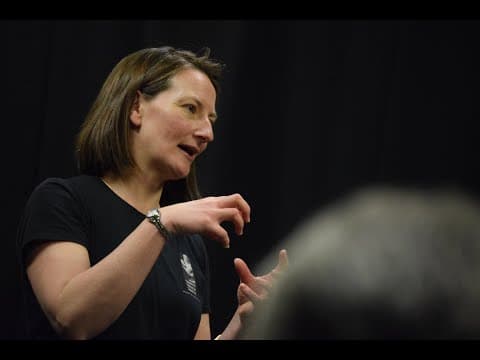
[0:00]Commedia is a style of theater that originated in Italy in the 16th century. It became hugely popular and spread throughout Europe. Commedia is important to know about as a performer because it is the roots of all comedy that we have today.
[0:18]whether it's cartoons, sitcoms, silent comedies. The things that are timelessly funny are generally based in their origins of Commedia dell'arte. Now, Commedia is all about the characters. Right at the center of it, there was a set of stock characters who appear in pretty much all scenarios that ever performed.
[0:46]An actor would play one character for their whole career. So they'd know really well how that character behaved, moved, thought. And so no matter what situation you put them in, they'll always know how that character will behave. Now, Commedia is known as an improvised style of theater. It's not entirely improvised, but there are certainly elements that are. Predominantly, it's the dialogue that is improvised. Each character would have a bunch of stock phrases, of stock speeches up their sleeve. They may have Lazzi, little bits of comic business, and they would just entertain the audience. They had pre-rehearsed sequences that they could go into. But the dialogue generally is improvised. I want to introduce you to a few of these characters today. So, the Zanni is one of the characters. Ah, they're coming after me. I don't know what I'm doing. Ah, oh! This is a mask of a typical Zanni. There are many, many different types. There's hundreds and hundreds of different names for the Zanni, but Zanni is a collective term meaning servants. The servant working class, the low-ranking characters. Note the long nose. Generally, the longer the nose, the more stupid the character, as a general rule. Very, very small eyes, very hard to see out of. So you're forced to move around the room using your head to move. So if you do this and put your hands over your eyes and create little binoculars, and have a look around the room, you'll see how your peripheral vision is very cut off, and if you're going to move, you find yourself using your body to turn around. It's a similar experience if you're wearing this mask. Different masks have different eye holes, different size of eyes, different size of nose. Different mask makers make them different ways. But this one in particular is intentionally made with very small eye holes to force the actor to move their head a lot. And this is mainly because the mask works well in profile when it's moving around. I'll show you.
[3:19]Oh, and I look down there. I look up there. I look over there. I look back there. I look over here, and each time I'll make a little stop. I look down there. Pause. I look up there. Pause. I look to you. Pause. If you notice, I make those little pauses so that you can take in my expressions. If I go too quick and I move my head around all over the place, you can't really see what's going on in my head. But if I go, oh, you can see what's going on. Accompanied with little noises. Some technicalities about wearing a mask. Being able to get the rhythm of the mask, the speed, the punctuation of the mask work, so that you get these points where the audience can take in the thoughts of the mask and read the mask. If the mask moves too quickly and doesn't have those little pause moments, you get, just don't get it. The audience miss what's going on. It becomes very confusing and you don't know where to look. So this is another Zanni, slightly shorter nose. More dopey eyes, slightly bigger eyes.
[4:36]The Zanni have a particular way of walking, a particular way of moving. Each character does in fact. Every character has a set of postures and moves that can help the actor to get into the character. And I'll get myself into the body. Yes. Now the body, the center is low. Low down in the center. The bottom sticks out a bit, the back arches. The head is looking around. The arms is a slight tension across the shoulders that makes the arms move around. You're ready and alert. There's an energy inside. Yeah. Oh, ah, yeah. And the Zanni very often balancing on one foot. Rarely are they in the middle. Usually, weight goes to one side. Quite often balancing. Oh, oh. If you see what big moves like that, and big moves become more like a cartoon. And hence this is where it comes from. So if the Zanni was to run, we run, we fly, the head's flowing back, the body leaning backwards.
[6:05]Because it's funny, it's a silly way to run. So we run and run. Sometimes looking at the camera. Yeah. Yeah. But the energy's got to keep moving, so the feet are moving all the time. Now, see if you can do this. Keep your upper body still whilst your lower body moves. Just try. Change your foot. Ha. Ha. Ha. And then try. The head goes the opposite way. The head sees something, the feet see something. The head goes, oh, the feet go, ah. So the head moves first, the feet catch up.
[6:53]Okay, okay. Now, we also control the creep. Another way of moving. So, you want to sneak up on somebody, we go. Yeah.
[7:20]We creep with high knees and with lots of shush. Because the Zanni are very good at being quiet. We make a lot of noise. Even when somebody goes, shh, don't make any noise.
[7:37]Couldn't help myself. Keep making noise. Or being really still. No move. I'm trying not to. But that energy is going to burst out somewhere. Yeah. So bubble of energy in the middle. Anyway, I'll go see you later. So, the energy in the Zanni, bubble of energy right in the middle, that's always wanting to burst out. If you're trying to be still, it's always going to come out somewhere. It might just come out in a little hand. The fact is that if you're still and you hold your breath, the audience are also holding their breath, and they're watching you meticulously. So if something just starts to move slightly, all the attention of the audience goes directly to that thing that's moving. Or it might move somewhere else. Okay, hold that. And it goes somewhere else. We hold that. And it goes somewhere else. If we hold the bum, it goes somewhere else. So the energy passes through the body. So that's a great exercise in keeping, being able to get this energy moving. The Zanni energy is out, out, out, all the time. Big energy outwards. There are many different types of Zanni, as I mentioned, there's lots of different names for them. Um, one very famous one is Arlecchino. This is one mask for Arlecchino. Different mask makers have made different variations. There are many variations on Arlecchino. Arlecchino has all the same kind of movement, this low center of gravity, moving from foot to foot. He has one extra little run that's really helpful for him, a very playful run. It's a little three-step. And he's made famous that little run. It's balancing to the side. Who is it? What did you say? Oh, Zanni? No! Other characters. There are many. Most of them are masked, but there are some who are unmasked. The Lovers are unmasked characters, the romantics. But because they're acting next to masks, their exaggeration needs to be as big as the mask characters. They play along with the fact that these characters are masked, they don't let on going, oh, you've got a funny thing on your face. They take it as this is a person that I'm faced with and it's quite normal for them to look like that. But their exaggeration needs to be an extension. And if they're a gentleman, extending the shoulders, broadening the chin, extending, they often have a sword that they have right here. They will make, they will strike great long poses. For a lady, they will strike beautiful poses that goes all the way down to their toes. And they will make sure that they, their bottom doesn't show. They don't arch in, or bend in an unseemly manner. And their face must always be perfect. And they move quite ballistically around the space. And they have a huge personal space. So that if one lover were to take this corner of the stage, you can see that my arm length goes almost to the center. So that if the one I love were to enter over there, Isabella, Sylvia, the one you love. Big personal space. I'm holding all this side of the stage. I will love her to the end of my days. And I will seek far and wide to find her.
[11:47]Oh, the origins of melodrama. The melodramatic lovers.
[11:58]The other mask, the other unmasked characters you may see are the female servants, the female Zanni. So Colombina, And like the Zanni, she has all the same moves, but it's all more in the hips and the hands. The little gestures.
[12:20]Now, she was unmasked as a servant. Because when ladies came onto the stage, it was the first time that women had been seen on the stage. And that in itself was quite a spectacle. Indeed. In fact, I've got a little hat here. I can completely transform. You won't know me in a minute. Oh, so Colombina, she moves showing off her legs a little bit, her nice trousers legs. And she moves around. Again, with high knees. They're very light on her feet. She's the love interest of Arlecchino, and possibly the love interest of Capitano, and possibly the love interest of Pantalone, and even the Doctor. Everybody loves her. Everybody loves Colombina. But as I said, having ladies on stage attracted an audience. So leave them unmasked. Let the gentlemen see the lady's faces, and that will make him come and pay for their seats in the front row.
[13:36]The other characters. I'm going to show you a few of those very quickly. Ah, it is I, Capitano.
[13:48]Capitano Spavento. He is I, and I am very handsome. You see? I have a great nose. And I like to pose.
[14:06]Sometimes I will march, and I march like this. I will march. I march. I am very good at marching. I am a trained martial artist. I am also a trained swords person. Yes, I teach you great sword things. I am endlessly brave.
[14:46]I will take on any of you. You? No. I am not really very good at sword fighting. Sometimes I am even scared of my own shadow.
[15:32]Did I say that? No. Let me pull myself together. Here I am. Yes.
[15:46]The Doctor and Pantalone. The Doctor is one of the master characters, as is Pantalone. These two are normally the heads of two households. Pantalone, the Doctor. So Pantalone, he is a miserable old man. He is the archetypal miser.
[16:16]Yes, the body changes, the heels together, the buttocks curve under. Look at that shape. Curved all the way down, all the way down, all the way down.
[16:29]And the chin comes up. And if you're being led, you might be led by the chin and the knees. You try walking like that for a while, it hurts. I'll tell you. You get a bad back doing this. And that helps, because Pantalone is always miserable, because he has got bad back. Yes. Yes. The only thing that moves quickly are his hands. Always moving quickly. Money moving through his hands, imagining the money that he could have. He likes money. He's very rich and greedy. Always looking for more ways to make money. The Pantalone is not very popular. I am respected. Or I was once. But not many people like me.
[17:19]I'll tell you why. Because I collect their money. I make deals, I take their taxes. It makes me rich. Yes. The Doctor is large, very large. The back is arching forward, and we bounce on the heels. I don't know if you can see that, but the heels are together and we sway the knees forward, meaning that you are almost slightly on your toes and always off balance. Keeping the heels together though makes you slightly appear like you are out of control. Thus adding to the comedy of the Doctor.
[18:03]It makes you move with little feet, and the belly weight will carry you around. Yes. Now, the Doctor likes to talk a lot. He likes to pontificate and proliferate and buffoon on. Yes. Oh, hand on his belly, another hand gesticulating and constantly talking and hard to get off the stage. The gadgets can be somewhat confused. One must go to the Latin equivalent and look at the ipso factums of the prenuclear. When one takes this particular, only orifice, one will realize that there is nothing so fantastic as the reason.


