[0:00]Hi, wie geht's, wie steht's? And welcome back to Cooked like a German. Today, border country cooking, country number three. And that would be Czech Republic at Bavarian border. And, uh, this will be our country number three. And we will make for our country number three, Goulash. A Czech Republic Goulash, but with maybe a little bit a German twist. Goulash is very, um, common in Europe. Everyone has a little differences, but we try to get the ingredients close to what I know, what I ate in Prague last year. Okay, let's see what we have for our Czech Goulash. When we went to Prague, at the border, I found this here. Uh, that's like actually Goulash gewurz in German, and the check, um, language here, that's how close it actually is. And, um, I will use this one day, but to make it easy for you to, because not everyone has access. This is in general the essence of what we have in here. It's a pretty, uh, decent amount of spices. So we have actually, I make it easy, so I don't have to point around. So we have salt, paprika, sweet and spicy. We have caraway, garlic powder, coriander, oregano, turmeric, allspice, marjoram, thyme, sage, black pepper, chili, celery. So this is in general what we have here on the plate and, um, you can most likely, uh, do variations what you want, not want. I also have onion powder and garlic powder in here as well. Um, but what you don't wanna omit is caraway, very, very, very important for the check, uh, cuisine. And, uh, paprika, smoked or sweet and spicy, that's up to you. So then, that will be our spices. We are going with a beef goulash. There, there are also pork goulash. They're like beef and pork goulash, but today, uh, we try to stay with the, this is a brisket cut, so relatively inexpensive. Try to make them like, um, an inch or so. Uh, when you buy them already precut, they are so big, then you end up like cutting like small cubes even smaller. So it's better when you cut it right away yourself. And in addition, we will have a little bit of, um, tomato paste. This is normally not in a traditional, uh, Czech Goulash, they don't use a lot of veggies in, but I have a one little, uh, carrot and a little bit of celery left. So I will throw that also in. Um, we have way more garlic than the recipe say, but we love garlic. This is are four cloves of garlic, and they are smashed, so don't even worry about like small cut it. We have a yellow onion. Actually, this is around two pounds of yellow onion. This is around two pounds of meat and the ratio is really, it's very like, uh, uh, um, the check Goulash is really a onion sauce base, uh, compared to a red wine, uh, sauce base. Um, so that's very important the ratio to keep it at one to one, roughly. There is a little sea salt and, uh, fresh ground, um, pepper with some flour. This will be used to protect A, the meat a little bit. We will clean it up in there and also to crunch it up better. We have a little frying oil, basically olive oil and vegetable oil, and we have, uh, um, beef broth. So, the first step what we have to do is, we have to get our meat powdered with our salt and pepper and flour. So let me get something to put the meat in. All right, so we use just our salt and pepper, and you can see our flour, and we cover it all up. You can use your hands, you don't need to have a something to stir here, pretty simple. So our first step is to get that meat. Now it's covered. Protects it a little bit. Uh, get that meat seared. And when you do this in a pan, depending on the size of the pan and how much meat you have, do not, do not overcrowd it, because what will happen, instead of searing, you end up with steamed meat. Not what we are shooting for. This pan is, uh, cast iron and very hot. We give it a little bit of oil.
[5:01]Now we add our meat.
[5:14]All right. What I'm doing here is I'm using actually all the flour, what we dusted our meat with. It has two two reasons. Reason number one. Uh, because I don't wanna waste it. Reason number two, we, after we coated it to protect it, later on the flour also will add to the thickening factor of our gravy.
[5:40]Uh, I would say we give this here. Bring it up to heat again. We gives us here maybe like five minutes and then we continue with the onions. So, the Goulash, uh, Czech Goulash normally in Prague, we had it with, um, bread dumpling. Same like I like it in Bavaria with bread or potato dumpling, but, um, again, overarching, both countries, they also have a noodle, what they use, um, with the goulash as another variety of carbs.
[6:15]And I will use today my egg spetzle. Normally, you make our own spetzle and my YouTube video channel has already some older spetzle, uh, recipes and videos to show you how to make your own. But today, we use good old noodles. We're almost done here with our, uh, quick sear. And, uh, then we will add the onions, actually, a better way is to take it out and then add the onions and bring the onions also to a like a brown color, dark brown color. Uh, what I wanted to mention as well, because these are heavy meals, um, it's very, very good to have. We will have a green mixed salad with it with some vinaigrette I will make. And my to go is white vinegar, distilled, very potent. Makes nice, uh, hearty, uh, um, salad dressings with a little bit olive oil and some lemon juice and you're good to go. So let's bring this here actually to one. You know what? Let's regroup. We keep it in. We keep it in. I have enough room here if your pan is too small, I would take the meat out. And now we have to add our onion. Like I said before, this is one to one, so we are talking about like, uh, two giant or big yellow onion.
[7:50]You can use also red onions if you prefer, but they are tend to be much more potent than the yellow ones. I made the executive decision that my onions are, uh, soft enough. So I will now mix in my onion. Now we mix our meat in. We're starting to deglaze. This is by the way, um, beef broth and around two cups. We are stirring. Now we add the garlic and the other spices, tomato. Some people have recipes say throw the garlic very late in. I mean, we are not burning the garlic here. This here will be a slow cook after we are having everything in here. So adding now our carrot and our celery. Now, we are adding our two, uh, teaspoons of tomato paste.
[8:59]Okay, now, most important, one I forgot to mention, this is actually mustard powder. If you have it, it gives it a little bit a bite, uh, use it as well. These are real spices and herbs. I mean it's tempting to use, uh, the package what I have shown you, but even that package from Prague is also a medley of those spices and herbs. There are others you have to watch it. Um, they contain sometimes gluten and soy and they are called like spice kits and they have thickness in it. They they are meant to, I throw that in and it makes your sauce or the thickness already in your spice mix. This is not the case because that's why we use flour and that's why we use so many onions, because this will be an aromatic natural thickness. All right. Now we bring it down the heat a little bit and we will cook this on medium heat for around one to one and a half hours. It really depends on your meat, your cut you have. And so in between try to taste and see if the meat is tender and that's your time where you're ready to go. In the meantime, you can make the spetzle, you can make the salad. I chop a couple of parsley, a little bit parsley what goes on top and a couple of fresh onions also on top. It's always a good for the eye, so we say.
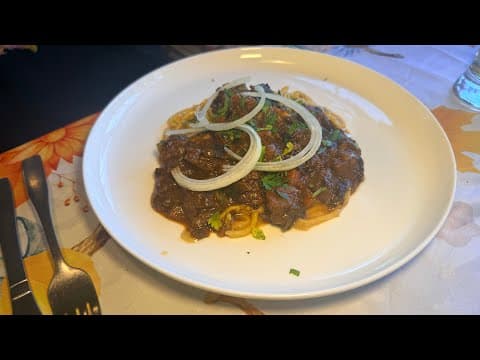
[10:37]Okay. All right, let's see. We are a little bit over an hour in. And see if we reach from point here. So we can see that our onion have turned into a sauce and that everything is getting thicker. Don't forget the the goulash. Not, not Czech goulash, it's not a goulash soup. So we want this here a little bit longer. Maybe we look it at it in 15 minutes again. And we want this a little bit more thick, but, uh, the meat is getting already tender. So, let's say we are shooting for in this case for one and a half hours altogether, not two hours, because, um, this pan is a very hot and the meat is uh, relatively tender, um, to begin with. Here, this will be our spetzle. Of course, shortcut because we had this in our pantry. But it will take maybe 15 minutes max on a medium heat. Then we dish the the goulash on top of our spetzle. And I prepped a little bit here. Show you what we have here. We have a couple of, uh, onions. We will put raw on the goulash. We have a little parsley, what we sprinkle over. We made a little vinaigrette and lemon because lemon juice what we will use for the salad. And with a meal like this having like a, like a sour taste, like a salad helps you break down the fat. All right. It is a little bit, uh, let's say one and a half hours. So, I think we are ready with our goulash, what is now nice and tender.
[12:54]Okay. And there you have it. Spetzle Czech Republic Goulash with a German hint and, uh, nice sour dressed salad. And of course, some beer always goes well with it. Prost. Let's see. Mm. Meat is tender. It's almost like, um, instant pot slow cook. Let's see with the onion. And thank you for watching my videos and leaving some comments. I always want to hear from you. What can be different, how you know it, um, in your area, if you like it, what you don't like, what you would like to change. Uh, just let me know.


