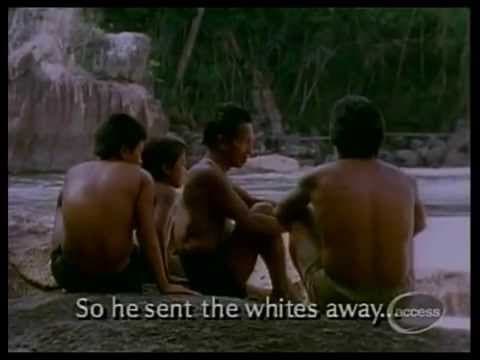
[0:55]My journey is to seek tribal wisdom for the modern world. My name, David Maybury-Lewis. Are we part of nature or apart from it? In the Amazon, humans and animals share the same spirit. Something this man is about to discover. The desert is a home of delicate balance for this African. While this gardener seeks a new ecology of mind. These are the stories we were told. Stories from the heart. Stories for a thousand years.
[2:08]In 1990, developers proposed to make vast unpopulated stretches of Cape York useful. They would build a satellite launch facility.
[2:30]The site has been the homeland of the Kuku-Yalanji and Wujal Wujal peoples for 70,000 years. They were forcibly removed 70 years ago.
[2:43]Today, they've come back to reclaim their homeland before it's too late.
[2:53]When I go up the sand dune and I look all over, my memory run bike, very far. I was thinking about my grandmother. All of a sudden tears run out from my eye.
[3:17]I want to build that place up again. Make that place come alive with human beings.
[4:09]It's an irony, that while tribal peoples with few resources strive mightily to keep their ties to the earth, we, with huge resources, strive mightily to leave it behind.
[4:49]The land is mother to all of us, white and black. And how you feel if somebody cut your mother in pieces in front of you. How you feel?
[5:10]Next door, on one side, is a hell of acid and poison gas and heat. On the other, a sad, lifeless place. Venus and Mars. And in between, the garden. Earth. A small change here. A piece of bad gardening there, and we could have another Venus or Mars. The Aborigines see the garden as something to care for, because they're part of it, servants of the earth. We see the garden as something to do with as we wish, because we're outside of it, lords of the earth. It is a most curious irony that the proud technology which took us away from the earth, made us look back and realize how fragile it is, and it's all we've got. If scientists looked down with computers and cameras to analyze who could live on the nearest thing we have to Mars on this Earth, the deserts of Northern Kenya and Southern Ethiopia. Science would come up with a description of a hypothetical nomadic people, with enormous knowledge of the small and delicate ways of the desert. Well, the people exist, the Gabra. If ever we do fail and turn the Earth into Mars, the Gabra will be the last of our species to gaze on Mars and Venus from this Earth. They are about 30,000 in an area little larger than Switzerland. The average temperature is 110 degrees Fahrenheit. They know at least 450 different species of plants. They have 177 laws governing animals, stars, men and things. The consummate state of balance in all things is called Finn. We would say, ecology of mind. Finn. And it's a 63-year-old elder, a man named Wato Isako, who will pass on his expertise in Finn to the next generation of Gabra. If you are born of a place, for you it cannot be a bad place, unless you burn it. In the desert you must look carefully to see things. To live here you must see and understand Finn. It is a many and different forms of fertile life here all around you. It is the way they work together. It is not hard to learn. Understand grass and water and wind and sun. A Gabra can know these things in half a lifetime. And the desert always changes. So you must learn to move always. Move your camp, move your knowledge. My son Molu has 30 years and is married, but always I tell him, learn. Bend with the wind or you will break. He's still learning. Father, water is so scarce and things so dry. Has it always been this way? Things always change - always. In the past, the rains always came on time. Now they are late one year, early the next. But there were fewer people then, and fewer animals. But now there are too many for the wells. So we go as far as Lake Turkhana, and even risk tribal wars.
[9:09]Things always change.
[9:14]The gift of Finn is the young. It is a gift quickly taken back in the bad times.
[9:30]Watch the young. These kids may die. It is a bad sign. The elders must meet.
[9:43]The problem is dry season births. Kids can die in one night. We must move soon. No time to send out scouts. It's dangerous to go without scouts. We are carrying baby goats, and baby camels.
[10:11]Without scouts, we might walk forever. So let's send Molu and Boya immediately. They can report back soon. Before we leave? Before we leave.
[10:38]May God provide good pasture. Do sons listen to fathers? I hope my son Molu has learned. For us, learning is the difference between life and death. They will go to the Huri hills. They say rain has fallen there. So, grass, I hope. I was told this at the well.
[11:58]Water, a great gift of God, water. Different water for animals, different water for people. We come in groups to the well. Some to draw water, some to mind the herd. Each herd in strict order, or the troughs will be trampled. Animals drink, we talk of news, council decisions, family matters, the Gabra way. Everything for a purpose. Everything in its time and peace. Goats need water every four days. Cattle, every three days. Camels, 14 days. Camels you have to watch. They can ruin a well, very bad-tempered. They don't like the wet. They fall over. Outsiders see confusion. We see Finn.
[12:51]Once an outsider built a well with a fine iron pump. We were grateful. One man could water his whole herd by himself. But then, no one gathered here. No news, no Gabra. Just many strangers.
[13:10]One day, the pump broke. We sent the parts to many different places to be fixed. Can't remember where they all went. Strange. It never came back. Now we all meet again. That's Gabra.
[54:45]If anything has a greater meaning to it, when we observe anything more closely, something happens. We open ourselves up to it more, we open up our hearts more. And when this happens, there's almost a feeling of reverence towards that other person, or that vegetable.


