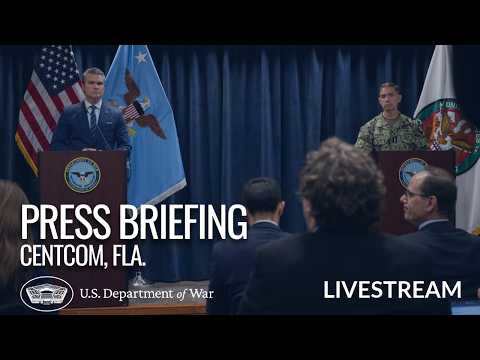
[0:28]Well, good afternoon. I'm I'm honored to stand right here today alongside one of America's finest. Admiral Brad Cooper, commander of US Central Command. We just had a chance to spend a couple of hours together. Better part of two hours, going through the entirety of this uh this operation, Operation Epic Fury. And Admiral, I want to thank you for everything you do in your incredible leadership. For your dynamic thinking, the way you're attacking this problem set on every level. In just days of Operation Epic Fury, you and your team have delivered nothing short of devastating, precise strikes taking out the better part of Iran's Navy making it combat ineffective, neutralizing missile sites and launchers and establishing total dominance over the skies we fly over and seas we fly over. Our forces are executing with unmatched skill and the mission is advancing decisively. This is the kind of no nonsense, results-driven war fighting that America demands. And you're delivering it in spades. You are the man for this moment. Admiral Cooper, on behalf of the President, the Department of War and every American watching, I want to thank you for your outstanding job you and Secom are doing. Keep pressing the fight and we are with you all the way. A few thoughts before I hand it over to the Admiral for an update. Iran is hoping that we cannot sustain this, which is a really bad miscalculation for the IRGC and Iran. You see, there's no shortage of American will here. We remember and honor our fallen. Those six that we will soon welcome at Dover, who gave everything for their country and this mission. We remember them. But we remember them by rededicating ourselves even more fervently to this mission. Our commitment to our mission objectives only increases as our advantages continue to increase. We've got no shortage of munitions. Our stock piles of defensive and offensive weapons allow us to sustain this campaign as long as we need to. Again, our munition status only increases as our advantage increases. Our capabilities, we have only just begun to fight and fight decisively. Having a chance to hear from Admiral Cooper, if you think you've seen something, just wait. The amount of combat power that's still flowing, that's still coming, that will be able to project over Iran is a multiples of what it currently is right now when you add up our capabilities and those of the Israeli defense forces. And we have no shortage of authorities. The Admiral knows we have clear objectives with maximum authorities on the battlefield. The dumb, politically correct wars of the past were the opposite of what we're doing here. They had vague objectives with restrictive minimalist rules of engagement. No more. Our authorities, his authorities, Secom's authorities through the president and myself are maxed out. Our capabilities are overwhelming and gathering still, as are those of our Israeli partners. Our munitions are full up, and our will is iron clad, which means our timeline is ours and ours alone to control. As long as it takes to ensure the United States of America achieves these objectives and as we flow more forces and as we flow more capabilities and as our munitions as we're flying over the top, have even more devastating effects. We set the tempo, we set the timeline led by the commander on the ground. Our ear is to the ground to listen to Admiral Cooper what he needs and what he needs, he will get. We are built for this fight, and we are in it to win it. And we have the right commander in the lead. So I'll now hand it over to Admiral Brad Cooper to give you an update right here from Secom, Admiral. Mr. Secretary, first, thank you very much, and good afternoon, and welcome to US Central Command Headquarters, America's war fighting Headquarters. Uh, it's great to be here alongside the secretary and representing the more than 50,000 men and women in uniform currently executing Operation Epic Fury. Uh, so, Mr. Secretary, first, thank you very much for your leadership and support and the very clear vision and objectives that you have given us to allow us to use overwhelming force against the Iranian terrorist regime. Uh, and thanks to all of you for attending today and welcome to Tampa. We are now uh starting our sixth day of a historic mission to eliminate Iran's ability to threaten Americans. We are, if I could channel my inner Navy officer, we are at full speed ahead in executing orders given by leadership in Washington. The president and Secretary Hech have been crystal clear in their expectations, and we are at a high level of execution. As described by the secretary and and earlier this week by me, US combat power is building as Iranian combat power declines. Our air dominance allows us to hit Iran's center of gravity with overwhelming power and reach. A couple of examples. In just the last 72 hours, America's bomber force has struck nearly 200 targets deep inside of Iran, including around Tehran. And in just the last hour, USB two bombers dropped dozens of 2,000-pound penetrator bombs, targeting deeply buried ballistic missile launchers. Notably, we've also struck Iran's equivalent of space command, which degrades their ability to threaten Americans. Then, if I just look back over the last 24 hours of the operation compared to the where we were at start, ballistic missile attacks have decreased by 90% since day one. Drone attacks have decreased by 83% since day one. Having said this, we remained vigilant. Our strikes against the Iranian Navy have intensified. You may have heard the president say uh just a little while ago that that we we have uh sunk or destroyed 24 ships. That was true at the moment, we're now up over 30 ships. And in just the last few hours, we hit an Iranian drone carrier ship, roughly the size of a World War Two aircraft carrier, and as we speak, it's on fire. The president gave us another task to raise or level Iran's ballistic missile industrial base. So we're not just hitting what they have, we're destroying their ability to rebuild. And so as we transition to the next phase of this operation, we will systemically dismantle Iran's missile production capability for the future, and that's absolutely in progress. This is going to take some time, but our forces are well supplied, as the Secretary said, and we are absolutely ready to prosecute this missile this mission decisively. Our combined joint forces have relentlessly destroyed Iran's air defenses over the past few days, and they've continued hunting for more systems to kill. Our air defenders are operating at the very top of their game. I couldn't be prouder shoulder to shoulder with our partners in the region in many cases, providing the most integrated air defense network in Middle East history. We are fighting to win. Through combined US and Israeli combat power, we will continue decimating Iran's ability to project power outside its borders. And if I can just uh conclude by saying, I uh strong salute to the brave men and women who are out on the pointy edge of this really doing exceptional work. I just couldn't be prouder and I know the American people share in that same pride. So thank you very much. Absolutely. And with that, we'll take a few questions right here.
[9:44]So uh, appreciate it. Admiral, I wanted to ask or Mr. Secretary, the Ukrainian president said today that the US has asked for specific capabilities to deal with shed drones, Iranian drones. Can you guys talk about what you asked for and has there been any surprised any surprises from Iranian capabilities that you guys have seen in the past six days? Go ahead. We're we're very familiar with Iranians capabilities and as you you might imagine we planned for it right from the outset. Uh and I feel good about what the plan was, like any good uh uh organization, we adjust as necessary to meet the environment and we've made those appropriate adjustments. Absolutely. Thank you, Secretary Heson. I had two for both of you. Uh, one, was an American pilot shot down today in Iraq and two, uh, I heard reports that there's an enriched Iranian stored in Isfahhan. I'm also heard reports that there's not a lot of bombing there. Is that on purpose? Do we believe there's in Rich in there and would we ever send special forces to secure it? As uh Secom pointed out that those reports of an F-15 being shot down are false. Um, as you can imagine, Iran is doing everything it can to peddle in lies, uh deception and inflation of numbers and reality. Mostly to propaganda to their own people, right? They don't they've they've shut down the internet. Uh, they're hoping they can convince their own population that they're having success. Uh, one thing one of their leaders said recently is that, you know, 500 Americans have been killed, they claim. Um, these are lies. The lies will continue. Secom will continue to debunk those lies. So, uh, and and as often is the case in conflict, first reports are are often wrong. As it pertains to to nuclear material and things like that, one of the objectives the president has always said is that Iran will not have a nuclear bomb, nuclear capabilities, but we would never disclose what we will or will not do inside operational plans. So Admiral Cooper's got a plan, we're working that plan and and targets will be struck or not struck according to uh what we want to achieve. Yeah, right there. Yes, sir. the Iranian, um, what can drones be it from Cooper, can you walk us through a little bit about the uh how effective the Lucas drones have been, what kind of targets they hit and how much that's helped, given that they're low cost, alternative to the more expensive, uh, feeling and Go ahead. Sure. Uh I I'm not familiar with the the particular offer, uh but uh uh interceptors in general. Uh we've had a number of new capabilities being fielded, obviously, I'm not going to talk about it from an operational perspective of what those are. Uh but I think you have seen over a period of time, us kind of get on the other side of this cost curve on drones in general. If I just walk back a couple of years, you remember you used to always hear, we're shooting down a uh a $50,000 drone with a $2 million missile. These days, we're spending a lot of time uh shooting down $100,000 drones with $10,000 weapons from ours. Uh so that's one aspect of it. But Lucas, indispensable. Uh as as many of you know and if you don't know, this was an original Iranian drone design. We captured it, pulled the guts out, sent it back to America, put a little made America on it, brought it back here and we're shooting them uh at the Iranians. Good targets.
[14:27]Good targets. Absolutely. Right here. Yes, ma'am. Thank you so much, Mr. Secretary. Um, President Trump in his first speech after the the launch of the operation Epic Fury, um, he addressed the Iranian people and he said that there is going to be a time for you to come out, but it's not now, stay home, it's not safe. I want to know if there is a timeline for that that you're going to urge Iranian people to come out, how that is going to play out and how are you going to protect the protesters. You know that they're going to be shot, probably, as we witnessed in January, that's what happened. How are you going to protect the civilians why you're attacking the IRGC people hard? Thank you. I would just say on the protests, um obviously a lot Iranian people the Iranian people showed a lot of courage in those protests and we saw the the the Iranian regime was revealed for what it is in the way they reacted to that. The world saw that. Uh no one's done more than President Trump to reopen the opportunity for those who want a free Iran to to do so. Uh ultimately, it's common sense, as he said up front, uh don't go out and protest while bombs are dropping inside Tehran and and elsewhere. So there will there will come a moment uh where he determines or they determine that it's the time to seize that advantage. But there's a lot of things we're doing and the Israeli military is doing targeting those individuals who are targeting those who protest. Uh the more you do that and you erode their will and you erode their capabilities, the more you create an opportunity for people to boldly stand up. Yeah, I would just reinforce the point we're targeting the people, we're targeting the headquarters and the people who are targeting the protesters, you know, first and foremost. I'd also just double down on the president's comments that he previously made uh to the to the people stay on your homes, keep things calm, you know, stay stay out of the way. There's there's a lot of uh US and Israeli uh capacity coming over, we're hitting a lot of targets. The best thing for them to do for right now is just to lay low. Right here. Mr. Secretary, um, one common outcome of American military action in the past has been taking in thousands of refugees into the American homeland. And I'm wondering if there's any safeguards put in place to make sure that the American people aren't having to have another wave of refugees from the Middle East or anywhere else, come and stay here. I think it's safe to say there's no plan for a wave of uh new Middle Eastern refugees to the United States of America. I think as the president has pointed out for a long time, there are a lot of countries in the in the region, uh who would be capable of of providing uh that kind of support if need be. Uh but that's certainly not something we're planning on. Yep, back there. Yep. Yes, sir. Michael in Washington time. I wanted to ask, I know, you know, separate gun because always a a truism in the military. Did the British decision to refuse Diego Garcia have any impact on the mission itself? It definitely does, sir. Were you able to just completely, you know, go with the mission without, without any order? Well, as the president stated, it was unfortunate that are uh that the Brits didn't from day one say, hey, go ahead and have access. But we got there. We got there and uh that's now part of the way that we're operationalizing bomber runs and that's part of uh when we say more to come. It's more fighter squadrons, it's more capabilities, it's more defensive capabilities, uh and it's more bomber pulses more frequently. Uh the amount of firepower over Iran and over Tehran is about to surge dramatically. Uh and part of it is that we're going to have even more basing and it's not just the UK. We've had other friends step up uh and and we're grateful for that. Maybe uh maybe one more right here. Yeah, uh the Israeli president earlier today authorized his mission to prepare troops for some type of retaliatory action at the airport strike. Uh, has the Department of War and Secom been working on deconflicting with this area if they were to move in or some type of escalation? Uh, I'm sure there are plans on all that Admiral speak to that, but I I that does allow me to kind of address this idea that that that the war might be expanding or there or there's chaos and nothing could be further from the truth. If anything, what Iran is doing by targeting allied countries that would otherwise want to stay out of this, they've actually pulled them into the American orbit. So now you've got UAE and Qatar and Bahrain and Saudi and Kuwait and others saying, hey, we're with you. Here's we'll shoot with you, we'll fly with you, we'll defend with you, we'll allow you more basing and and other a lot of which, you know, we can't talk about and won't talk about, but it's actually firming up the unity of the resistance in order to focus exactly where we need to. So, this idea that it's expanding or going, no, it's actually it's actually simplifying in a number of ways, exactly what we need to achieve and how we'll achieve it. I don't know if you want to add to that. I won't I won't get out of policy ahead of policy in terms of what we might do, what I will point out is, this is now the 12th country uh that Iran has attacked. 12 countries, which goes right back to the secretary's point, uh those 12 countries uh are are not too happy and uh I I look forward to working with all the partners who are willing to join us in this. And I would just close by saying, Mr. Secretary, one more question. Sure. What's your message to Americans who are concerned about security here at home with the change off that we're going to see at the Department of Home Lines? Well, I think I think uh Christy Nome did an excellent job over there securing our border and and get keeping us focused on on threats. And president making a change. We all served at the pleasure of the president. I'm sure Mark Wayne Mullen will do a fantastic job. He's been a friend of mine for a long time, but uh Christy did a great job setting herself for success. So I don't have any concerns about whether or not uh the homeland will be covered down on. And I'll just end by saying, I I wish every American could get a chance to see what we see. I had a chance to go into the uh control room, into the tactical operation center. Go see these young men and women that are doing this, the dedication that they show at every level. The way they've refined their craft, I've talked to a young colonel who's iterating on how we target, uh and how we how we find and fix different aspects of what the Iranians are trying to do. If they, they don't know what they're up against, and uh it it if if they think they've got it solved for, they're wrong. Uh and ultimately, the combination of our ingenuity, the skill, the professionalism, the discipline and then the sheer weight of the capabilities of the US military. What you're going to see uh may look routine. It may start to be like, oh, another boat, oh, another launcher, oh, another drone facility. What it takes to do this, uh with the precision that we do is world class. No one else can do it. And it's world-class Americans, uh like the ones I saw here, like the ones that are coming home that we're going to greet home, that are the engine of what makes our country great. And so I am so grateful for folks like those here at Secom at Central Command who are under your command. Thank you for your decisive leadership, and all I'll say to you is what I say to them, keep going because uh the president and myself, we have your back. Thank you, Admiral. Appreciate it.


