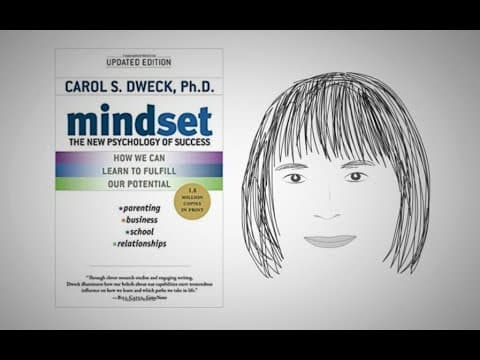
[0:09]judged. At the age of seven, I developed a severe stutter, and I feared that I might not be as smart as the other kids in my class. In school, I had one all consuming goal, don't look stupid. In my head, I'd always be thinking, what are the chances that I'm going to stutter and look stupid in this situation? If the chances were high, then I would do anything I could to avoid that situation. It wasn't until I read the book, Mindset by Carol Dweck, that I really understood my constant fear of judgment. In the book, Mindset, author and renowned psychologist Carol Dweck, explains that the constant fear of judgment and the need to avoid looking stupid stems from a core belief people have about themselves and everyone around them. That belief is, everyone has a set amount of intelligence. From that belief, the logic goes, if I only have a fixed amount of intelligence, and if I start making mistakes and look stupid doing something, then I must not have very much intelligence. Dweck calls this underlying belief a fixed mindset. If you have a fixed mindset, you essentially believe you've been dealt a hand of cards in the poker game of life, and you're stuck with those cards. If you happen to get good grades in school, and your parents praise you for it, then you might start to believe you've been dealt a royal flush. But as you get older and face competition in school, make mistakes on tests, and encounter challenging situations, you start fearing that the hand you've been dealt really isn't that good. To maintain the illusion that you're still smart and special and talented, you avoid doing anything that you might look bad at, and you simply lose interest and stop trying. Because if you show that you don't care and you're not really trying, then people can't really judge your full ability. Author Carol Dweck has seen this pattern emerge over and over again in her research. In one study, she gave fifth graders a group of puzzles to solve. Each of the puzzles was within their current puzzle solving ability, and all the kids loved them. But when she increased the difficulty of the puzzles, the children who had been praised for their puzzle solving ability, and developed the belief that they were gifted, showed a steep decline in interest and effort as the puzzles got harder. However, Dweck found that there was another group of children who didn't shy away from the puzzles once they got harder. When Carol asked them why, they said the puzzles were an opportunity for them to get smarter. These kids took the initiative and asked Carol Dweck if she could write down the names of some of the puzzles so their mom could buy more when they got home. These kids had what Carol Dweck calls a growth mindset. Growth mindset people don't believe talent and intelligence is a gift, they believe you have to work for it. A person with a growth mindset firmly believes that with the right strategy and enough effort and time, they can get better at anything. A growth mindset person believes they are always getting smarter.
[3:07]So they're less afraid of being labeled stupid. They know that even if they've been dealt a bad hand in the poker game of life, they can continue to draw more cards by putting in more effort and finding better strategies until they eventually have a great hand of cards. Now, this growth mindset seems inspiring. It seems cool to be able to grow our intelligence, but is it actually true? Well, 40 years ago, the answer would be no. Scientists at the time thought you could grow a little, but you were largely constrained by the default wiring of your brain. But recent science shows that they were mistaken. Based on other books I've read over the years, I've learned three amazing ways you can change your brain, regardless of how old you are. One. You can physically grow your brain. Two. You can speed up the circuits in your brain. And three. You can rewire your brain for increased performance and intelligence on specific tasks. Several years ago, before taxi drivers used GPS to get around, brain researchers took brain imaging scans of experienced London taxi drivers. Researchers noticed that the more time a London taxi driver had spent driving a taxi in London, the larger a region of the brain associated with spatial awareness and memory, the hippocampus, had become. It was apparent that the more demands the taxi drivers put on their brains, the more they had to navigate the challenging road system of London, the more neurons they were able to grow in an area of the brain that they needed to complete their job.
[4:37]But not all brain regions can expand in size. So other brain regions just make circuits faster. This is done by the process of myelination. As I briefly touched on in my deep work book summary, when you focus intensely on a single subject for a period of time, you start forming white sheaths on your brain cells called myelin.
[4:56]This myelin acts like insulation on an electric circuit. A brain circuit with myelin can transmit information up to 10 times faster than a brain circuit without myelin. After you've added as much myelin as you can to brain cells, you can then increase the capacity of your brain by rewiring it so it activates neighboring brain regions to assist with certain tasks. You can think of this like rewiring a house so that when you hit a switch to turn on one light, you actually turn on two or three additional lights nearby. One study showed that when a person practices guitar for hundreds of hours, and uses their fingers in their left hand to play the different notes on the strings of the guitar, they light up regions of their brain associated with the left fingers, no surprise, but they also light up regions of the brain associated with the palm of the left hand. When researchers took brain scans of novice guitar players, only the fingers in the left hand were activated in the brain. It turns out that guitar players who had put in hundreds of hours of practice were able to activate more of their brain so they could play the guitar with more speed and accuracy. Now that I know that I can grow my brain's capacity, I think about challenges in a new way. Before I go into a challenge, I stop thinking, will I look smart or stupid while doing this? And start thinking, what can I learn? After a difficult challenge and a series of mistakes, I stop thinking, I'm not smart enough to do this. And start thinking, I'm not smart enough to do this yet. Now that I've changed my core belief to everyone can grow their cognitive abilities, I am less afraid of being stupid because I know I am continuously getting smarter. Even if I look stupid now, I won't look stupid very long if I apply enough effort and the right strategies. I now have the courage and confidence to go into challenging situations because those situations will allow me to upgrade my brain and learn the skills to overcome future challenges. That was the core message that I gathered from Mindset by author Carol Dweck. Reading this book will set you on the path to becoming an infinite learner. I highly recommend it. If you would like a one page PDF summary of insights that I gathered from this book, just click the link below, and I'll be happy to email it to you. If you already subscribe to the free Productivity Game email newsletter, then this PDF is sitting in your inbox. If you like this video, please share it, and as always, thanks for watching, and have yourself a productive week.


