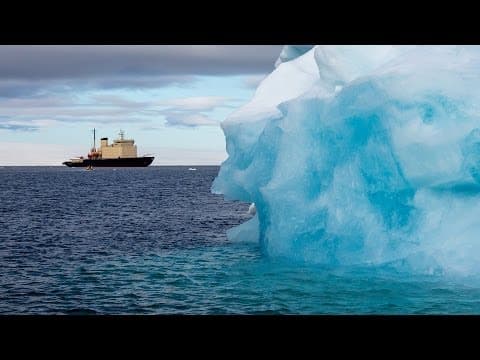
[0:22]In some respects, the Arctic is the least explored part of the world. We know more about the surface of the moon than we know about the Arctic.
[0:35]One thing that scientists universally agree on is that the Arctic is warming. The ice is melting rapidly, allowing all kinds of access to new resources and geographies that heretofore have been frozen and locked away. And that rate and pace of change is having profound implications for the region and for the world. When I think about the Arctic, I don't think about the Arctic in isolation. I think about it in terms of its location in the center of some major geopolitical developments. The so-called reset between the United States and Russia, the crisis of global climate change. The development of China as a major economic actor who is dependent on shipping to have access to resources and markets. The Arctic is in the middle of all of this. Oil and gas resources, mineral resources, fisheries, tourism, shipping, all of these factors are profoundly shaping the new geo-economics of the Arctic. They could be transformative for the global economy, as far as shipping and mineral resources, but certainly a huge boost to the Arctic states. Russia, Norway, Denmark via Greenland, Canada, and the United States. International law and the United Nations Convention on the Law of the Sea gives those five coastal states the right to explore those resources in their exclusive economic zone or EEZ, 200 nautical miles from their coast. And if you can prove that your outer continental shelf extends, you can exploit and explore those resources on the seabed. Canada's new government has put the North higher on the domestic policy agenda than it has been for half a century. All Canadians need to recognize there is a convergence of economic, environmental, and strategic factors occurring here that will have critical impacts on the future of our country. Should these important shipping routes open, like the Northwest passage, which goes through Canadian territory, and the Northeast passage or the northern sea route, which goes above Russia? It could cut off shipping times between east and west. And then beyond the 200 nautical mile exclusive economic zone will be international waters. We call it the doughnut hole, and that's that circle around the North Pole that are the high seas. And so there are non-arctic states like China, other Asian countries, far afield as India are saying, well, eventually we can explore those resources, those are international waters.
[3:23]The Arctic has a rapidly changing environment. In some cases, it has blurred borders. It has very rich natural resources. And in the past, that could lead to increased competition and perhaps military friction. However, recent years show that Arctic nations are actually working in a concerted way towards collaboration and cooperation through organizations such as the Arctic Council, through bilateral agreements, and through a whole host of multilateral regimes based upon the solid bedrock of the UN Convention on Law of the Sea, But it's something that the world should definitely keep an eye on. In particular, how Russia chooses to behave in the new Arctic neighborhood will be very important in terms of how the Arctic develops. I would ask you to pay special attention to the deployment of infrastructure and military units in the Arctic. Russia is actively exploring this promising region, returning to it, and should use all possible channels to protect its security and national interests. Russia's Arctic strategy is largely driven by the need for Russia to be able to use the Arctic region as a base for its energy needs in the future. On the international side, I think it's mostly an issue of prestige and international recognition of Russia as being one of the key if not the key actor in the Arctic. The Arctic Council was established as part of an effort to engage Russia in the post-Cold War era, and the Arctic Council has grown into a regional organization that has stepped up to the plate as the the place where multilateralism takes place in the Arctic. The Arctic isn't a crisis today. Even though you sometimes see headlines that say the new cold war and the race for the resources, it's an area of cooperation. But we have to think in the long term and make some difficult choices about how we spend our precious resources and how we protect our precious environmental resources. We believe that the Arctic is a new frontier for oil and gas. It's going to be relatively expensive oil and gas, nothing cheap over there. But if you think that the oil price are going to be around $90, $100 is still competitive. It's a disaster waiting to happen. We can see the Arctic sea ice melting in front of our own eyes and instead of seeing that as a huge threat to mankind and the planet. All companies are rushing into the Arctic to drill for the oil that caused climate change in the first place. The Arctic is changing, but it's not becoming safer. And to reduce those risks, companies and countries will have to invest literally billions of dollars. Arctic governments will have to decide whether they're prepared to take decisions together that will raise the costs of Arctic development, internalize some of the externalities and perhaps put something of an economic disincentive on some of the excitement about economic development that we currently hear.
[6:45]The United States, like the other Arctic nations, needs to make investments in hard infrastructure, airfields, roads, ports, and ships to operate there. We need to chart the Arctic. We need better research and bathymetric data. This begins with really a change in attitude of the Arctic's increasing relevance and centrality to international relations.


