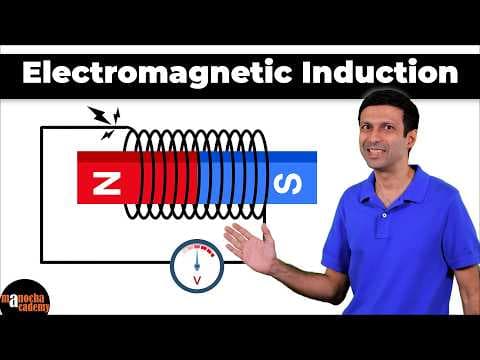
[0:00]Hi friends. As we discussed in an earlier video, a current carrying wire produces a magnetic field around it.
[0:09]This is called magnetic effect of electric current or electromagnetism.
[0:14]So electricity produces magnetism. But is the reverse also true? Can magnetism produce electricity?
[0:23]The answer is yes. This phenomena is known as electromagnetic induction and that's going to be the topic of this video.
[0:33]We are also going to look at Fleming's right hand rule and Lenz's Law.
[0:39]I'm going to make the concepts really easy for you. The production of electricity from magnetism is called electromagnetic induction.
[0:47]And the electric current that is produced is called induced current.
[0:52]Electromagnetic induction was discovered about 200 years back in 1831.
[0:59]It was discovered by British scientist Michael Faraday and an American scientist Joseph Henry independently.
[1:08]Let's understand electromagnetic induction with a simple experiment.
[1:12]For the experiment we'll use a horseshoe magnet.
[1:16]A straight wire is held between the north and south poles of the horseshoe magnet.
[1:22]The two ends of the wire are connected to an instrument called a galvanometer.
[1:28]You might have seen a galvanometer in your lab. It looks something like this.
[1:36]Do you know what a galvanometer is used for?
[1:39]That's right, to detect the presence and direction of electric current.
[1:45]When there is no current, the galvanometer needle points to the zero mark.
[1:50]Now I'm going to pass electric current through this galvanometer. As you can see, there's deflection in the needle.
[1:58]It deflects to the right side of zero, indicating the flow of current.
[2:03]To reverse the direction of current in the galvanometer, I'm going to switch the red and black wires on the galvanometer.
[2:10]Now when I switch the wires and turn on the voltage supply, Can you see that the galvanometer needle deflects in the opposite direction to the left side of zero because the direction of current is opposite now.
[2:24]When the wire is stationary, that is the wire is held in the magnetic field without moving it, the galvanometer does not show any deflection.
[2:35]So when the wire is stationary, there is no electric current in the wire.
[2:40]Now when the wire is moved upwards rapidly, there is a deflection in the galvanometer.
[2:46]This indicates that electric current is produced in the wire. This is called induced current.
[2:54]Electric current can be produced only when there is a potential difference. So a potential difference or voltage has been induced across the ends of the wire.
[3:05]This induced voltage is called electromotive force or EMF in short.
[3:12]Note that the galvanometer deflection lasts for a very short time. The EMF and electric current are produced in the wire as long as there is motion of the wire.
[3:24]When the motion stops, there is no EMF and hence no electric current.
[3:30]To keep things simple in this video, we'll not use the term electromotive force EMF a lot. We will just use the term induced current.
[3:40]Now if we move the wire downwards rapidly between the poles of the horseshoe magnet, again there is a deflection in the galvanometer.
[3:50]But the deflection is now in the opposite direction.
[3:54]So electric current is produced in the wire, but the direction of the electric current is opposite.
[4:00]Again, the deflection in the galvanometer is for a very short time and last as long as there is motion in the wire.
[4:09]So this experiment shows that when a wire is in motion in a magnetic field, electric current is produced in the wire.
[4:17]What do you think will happen if you move the wire up and down continuously in the magnetic field?
[4:25]That's right, a continuous current will be produced in the wire.
[4:30]When the wire is moved up, the current flows in one direction and when the wire is moved down, the current flows in the opposite direction.
[4:41]The direction of electric current will keep changing continuously as the wire is moved up and down. Do you know what is this current known as?
[4:50]That's right, alternating current or AC in short because the direction of the current keeps on alternating changing.
[5:00]Let's understand why electric current is produced in a wire when it is moved in a magnetic field.
[5:07]When the wire is moved in a magnetic field, the free electrons present in the wire experience a force.
[5:14]This force makes the free electrons move in the wire in a certain direction.
[5:20]And what is the movement or flow of electrons known as?
[5:24]That's right, electric current. So when a wire is moved in a magnetic field, an electric current is produced in the wire.
[5:33]Because the free electrons experience a force and that's why they flow in the wire.
[5:41]Electric current is being produced, so we can say that electrical energy is generated.
[5:46]The output here is electrical energy.
[5:50]But let me ask you, where is this energy coming from? What form of energy is converted to electrical energy?
[5:58]That's right, mechanical energy. It's the mechanical energy used to move the wire that is being converted to electrical energy.
[6:09]As we have discussed, when a wire is moved in a magnetic field, electric current is produced in the wire.
[6:15]So when there's motion of the wire in the magnetic field, current is produced.
[6:20]This is called electromagnetic induction.
[6:24]Now let's see how we can predict the direction of the induced current in the wire.
[6:30]We'll use our example of a straight wire in motion in a magnetic field.
[6:35]To find the direction of the current in the wire, we need to use Fleming's Right Hand Rule.
[6:42]Remember we had learnt Fleming's Left Hand Rule in an earlier video to find the direction of force on a current carrying wire placed in a magnetic field.
[6:53]And for electromagnetic induction, we need to use Fleming's Right Hand Rule.
[6:58]For Fleming's Right Hand Rule, hold your right hand like this with the forefinger, center finger and the thumb at right angles, 90 degree angles to each other.
[7:11]The forefinger represents the direction of the magnetic field.
[7:16]It's easy to remember. F for forefinger, F for field.
[7:22]The thumb represents the direction of motion.
[7:27]And the center finger represents the direction of the induced current.
[7:32]You can remember it as C for center finger, C for current.
[7:36]Let's see how we can use Fleming's right hand rule to find the direction of the induced current when a wire is in motion in a magnetic field like this.
[7:47]The trick is to consider each thing one by one.
[7:50]Let's start with the magnetic field.
[7:53]So what is the direction of the magnetic field here?
[7:57]That's right. The magnetic field is from the north pole to the south pole.
[8:04]The four finger represents the magnetic field.
[8:07]So hold your forefinger like this along the direction of the magnetic field.
[8:13]Next let's look at the direction of motion of the wire.
[8:18]So keeping the forefinger aligned along the magnetic field, now align your thumb along the direction of motion of the wire.
[8:26]Since the wire is moving upwards, the thumb is pointing upwards.
[8:31]The center finger will automatically give you the direction of the current in the wire.
[8:37]As you can see, the direction of the induced current is outwards along the wire.
[8:43]One important thing to note is just like Fleming's left hand rule, Fleming's right hand rule also gives the conventional direction of the induced current, not the direction of flow of electrons.
[8:56]Now what will be the direction of induced current if the wire is moved downwards here?
[9:02]Again, let's use Fleming's Right Hand Rule.
[9:06]The forefinger points in the direction of the magnetic field.
[9:11]Since the wire is moving downwards, the thumb which represents motion will point downwards.
[9:18]The center finger will automatically give us the direction of the induced current.
[9:24]As you can see, the direction of the induced current is inwards along the wire.
[9:30]So out of these three things, magnetic field, motion, and induced current, if the direction of two things are given to us, we can use Fleming's Right Hand Rule to easily find the direction of the third thing.
[9:45]But just remember to keep the three fingers at 90 degree angle, right angle to each other.
[9:52]You may need to rotate your hand at the wrist in order to align with the question that is given to you.
[10:00]Fleming's Right Hand Rule may seem a bit difficult at first but with practice I'm sure you'll find it really easy.
[10:07]Let's go ahead and put Fleming's right hand rule on our concept board.
[10:12]We discussed the concept of electromagnetic induction using a straight wire that is in motion between the poles of a horseshoe magnet.
[10:24]Now let's look at the experiment where the wire is in the shape of a coil and a bar magnet is used.
[10:30]The two ends of the coil are connected to a galvanometer.
[10:34]Now let's take the bar magnet and bring it near the coil.
[10:39]When we don't move the bar magnet, that is the magnet is held stationary, then there is no deflection in the galvanometer.
[10:48]This means that there is no current in the coil.
[10:53]Now when the bar magnet is moved quickly into the coil, a deflection in the galvanometer is observed.
[11:00]This indicates there is current flowing in the coil. But when the magnet stops moving, the galvanometer reading shows zero indicating there is no current flowing in the coil.
[11:11]Now when the bar magnet is moved quickly out of the coil, what do you think will happen?
[11:18]That's right. The induced current in the coil flows in the opposite direction. The galvanometer shows deflection in the opposite direction.
[11:28]Now if the magnet is continuously moved into and out of the coil, a continuous current is induced in the coil.
[11:37]The direction of the current keeps changing alternating.
[11:41]So an alternating current is produced in the coil due to electromagnetic induction.
[11:47]In the first example, we saw that the magnet was fixed and the wire was in motion and a current was induced in the wire.
[11:56]In this example, we saw that the wire a coil is fixed and the magnet is in motion.
[12:03]Again a current is induced in the wire.
[12:06]So you need relative motion between the wire and the magnet to induce a current in the wire.
[12:13]This is the principle of electromagnetic induction.
[12:18]Now if we focus on the coil example, when there is relative motion between the coil and the magnet, the magnetic field lines cutting through the coil are changing.
[12:30]The magnetic field lines linked with the coil is called magnetic flux.
[12:35]It is this changing magnetic flux linked with the coil that induces a current in the coil.
[12:42]How can we find the direction of the current induced in the coil?
[12:46]Earlier we had learned about Fleming's right hand rule to find the direction of the induced current for a straight wire.
[12:54]To find the direction of the current in the coil, we can use a law called Lenz's Law.
[13:00]Lenz's Law states that the direction of the induced current is such that it opposes the cause which produces it.
[13:09]Let's apply Lenz's Law to our example.
[13:12]Let's say the north pole of the bar magnet is moving towards the coil as shown here.
[13:19]The induced current will flow in such a direction that there is a north pole on the end two of the coil and a south pole on the end one of the coil.
[13:30]Now the coil can repel the magnet. Because according to Lenz's law, the induced current should flow in such a direction that it opposes the cause that produces it.
[13:42]So it's opposing the motion of the magnet here.
[13:46]And remember the clock face rule, to produce a north pole on N two of the coil, what should be the direction of the induced current if we are looking from N two?
[13:57]That's right, the current will flow in the anticlockwise direction and that's how a north pole is produced at N two and a south pole at N one.
[14:10]So Lenz's law helps to find the direction of the induced current in the coil.
[14:16]Now when the magnet is moved away from the coil, the current will flow in the clockwise direction and it will produce a south pole at N two and a north pole at N one.
[14:30]Now let's see how the magnitude of the current induced in the coil can be increased.
[14:34]One way to increase the current is to increase the area of cross section of the coil and increase the number of turns in the coil.
[14:44]Another way is to increase the strength of the magnet.
[14:48]You can also increase the speed of the relative motion between the coil and the magnet.
[14:54]This will increase the induced current.
[14:57]Now let's place these different ways to increase the magnitude of the induced current in the coil on our concept board.
[15:05]Now let's look at another interesting case of electromagnetic induction where there's no magnet.
[15:12]We just have two coils placed side by side as shown here.
[15:17]Coil A is connected to a battery and a switch and coil B is connected to a galvanometer.
[15:25]What do you think will happen when you press the switch on coil A?
[15:31]Current will pass through the coil A. But something interesting is observed on the galvanometer in coil B.
[15:39]When the switch is pressed, the galvanometer shows deflection for a short time and quickly returns back to the zero position.
[15:49]This means that a current has been induced in coil B.
[15:54]Now when the switch is turned off in coil A, there is again a deflection in the galvanometer, but now in the opposite direction.
[16:03]The galvanometer deflection is there for a short time and the pointer quickly returns back to the zero position.
[16:11]Now what do you think will happen if you keep playing with the switch and keep on switching it on and off continuously?
[16:19]That's right. The galvanometer pointer keeps on moving on both the sides.
[16:26]And this shows that an alternating current is induced in coil B.
[16:31]But how is electromagnetic induction happening without a magnet here?
[16:36]Let's take a closer look.
[16:39]Initially, the switch in coil A is in the off position.
[16:43]When we switch on the current in coil A, it becomes an electromagnet.
[16:49]Coil A produces a magnetic field around it. The magnetic field lines go and cut through coil B.
[16:56]It's like pushing a magnet into coil B.
[17:00]So a current is induced in coil B and there is a deflection in the galvanometer.
[17:06]When the current in coil A becomes steady, the magnetic field lines cutting through coil B also becomes steady.
[17:14]Now there is no changing magnetic field. So the current in coil B becomes zero.
[17:20]When we switch off the current in coil A, the magnetic field lines will disappear.
[17:25]This is like pulling a magnet out of coil B.
[17:29]So a current will be induced in coil B, but in the opposite direction.
[17:34]The galvanometer deflects in the opposite direction. A changing magnetic field induces a current in coil B.
[17:43]This happens when the current in coil A is switched on and when it is switched off. If we keep switching the current on and off continuously in coil A, the magnetic field will keep on changing.
[17:56]So a current will continuously be induced in coil B. The current will be alternating in nature.
[18:03]So an alternating current will be induced in coil B.
[18:07]I hope the concept of electromagnetic induction is super clear to you now.
[18:12]Do you know where this principle is practically used?
[18:16]That's right, in an electric generator.
[18:19]There is relative motion between the coil and the magnet in the generator. This induces current in the coil.
[18:27]And that's how electricity is produced by a generator.
[18:31]And that's how we get electricity in our homes and offices. It's being produced by a generator located in a power station far away from the city.
[18:42]And to revise the concepts, just go to my website manochaacademy.com.
[18:47]To make it easy, I'll put the links below.
[18:50]Thanks for watching.


