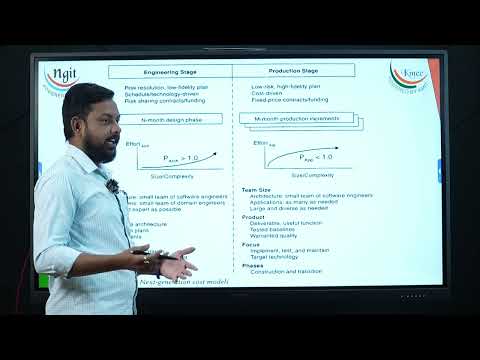
[0:05]Welcome back, students. So, in this lecture we'll try to understand about next generation software economics. So, uh, we, uh, so far we have discussed about the different conventional models and modern approaches that are available in your software development process. So, this particular lecture will make you understand what is the impact of the new generation software models on the economics related to your software development. So, many software organizations are making use of this new generation software, uh, software models in order to build their softwares and the impact of this particular, uh, modern approaches could be analyzed by using this cost models of your next generation and your modern software economics. So, so, what, what, what do I mean by this, we'll try to understand. First, we'll see what are these next generation cost models available. So, software experts, uh, they are widely making use of this software, uh, next generation software economics here. So, what is this going to do is, uh, the, your software experts, they like, okay. So, here the software experts are making use of this next generation soft models. This is used to identify what is the, what is the difference between your, uh, what quality versus your dis qualities, scale versus your dis scaling, right? So, this is also going to find the differences between productivity versus your quality. Right? So, it is also going to identify the differences between your programming languages like if I if I if you are going to make use of your Java programming language in order to design your product. So, how is it different from another object oriented programming languages from C++. If you are making use of some testing tool, say how is this testing tool T1 is different from your T2. So, in on on the basis of these particular approaches your modern software cost models differs. So, how one approach is different from other and in what way they are different. So, this will impact on the cost and the cost of your product project development. Right? So, your next generation, it actually focuses on your architectural design majorly rather than focusing on the documentation. Your next generation models is completely based on your cost development, uh, sorry, on your product development. So, the total effort of this particular product or of this particular model can be taken as your effort is equals to, the effort could be taken as effort is equals to the total focus on the architecture, comma, the So, T stands for your technology parameters that you are used, S stands for your scale of parameters, Q stands for your quality and P stands for the process or the parameters that you are going to make use of in your architecture. Plus it is also totally equivalent to the applications that are being used in your software. So, same, so this is taken as the total effort related to the focus of your, uh, technology, your scale of quality, your quality and the process that is being used. At the same time, you can also measure the time related to your product development in the same fashion. So, time can be taken as the total focus laid on the process of the architecture that is being followed, comma, the effort of your architecture. So, we have already discussed this particular effort depends upon this four different parameters. Plus, plus again the focus of the process of your application, comma, the effort of your application. So, this is how the cost and cost and time could be measured in your next generation software models. So, here this next generation software models will give you, uh, uh, like, how how the how the effort is being differed from conventional model to non conventional models, that is your iterative models. So, when we talk about your conventional models, like conventional models the effort of your the effort related to the human is more when compared to your modern software approaches. So, in in this case, what I mean to say is like your conventional model is majorly focused on the human efforts, so human human are supposed to code the program from the scratch or they are supposed to be involved from the scratch of your project development. But when you go with your, uh, modern software approaches. So, the cost laid on the human effort is less and the cost laid on the automation of your project is more. So, most of the project development is focused on the automation of your project itself. So, many automation tools are used when compared to your conventional models. So, this particular diagram gives you how it is different from other. So, here, in your engineering stage, if I take it as your conventional model, the effort of your the effort of your architecture design is taken in this form. When you go with the say in your production stage, the effort laid on your the effort related to the size of your project is taken in this particular form. So, always the process is less than the process achieved in your engineering stage is less, and it is gradually increasing and the effort laid is rapidly increased in your production stage. Right? So, these are the different parameters what they have already discussed with your formula in your previous type previous slide. Right? So, here, uh, the basic thing is, uh, if you are making the cost used in your next generation models could be reduced if you are able to overcome the overheads of the cost wasted on your human being, like people intervention and reduce the cost related to your automation also. So, most of the modern process modern approaches are going to focus on automation here. Right? So, here this diagram is going to give you a potential differences between the solutions on your cost estimation models. Right? So, here if you based on the number of iterations that are being performed in your project, the cost related to your project also increases. So, in your conventional model, you start building your project from the scratch and we all know this this from your very first lecture. Right? So, whenever you are building your project, whenever you build your project, if I take this as to your problem space. So, these are the different units of your project development here. So, first is how many requirements you require, how many requirements are there in your project and this requires what is the complexity of involving them into your project and this indicates how many use cases you are going to draw and this indicates what is the complexity of your use cases. So, based on this particular problem space, say your solution one is designed. Solution one is designed, So, how this particular solution one, the cost of this particular solution one can be taken as the total value is the features plus quality plus life savings. By your risk schedule and cost. So, as the number of solutions being developed increases, the cost wasted on this particular project also gets increased in your conventional model. So, here, cost estimation depends on the total number of solutions that are, uh, like released from scratch to the end.
[8:43]Right? So, here, uh, this the total number of, like, okay. So, as per the author of this particular textbook. So, in the next generation software cost models, he is suggesting two different improvements.
[10:04]So, first improvement is separation of your engineering stage from the production stage. So, here, uh, this particular thing, it is going to force, uh, the estimation between, right? So, if this engineering stages is separated from the production stage, this will help you in separating the scale of your program with the quality of your program here. Right? So, what is the implementation size that you are supposed to, what is the implementation size of your project can be separated from the scale or the total number of programs that is supposed to be developed. So, this will help in organizing your project and improving your requirements more easily. Second is this rigorous design notations. So, these notations will help you in, right? So, by using various UML diagrams, you can start code you can start designing your projects or you can code your different entities or attributes of your project. So, this attributes or this particular design will help in automation automating your project rather than focusing on re-implementing the same set of statements multiple number of times. If any changes are there, so rather than focusing on implementation part. So, there are number of automation tools that are available which can automatically code your classes based on the UML diagrams that are designed. So, before hand you are supposed to design your notations very clearly. So, these are the two improvements that are supposed to made in order to improve the next generation cost models here. Right? So, okay. So, here, uh, these particular improvements, what I have already stated. So, that is going to provide you different environments here. So, in your conventional model, what actually happens is, say, if I take these as your basic phases of your project. So, in your conventional experience, each and every phase is dependent on other phase and your data and the cost wasted on each and every phase is equally distributed or depending on the requirements of your phases, the cost is distributed. So, here the time, your project may or may not be deployed on time and depending on the project requirements or project, right, project requirements, your you may or may not make the changes necessarily, but cost wasted could be increased rapidly. So, the cost totally wasted on your conventional experience is more. But when you go with your software experience, so this actually depends on your artifacts that are being led and, fine. So, this management, it is purely based on the artifacts and based on your necessary artifacts, you can even increase or decrease your like include your artifacts or remove your artifacts. So, when compared to your engineering experience of your conventional model, software engineering experience is comparatively less in terms of your cost. But when you go with your third phase, that is your next generation cost models or next generation environments. So, here what is this next generation environment going to do is it is making use of your round trip engineering phase. So, this particular round trip engineering phase, it is going to split or divide all these, sorry, it is going to overcome this implementation part or remove this implementation part. And it focuses majorly on these three parts only. So, the cost could be majorly cost could be majorly placed only on these three parts. So, what about this implementation part is, so this implementation part could be done most majorly from the automation tools. So, there are number of automation tools that are available, so based on this particular design that is generated. So, there are number of automation tools which focus on generating codes to this particular design and overcome this implementation cost here. So, what actually happened is by using this next generation environments, your automation has come into picture and it is reducing the total cost when compared to your conventional model. So, this is how your construction process has been reduced. Time and cost has been reduced in your construction when you compare it from your conventional to the next generation models. Right? So, so that is about your next generation cost models. So, next generation cost models were reduced in the same fashion. Uh, so that is all for this lecture. Let us meet in your next lecture. Thank you.


