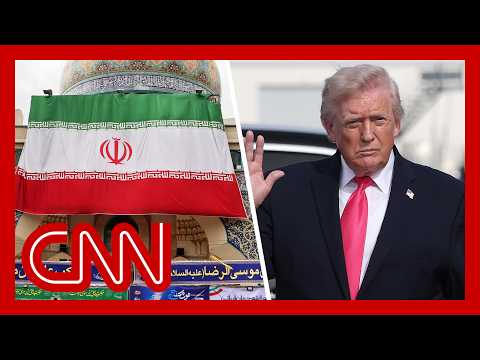
[0:00]All right. So, we've got a little bit of breaking news here. There's a new statement from President Trump just posted on his truth social platform. He says this, quote, based on the fact that the Government of Iran is seriously fractured, not unexpectedly so, and upon the request of uh Pakistani officials, we have been asked to hold our attack on the country of Iran until such time as their leaders and representatives can come up with a unified proposal. I have therefore directed our military to continue the blockade and in all other respects remain ready and able and will therefore extend the ceasefire until such time as their proposal is submitted and discussions are concluded one way or the other. President Donald J. Trump. Barack Ravidd, I mean, how do you read between the lines of this? I mean, the president here clearly, we will therefore extend the ceasefire until such time as their proposal is submitted. Uh you were talking just at the top of the show about thinking we could see this resumption of hostilities any moment. Seems like the president's taking that off the table for now. What say you? Well, first uh we said uh right that uh Vice President Vance postponed his trip to Pakistan indefinitely. I think President Trump here announced uh that there will be a ceasefire indefinitely. Um he did not give any time frame for this extension of the ceasefire. And I think what we see here is what I, you know, I think we we discussed, you know, earlier in the show. President Trump wants to end the war. He did not want to resume it. He wants a diplomatic solution. He thinks that all the military objectives as far as I again, this is what I hear from people around him. He thinks that the military objectives have mostly been achieved and therefore the other objectives that uh still need to be achieved will be better achieved through a diplomatic deal. especially when it comes to Iran's nuclear program, its enrichment program and its uh enriched uranium stockpiles. Uh and I think this is the reason that President Trump just now announced that he he's extending the ceasefire indefinitely. I think this means that he wants a deal. The problem is that if you announce such a thing, you take a lot of your leverage away. And while the the blockade still will still continue, I'm not sure that the Iranians will now feel that there's credible military threat. Therefore, I'm not sure it will lead to concessions. Richard Hass, always wonderful to see you. Thank you so much for being here.
[2:37]Uh what do you make of what the president has announced here? I have to say, uh the language alone in this post is remarkably sober by President Trump's standards. Well, I think what happened is people look at the implications, for example, of resuming uh conflict of start attacking. And we don't, we don't have essentially a serious target steft left anymore. Plus, renewed warfare opens up the possibility of Iranian retaliation against the countries of the region. That would be a that would be a disaster. So I think the president wisely extended the ceasefire. And I think what you have now, Casey, even though you don't have formal negotiations, I think this is an interesting moment for signal passing, whether it's direct or through Pakistan or whatever. Because what you could have, for example, is the United States could signal what we would be prepared to do with standing down the blockade, what we would require of Iran. Or we can send some messages about nuclear issues or or what have you, or what we would want in order to get the talks restarted. So I actually think this is uh it's actually a positive a positive development here. One of the pieces of this message was him, the president saying that they're going to wait for the Iranians to come back with a proposal of of some sort. And Barack Ravid was on earlier reporting about splits essentially between the military and civilian wings of the leadership of Iran. What role do you think that's playing here?
[4:36]Well, it's both ironic and it's serious. It's ironic because the United States is in no small part responsible for it. The United States and Israel, all the targeted killings of Iranian political, clerical and military leaders created a leadership vacuum. And what you now have is all sorts of people getting their footing, competing with one another. So it doesn't come as any surprise if, you know, the other day when the Iranians sent their delegation to Islamabad, they could have filled Madison Square Garden with it. There were so many people representing so many uh constituencies. So I think, you know, giving them some time and putting the ball in their court, letting them propose something rather than jamming them with an American position. I think this is much better. It forces them to come to terms with one another and we're not put in the position of putting on the table something that looks uh unrealistic or from their point of view uh insulting to their dignity or or or pride. So I actually like this. It gives everyone a little bit of time to take a breath and it gives them some time to sort themselves out.
[6:11]What do you think are the best and worst case scenarios sitting here today? Well, the worst we already alluded to, which is that talks for whatever reason don't go forward, either because the Iranians can't come to agreement or we openly put something on that they reject out of hand. And then you have a resumption of hostilities and things escalate and bad situations could get worse and that would be the definition of that. A lesser bad situation would simply be the straight stays closed, that you have, you don't have active hostilities, but you have a closed straight of Hormuz which leaves everybody, Iran as well as the the world worse off economically. The best is obviously you get some kind of a deal on the straight that allows it to to reopen and it puts a limit on Iranian control or or influence. And then secondly, you deal with the either the nuclear issue, you know, to some degree. You don't have to necessarily solve it, but you you deal with it, you park it in an acceptable place. I don't think it's realistic to think we're going to get a deal on other issues like Iranian support for proxy groups or Iranian ballistic missiles what have you. My own sense is that that's a too ambitious, but the two principle issues, the straight and the nuclear issue, getting some resolution of those two on terms we could live with. I think that's the best we could hope for and I think it's I think it's a possibility. I don't I don't think anybody should rule it out. As you sit here and and lay that out uh for us, very smartly, of course, it just occurs to me that you know, the straight of Hormuz was not on the table as an issue really before we started this war. Do you see America? If if we have that best case scenario that you laid out, are we better off in the wake of this or are we not? No, we'll be lucky if we're not worse off or not too much worse off. You can't be better off with the straight of Hormuz because there was no issue there beforehand. So at best you get back to where you were and probably more realistically we won't get all the way there, but maybe we can get 90% of the way uh there. The nuclear issue, again, it wasn't an active issue. Iran was not about to do anything new when we started this war six weeks ago. There's no intelligence there. The kind of deal we're going to have to negotiate is probably the sort of thing that Messrs Woodcoff and Kushner were negotiating just beforehand and rejected. So we're going to come back to some, the same set of issues, by the way, that the Obama administration negotiated and this administration wouldn't negotiate. Uh inevitably, we're going to, we're going to end up there. But are we better off or worse off even under the best case? My sense is the only positive is Iran is for years going to be weaker, but they'll be able to regenerate their drones and ballistic missiles and the uh and and the rest. The the downsides though are many. Iran's learned some dangerous lessons about its ability to influence the region and the world by controlling the straight. American munitions stockpiles are much diminished. America's relations with its golf partners with its allies in Europe and Asia are strained uh to an extraordinary degree. American standing in the world is down. So overall, uh even under the best case, it's hard to see shall we say that we're that we're better off. I just don't see it and I think history will be will be probably quite critical uh what again was a discretionary war, what I would call a war of choice that didn't have to be fought at this time. Uh I think history's going to be quite tough that the results won't won't justify the decision to go to war. All right, Ambassador Richard Hass, always really appreciate your perspective. Thank you so much for coming on.
[11:09]Ambassador Roger Carstens, uh Ambassador, good to see you again. Um what do you make of President Trump extending the ceasefire? It sounds indefinitely. You know, Jake, thanks for having me on. Uh uh yeah, it sounds like that's what he's trying to do. Um I think in terms of what I am interested in always and that's bringing hostages home. I think in a way when you extend a ceasefire like this, you lose a little bit of leverage. I think in my perfect world, we would have ended the ceasefire and at least had the threat of military force in a to in an effort to increase leverage, which could be used not only to achieve our political military aims, but also to bring some of the six Americans that are held by the Iranians home to the United States. I want to get to those Americans in a sec, but but I want to also ask the Trump administration is considering imposing a new round of sanctions targeting Iran.
[12:13]Um would that help help in getting Iran to negotiate not only for some sort of peace deal having to do with this war, but also to release uh these Americans. I I don't recall hearing anybody in the administration say that they are. You know, Jake, all we have is that story that came out in the Washington Post on the 10th of April, saying that prior to uh uh J.D. Vance heading off to Pakistan that the Americans would be brought up as part of the negotiations. However, after the uh negotiations took place in Islamabad, I've heard nothing and no one that I've noticed heard anything about uh the Americans being a part of those negotiations. I mean, you can, you know where my head's at. I'd encourage the administration to make this a part of their negotiated aims and let's make an effort to try to bring him home. To the west uh of Iran is Kuwait, uh where a Kuwaiti American journalist is being detained. His name is Ahmed Shahab El Dean. Uh Press Freedom Advocates say he was arrested after sharing videos related to the Iran War, such as this video uh on March 2nd of a U.S. fighter jet crashing west of Kuwait City. Um could El Dean be part of negotiation talks, even though it's not related specifically to Iran? Yeah, Jake, remember what happened when we uh made a a grand bargain with Russia on on the 1st of August of 2024. We did what was called enlarging the problem. We we expanded the amount and the, I guess numbers of hostages held in different countries to bring together a deal that might have been inconceivable had it been just done in a bilateral channel. So there's a chance that he might be brought into this. Uh also additionally, Kuwait might be able to or be willing to just uh make a good deal with the United States to let them know that look, you know, publicly, we're going to have this stance, but privately, we'd like to send a very clear message to the United States by releasing him back to you. So my hope is that uh that he gets released soon. I know that they've uh the Kuwaitis have ramped up their national security laws and he uh actually came and perhaps posted a video online at a very problematic time. But clearly, he's a journalist trying to do his job and he's an American citizen and we need to work to bring him home. Yeah, and Kuwait's supposedly an ally of ours.


