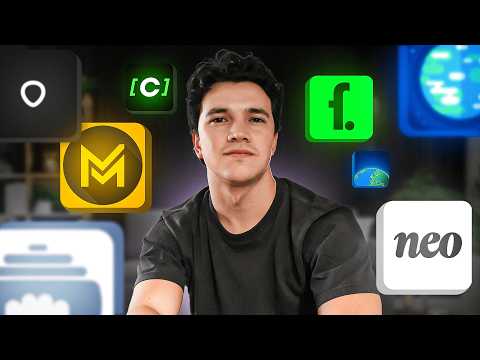
[0:00]So, I've spent the last two years studying faceless YouTube documentary channels because this space is growing like crazy. If you're watching this video, you probably know that these kinds of channels can make a lot of money. I mean, if you just go to view stats here, they're estimating that this channel Fern is making somewhere between 20 and $45,000 a month. But the thing is, of course, that for every channel like this, there are thousands of others that don't even get a fraction of the views. I wanted to figure this out at a fundamental level. What do the most successful documentary channels on YouTube do differently? So I've analyzed literally hundreds of channels like Kurgesagt, Fern, Magnet Media, Cypher, Neo, and I've found a pattern, a few actually. There are a handful of things that these channels do consistently in every upload that make their videos simply better. I call them principles, because to me, these are the fundamental building blocks of a great YouTube documentary. Today I want to share these principles with you and show you examples so you can see exactly what makes these channels so successful. Now, each principle I'll show you today, roughly follows the process of making an actual YouTube video. So, naturally, that means that the first one has to do with the idea. Principle one of all great YouTube documentaries is that they have a compelling lens. And to show you what I mean, let's look at Fern, because honestly, they're probably the best at this. Now, when you see a channel like Fern, at first glance, it looks like their videos are just about random topics, and they are. But the common thread throughout them is that they're analyzing these random topics through a compelling lens. Like, for example, you have this video here about the Mercedes Tower, or the World's Biggest Aquarium, or McDonald's self-order kiosks, or a prison escape, or a nuke, or an attack on the Twin Towers, or the Pyramids of Egypt. But when you look at the title and the thumbnail, which is really the way you communicate a video idea, you'll see that this isn't just a video about the Mercedes Tower, it's the evil design of the Mercedes Tower. This one is why the world's biggest aquarium broke. This one is about the $2.1 billion McDonald's machine, the craziest prison escape, the biggest nuke ever made, the forgotten attack on the Twin Towers, how were the pyramids actually built? Now, this last one about the pyramids is I think one of the most interesting ones, because even though it seems like a simple question, there's actually a lot going on here. First of all, it's a question, which makes it seem like the video is going to be some sort of investigation. Then there's the word built at the end, which makes it seem like the video is going to be about construction. And the word actually here makes it seem like there is some sort of mystery or conspiracy or disagreement about this. So, do you see what's happening here? They're not just saying, here's the thing, they're saying, here's the thing through a specific lens. Now, a lot of other documentary channels are actually scared to do this because they think if I narrow the scope of my video, the naturally the size of the audience is going to get smaller, right? But it's actually the opposite. With a video like the pyramids, you might think that because it's about how they how they were built, that this video would then only become interesting to engineers and people who are interested in construction. But it's actually the opposite. It becomes more interesting to more people. And the reason for this is that curiosity is universal. And the beautiful thing about doing this consistently over time in your channel is that over time that lens becomes your brand. That is why a channel like Fern, which makes the most random ass videos in the world, can build a brand like they have. Their specific way of looking at the world is the reason people keep coming back to their channel. If the first principle was all about the idea of your video, then the second one is all about how you communicate it. Principle two of all great YouTube documentaries is that they have a compelling setup. And in case you haven't noticed the pattern, I really like the word compelling. If you look up the definition, it's actually evoking interest, attention, or admiration in a powerfully irresistible way. And what better way to describe a YouTube video that just captures your attention like that? So principle two, a compelling setup. And the reason for this is, if your title and thumbnail promise one thing, then your video actually has to deliver on that. But there's a right and a wrong way to do this. And to show you what I mean, let me show you this documentary by Primal Space about the crazy engineering of Venice. The video doesn't immediately start by talking about engineering. It actually starts talking about history. You know, in 1492, these people were conquering Italy and the people of Northern Italy had to move to these islands, but they were all like swampy and made of clay, so building there was kind of impossible. At least with their current methods. I mean, it's the essence of storytelling, that's it's a problem, like, okay, we have this challenge, we have to figure out the engineering. The best documentary channels know that when they set up their video with a compelling idea, that they don't have to rush. Now, obviously, this doesn't mean that you just don't have to talk about the thing in your title and thumbnail.
[4:51]You do eventually have to confirm the click, which to me basically means that, yeah, this video is about what I thought it would be. But once you take that box, what matters much more is how you frame that idea, especially in your introduction. There's this idea that you need to pay off your title and your thumbnail immediately inside the video. But this is, I think, a bit of propaganda that the YouTube space is sort of fallen for. I think that much more important than timing here is just the way you set up an idea. And if you manage to pull that off, then your retention throughout the video is just going to be a lot better. Principle three is a clear and compelling structure. Again, with the compelling. Because once the viewer understands the idea for the video and you've set it up in an interesting way, then the question they're asking is, how am I going to get this information delivered to me? The best documentary channels don't leave that up in the air. They're actually very, very clear about it. And again, to show you what I mean, let me show you an example from Kurtz, and this video tired of doom scrolling. This is the video that made me realize how powerful this principle can be. So the title of the video right now is Tired of Doom Scrolling, but it actually used to be, Is Our World Broken? So the video sets up this idea by talking about how, you know, in the 21st century, we have more abundance than ever. And yet, as advanced as we have gotten as a society, we are not without our problems. So the question becomes, is our world broken? And that is a compelling question that you want the answer to. But then the viewer naturally is going to be asking, how are they going to answer this question? And this is how they do it. But as Terry Pratchett said, we are the storytelling ape. We think in narratives and live in a network of stories that make up our world. So, without minimizing the darkness, we want to add a story that we find helpful for dealing with the world. That, which you just saw there, is masterful. Basically, what they did is they tell people like, we are humans, we think in stories. So today, we want to tell you a story that we use to think about this. A story is a kind of structure, just how like a list of 10 facts is a kind of structure. So, first of all, you have to find a compelling structure, because that makes your video interesting, it adds intrigue and curiosity. Second, it needs to be clear. You know, YouTubers talk a lot about retention and optimizing, but the number one thing that's going to make people click away from your video is not if you're not using fancy animations or transitions, or retention loops and curiosity hacks. The number one reason people are going to click away from your video is if they are confused. You can have a boring video and people will watch it, but if you have a confusing video, people will click away 100% of the time. That's why setting up a structure at the beginning of your video and making it clear is so important. Of course, depending on your video, the structure can vary, like in this video, it's very clear, it's a story. In this video you're watching right now, it's a list of principles, but in another video, it could be a step-by-step guide. It can be discussing different theories, it can be an engineering breakdown of how a device works. It doesn't really matter what you pick, it just has to be right for the context and the audience clearly has to know what ride they are going on. And if it's compelling, hopefully, it'll be a ride that they actually want to be on. All right, so, the fourth principle here is where we finally move past the setup of the video and actually get into the making of it. Principle four is that your video format and your visuals have to match. And it's shocking how many channels get this wrong. If you watch YouTube documentaries, everybody is trying to do this 3D style, and it's because of Fern. They weren't the first, but when people started seeing them getting hundreds of thousands of subscribers every single month, then they naturally thought, like, hmm, you know, they're doing this 3D thing, I should too. But it's a mistake, and let me show you why. YouTube, as you know, isn't about cinema-level production quality. You can have a video like this, for example, and it'll get millions of views. Meanwhile, for example, you'll have one of these 3D videos, and as cool as it might look, it'll get nothing. That's because there is just such a variety of content in YouTube that the visual styles have to match with that. For example, in this video by Neo, it's about how Formula 1 pit stop works. 3D is a great option here because it's something inherently physical, it's like people moving things. So it makes total sense. Magnetts Media does business documentaries. In their case, motion graphics works perfectly because they have to explain these abstract ideas like the business model and how a certain business got customers. Motion graphics can be perfect for that. For a channel like Real Life Lore, they're making a video about World War I. Then a map is the perfect way to show, like an army advancing. Your visuals don't have to be fancy, they just have to work. You know, they need to make your story clear, they need to make your concepts work, they need to make your video more intriguing and emotional and impactful. But they don't have to be fancy. And this also doesn't mean that you have to stick to just one kind of visual throughout the video. What matters most is that you are using the visuals that are the most effective way to communicate what you're saying. So, in a nutshell, don't do 3D for 3D's sake, just use what works for you. So you've got the visuals now, and what's underneath it now is the writing. That's why principle five is bulletproof storytelling. Look, no matter what kind of video you're making, you're going to have to use storytelling. But I've found that this is something people really, really struggle with. And it's a shame because the writing is truly the foundation of a great video. So one of the best examples I've seen on this, and I'll admit I'm a little biased because I worked as a researcher and writer for this video, is Magnate Media's documentary on John D. Rockefeller. That video has over 7 million views today, and I think it's one of the best videos ever put to YouTube, period. And let me show you why. If you read the script for that video, not a single sentence, probably not even a single word is wasted. There's absolutely zero fluff. Something I learned from the owner of Magnates from working on this video and a few others is that stories are just a sequence of events. But how you connect them is what makes the story truly great. The mistake you'd see is that people just add event one and then event two, and then event three, and then event four. But that makes the story boring, and it's almost like cognitively overloading. What you have to do instead, and this is just a general storytelling principle, is that you have to connect your events through either causation or conflict. Through causation, that means event one happens and that leads to event two happening, and that leads to event three happening. And through conflict, that means event one happens, but event two happens, so event three happens. And then the next level of storytelling beyond that is making sure that those events are the right events. So actually in the first draft of this Rockefeller video, I actually wrote more about Rockefeller's business partner. It was this guy called Henry Flagler. He's mentioned a little in chapter two or three, but then the video just really doesn't talk about him. And this is actually a great choice. John, the owner of Magnate Media, when he was editing the script, he removed a lot of the things about Henry Flagler, because they really were unnecessary, they were diluting the story. What the best documentary channels do is they just focus on the best and most interesting parts of the story, and then connect them together through conflict and causation. This is what makes YouTube videos feel like you just have to watch them, because when a story is well-built, and it's built with the right things, then it's just irresistible. And so that's what I mean by bulletproof storytelling. For the sixth principle, now that you have your story in place, it's time to actually put some words in it, and that's what this is all about. Principle six is clear over clever writing. So again, to show you what I mean, let's look at a video that I wrote for the channel Cypher. This video was about a failed bank heist, and I mean, the story had everything. It had robbers, it had the police arriving, it had a crazy shootout where over a thousand bullets were fired, it had a car chase, it had everything. You'd think that with a story that intense, that the script probably should read like an action novel. Wrong. You read that script, it isn't really action packed, the story behind it is, but the words expressing that story isn't. This is just my philosophy around writing. If you're already telling a good story, then your job isn't to elevate that story, your job is to not mess it up. What I mean is that the story is only as good as it is. And then the way you tell it, you can either get to 100% of its potential, or make a few mistakes, you'll reach 99% of that story's potential, 95, 90, 80, 70, 50. And so how close you get to that potential really depends on how clearly you tell the story. Whatever kind of genre story you're telling, you know, it can be action, it can be horror, it can be philosophy, it can be mystery. People tend to think that your writing has to match the style of the genre, and yes, it does. But what people get confused here is that they think that the writing itself is the thing that is going to be responsible for creating that mood. It's not, and this is coming from a script writer. The truth is, on YouTube, especially in narration heavy videos, which many documentaries are, the mood you're trying to create for your video does not come from the writing. It comes probably most importantly, from the way you deliver your narration. If you try too hard to create the mood with words, it ends up sounding cringe. Like I said, if you're writing about a good story, it's going to tell itself as long as you don't get in the story's way. A scary story is scary in and of itself. An intense bank heist is already intense by itself, and often if your writing becomes too clever or too dramatic, then what ends up happening is your writing becomes confusing. And like I mentioned again, confusion is going to be the number one reason that people click away from your video. So that's why clear over clever writing is so important for these documentary channels. Now, like I mentioned, there are these kinds of videos where you want to add that element of drama. You want to add a certain mood, there are more effective tools for that than writing. And again, this is coming from a scriptwriter. This is why principle seven is exceptional sound. The best example I can think of this is, without a doubt, James Jany. Technically, he's not a faceless creator, but he makes some of the best documentaries on YouTube, and there's a lot you can learn from him, even if you make faceless videos. When you watch his videos, you can't look away, because they're just so immersive. And there are three main reasons for this. First of all, narration. It's the stuff we were talking about before. Much more important than the actual words you say is how you say them. There's actually even been some science around this. When you are talking to people, the words you say is only a small percentage, like around 7% of the actual message that gets across to somebody. The rest, your body language, your intonation, your pacing, your mood, that is the actual content of the message. So James in his documentaries, he doesn't rely on the fancy scripts. His writing is straightforward, it's clear over clever. He does it with his voice. I mean, just listen to this. Everybody likes a story about an underdog. He's the CEO of the cryptocurrency exchange FTX. The second thing he does so well when it comes to sound is music. Crypto billionaire to bankruptcy. The Southern District of New York has confirmed the arrest of FTX founder Sam Bankman Fried. The once crown king of crypto, now adorned in handcuffs in the month of November 2022. One of the biggest tales of financial fraud was unravelling. This is worse than Theranos, this is worse than Madoff. A lot of people get music wrong, because they want to create this intense mood, then they think intense music. But there's a subtlety to this. As someone who's making these documentaries, you absolutely never want somebody who's watching to start thinking that music is really great. What you want is for your music to add to the mood and the story, without distracting from them. You just want it to pull people in and keep them there, hold their attention. It's just a tool that you use in a very discrete way. And the last thing that James does exceptionally well is sound effects. Again, it's the same principle as with music. You want them to pull you in, but you don't want them to distract the viewer. Honestly, exceptional sound in YouTube is a non-negotiable. You can have the best script in the world, you can have the best editing in the world, but if your sound design kind of sucks, it just won't hit as hard. But on the other hand, I mean, you can have a decent video, you can have a decent script, and with exceptional sound design, the video will just feel like truly completely elevated. So principle eight is true depth, and this is one of the things that separates truly great videos from just good ones. You see it all the time, you log on to your YouTube homepage, you click on a video that looks kind of interesting. Once you get into it, it's all like surface-level stuff. Now these days, most of the time when this happens, you just know that it's a low-effort AI slop video. And the thing is, people can smell this instantly now, like they know what AI slop sounds like. These principles that I'm talking about, they build on each other. So this ties back to principle one, which is having a compelling lens on the topic you're talking about. I think if you have that, you're almost forced to make a video with actual substance. You know, usually when I'm training other scriptwriters, one of the first things that I mentioned to them is that the things you write have to be worth reading. It's almost so obvious that it need not be mentioned, but if you're going to watch a YouTube video, it better not be something you can just Google. It better not be something that you can just ask Chat GPT for the answer. If you look at all the best documentary channels on YouTube, and you watch even one of their videos, you can clearly tell. There's true research behind what they're saying. When I say depth, I don't mean that your videos have to be super deep in like a philosophical way. As a viewer, you just need to be able to tell that there's a real person with an idea and a creative vision behind them. That's why true depth, in my opinion, is the multiplier effect on the rest of these principles that we've been talking about. And for the final principle, the last cherry on top, principle nine of all truly great YouTube documentaries is that they have a profound effect on the viewer. Let me give you an example. A few months ago, I wrote this script for Cypher about the last 24 hours on death row for prisoners in America. The video is very powerful emotionally and there's a lot more happening to it, like there's a lot more pieces to it. I actually want to make a video covering that video specifically. The crazy thing about this video is that we follow a specific death row inmate, which was executed the day that we uploaded the video. Very intentional choice. We take the viewer through the whole journey of those 24 hours. The last meal, the preparations, final words, throughout that entire process. We don't talk about what this guy that we're talking about did. That only comes towards the end of the video. And I know, I know this is a death row inmate, but it gives them the opportunity to empathize with them, or at least put themselves in their shoes. And then towards the end of this video, we reveal what this guy did, which, you know, it turns out, in order to end up in death row, you need to have done something truly horrible. But the point is, with that structure we set up, where you have a chance to put yourself in this guy's shoes, and then suddenly there's this sharp contrast of, this guy is horrible, you probably shouldn't sympathize with him. We end the video with a simple question, asking it directly to the viewer. I'm paraphrasing here, but it goes something like, Perhaps you believe that he no longer deserves his life. The question is, do we as a society deserve to kill him? If you go look through the comments of that video, you'll see that this video really had a profound effect on the people who saw it. I mean, there's people asking, like, why am I crying? There's people with very firm opinions of like, yeah, the death penalty is wrong. There's people with very firm opinions that we should kill all of these monsters. There's people saying, like, oh my God, I was imagining myself in that scenario and it felt just so wrong to subject a human to that. But then when the video revealed what he actually did, I just don't know what to think. Either way, like, whatever opinions, whatever feelings people were feeling in that comments, it's clear that that final question, and that's what the video was really building up to, that final question had a profound effect on anyone who watched all the way through. This is what I think the best of content creation can be, the best of writing can be. It changes people, it has an effect on them. Sometimes it leaves people just fascinated, sometimes it's horror, sometimes it's more philosophical, like in this video about death row. Sometimes it's something deeply emotional, but either way, it imprints something into the viewer. If your videos manage to have a profound effect on your viewer, then you are doing something truly special. You are making beyond content, you're making art. That is the mark of a great YouTube video. In my opinion, it's something to be truly proud about. And so, in the spirit of that last principle, of leaving the viewer with a profound effect, let me try and do the same now. If you've been paying attention, you've probably noticed that none of these nine principles are hacks. It takes effort and it takes time, and it takes a real human person with a true creative vision behind it. So if this video leaves you with anything, I hope it's a profound appreciation of all the effort and care that goes into making these kinds of videos, and why the best ones stand out. So yeah, those are the nine principles of a truly exceptional YouTube video. Now, a few months ago, I made a very specific breakdown on how Fern creates their video ideas. If you're interested to know more about how these documentaries are made, just click this thumbnail on screen right now, and you can watch that video. All right, that's it, and I'll see you in the next one.


