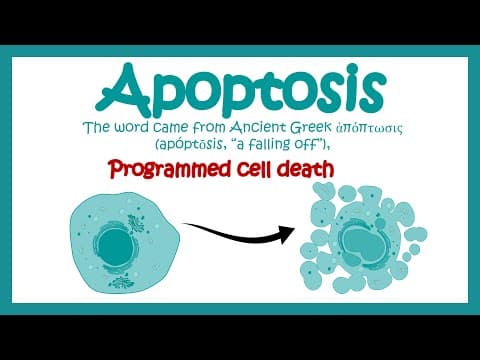
[0:00]In this video, we'll talk about apoptosis. The Greek word apoptosis means falling off. Apoptosis is one type of programmed cell death. In apoptosis, cells shrink and forms these kind of blob-like structures known as apoptotic bodies. And there is an overall shrinkage of the cell size. In this video we'll talk about what is apoptosis, classification of apoptosis, molecules which are associated with apoptosis, and how apoptosis can be detected. So apoptosis is a pathway which is highly regulated and it's a suicide program. In this process, the dying cell activate several intrinsic enzymes that degrade the cell's own nuclear DNA and nucleic and cytoplasmic proteins. So it's an auto-destruction program. Apoptotic cells break into fragments known as apoptotic bodies, which are later on taken up by specific phagocytes. It is important to note that the plasma membrane of apoptotic cells do not disintegrate. The integrity of membrane is maintained, however, the composition of the membrane is altered, which attracts the phagocytes and it has many other roles. So these phagocytes take up these apoptotic bodies or blebbing cell and thereby no inflammation is actually created due to apoptosis. And that's the biggest signature feature of apoptosis. When compared to necrosis, we would see necrosis is often associated with inflammatory response, but apoptosis is not. Moreover, there is no leakage of cytoplasm during apoptosis, whereas there is leakage of cytoplasmic materials during necrosis due to the loss of membrane integrity. In a different video, I have described necrosis in bit more details. So click on the video in the I button or in the description to learn more about necrosis. However, in this video we are going to focus on apoptosis. Apoptosis can broadly be classified into two subtypes. Pathology associated apoptosis, which occurs during many infection or many kind of like kind of pathological situations. And physiological apoptosis occurs during development. And actually, apoptosis is a key regulator of development. So let's try to understand how apoptosis shapes up development and it's an important process in human physiology. Apoptosis could be found and could be seen during the time of digit individualization. All our digits are actually combined by via a thin membrane. And there are many cells which die in during this development process and thereby separating the digits at birth. That means apoptosis actually works like a molecular sculpture artist who is culting and revealing new structures in the course of development. Similar examples could be found in morphogenesis of frog where the tadpole tail is lost due to apoptosis, or we can see similar structure in human brain development. Whereas specific cell type known as Kahal-Retzius cells, which are the transient cell population, they die during the course of development and before birth, they should be dead. If they are forced to survive, then there are detrimental consequences. So that tells us death of certain cell type is equally important like survival. In immunology, we can also see in our immune system, especially in our lymph node, in the germinal center, apoptosis is going on very frequently. In the germinal center, there are a lot of immature B cells which are trying to recognize antigen, but their B cell receptors might have a low affinity towards an antigen or a high affinity towards an antigen. If the affinity is low, then and there these cells are eliminated via apoptosis and there is no inflammation which is evoked. And if the cell has high affinity, then they differentiate into specific plasma cell. That means overall apoptosis is pretty important for cellular physiology. Let's talk about apoptosis happening in pathological circumstances. First circumstance is DNA break. DNA break is pretty detrimental and if double stranded DNA break cannot be repaired, apoptosis might be evoked. Unrepaired DNA break has harmful consequences such as it can stall the replication fork, it can lead to loss of the chromosome segment, etc. In these extreme scenario, when the defect cannot be reversed, then cell choose to die in a regulated fashion via apoptosis and save the cells in the surrounding. Now apoptosis can also be caused due to accumulation of misfolded protein and this kind of theme is very common in neurodegenerative diseases like Parkinson, Alzheimer's, etc. In Parkinson's disease, the Lewy bodies are actually aggregated proteins which accumulate in specific neurons in the substantia nigra and these dopaminergic neurons actually die in the Parkinson patients. Now, accumulation of too much of these aggregates in the endoplasmic reticulum causes the ER stress, which culminates in apoptotic cell death. Now, let us try to understand the molecular pathways which is regulating the apoptosis. There are two different pathways which are most studied in context of apoptosis. One is intrinsic pathway which involves the mitochondria, another is extrinsic pathway which does not involve the mitochondria. So in the intrinsic pathway, there are specific sensors. And in the extrinsic pathway, there are specific receptors which bind to ligand, which are actually giving the signal for apoptosis. These receptors are fast receptors which bind to fast ligand, very commonly found in immune system. TNF receptors, which binds to TNFs. Anyway, these receptors interact with several adapters which we are not focusing right now, but the goal of these receptor ligand mediated interaction is to activate initiator caspase. These initiator caspase get activated or cleaved. These cleaved initiator caspase then can initiate a caspase cascade. And this caspase can activate a ultimate executive caspase. Most of the cases the executive caspase is the caspase 3. So cleaved caspase 3 is the hallmark for apoptotic cell and cleaved caspase 3 can cleave DNA proteins and many other things. Now let's talk about the intrinsic pathway. There are several sensors which can sense something is going wrong inside the cell and the cell need to die. There are BCL2 family sensors which can sense this. Several BCL2 family regulators such as Bax, Bad, all of these can poke holes in the mitochondrial membrane, which leads to the leakage of cytochrome C. Cytochrome C is involved in the electron transport chain. It should not be leaked into the cytoplasm. But when it leaks in the cytoplasm, that means something is wrong and now apoptosis or auto-destruction program has to be triggered. Cytochrome C interacts with other molecules such as APAF1, which further activates and accelerates the process of caspase 3 cleavage. Moral of the story, in both of these pathway, they converge at the step of caspase 3 cleavage. Caspase 3 is the executor caspage which execute the process of apoptosis. It leads to destruction of the DNA fragmentation of the DNA. It also leads to fragmentation of other organelles, ERs, etc. And ultimately it leads to blebbing of the cell. And inside the bleb, we can have a broken DNA, some organelles like mitochondria, lysosome, etc. Ultimately these blebs would be projected out of these cells and that can be uptaken by specific phagocytes. Now, these kind of scenario is pretty common in case of viral infection when there is a viral infection. The virus infects the particular cell type. Now this particular cell type has a specific machinery known as class one MHC generation machinery. So some of these viral proteins are actually degraded by the proteasome and these degraded proteins are uptaken into the ER by a transporter known as TAP1. These viral protein can be loaded onto class one MHC molecule. And the class one MHC molecule bound peptides can be displayed on viral infected cells. These class one MHC molecule bound peptides can signal CD8 positive cytotoxic killer T cells. Cytotoxic killer T cells secrete specific cytotoxic granule. These granules contain perforin and granzymes. All these things lead to apoptosis. So perforin creates perforation or pores and through these pores granzymes come inside. Now these granzymes can actually activate BID or these BCL2 family regulators, which can poke hole in mitochondria and let the cytochrome C be released into the cytoplasm. Now as we have discussed earlier, cytochrome C can interact with APAF1, activate or activate the cleavage of the class caspase 3 and thereby triggering apoptosis.
[10:28]And thereby the virus infected cell dies. Though this particular cell dies, the cells near the vicinity are saved. So apoptosis is an overall protective mechanism during infection as well. So now we understood what is apoptosis. Let's try to focus how one researcher can detect apoptosis. Now, first of all, a researcher can perform immunohistochemistry against cleaved caspase 3 to understand whether the cell is undergoing apoptosis or will undergo apoptosis or not. If there is an accumulation of cleaved caspase 3, that is highly indicative of that, the cell is undergoing apoptosis. Now there are other labeling techniques known as terminal deoxynucleotidyl transferase or TDT, nick end labeling. So this is known as TUNEL assay. In this process, this process is based on the fact that the apoptotic cell would have fragmented DNA. And there are specific enzymes such as TDT transferase. This transferase can incorporate specific labeled dUTP into these DNA and thereby marking the DNA of these apoptotic cells. So here the fluorescence present would ensure that there is a broken there is significant amount of broken DNA in a cell. Most likely that cell is undergoing apoptosis. There are other high throughput techniques known as Annexin-V PI assay. Annexin-V PI assay is basically combined it's basically a assay which is combined with a flow cytometry. The Annexin-V protein binds to the exposed phosphatidylserine on the membrane. Now phosphatidylserine in the healthy cells are often present in the inner leaflet. So they are never exposed to the cytosolic side. But in an apoptotic cell, it is exposed on the cytosolic side such that we can detect it via particular protein binding.
[12:30]Now membrane lipid composition is heterogeneous and there are several type of membrane lipids that are present. We have to understand in in case of apoptosis, the membrane lipid distribution dramatically changes. For example, the phosphatidylserine, which is always present in the cytoplasmic side, now flips into the outer leaflet and that's a characteristic signature. And this is exactly detected by Annexin-V which was actually an anticoagulant protein. And this binds to phosphatidylserine with very high affinity. And this is taken care of using flow cytometry, because a conjugated Annexin-V can be detected using flow cytometry and that would tell us about the status of apoptosis. And now propidium iodide is another dye which gets inside the cell when there is enough amount of uh, so so enough amount of damage to the cell. It's a late stage apoptosis marker. Now if you want to learn details about this Annexin-V PI5 assay and how the flow cytometry can be used to determine that. I have a separate video on that. But moral of the story is looking at the facts data, we can understand whether the cell is at very early stage of the apoptosis when we don't see any signal due to, let's say, a propidium iodide or Annexin-V. It might be viable cell. It might be late stage apoptosis, or it could be also necrosis. In case of necrosis, there is no Annexin binding, but there is propidium iodide which leaks in. So all these signatures could be highly informative for a scientist to understand whether the cell is undergoing necrosis, apoptosis, or the cell is viable at this moment. Now this is a little bit fast in terms of understanding. So you can watch the video at a slower pace and it is the link is provided in the I button. Anyway, in this video we looked at what is apoptosis, classification, and we looked at the molecular pathways which are associated with apoptosis and we lastly look at how apoptosis can be detected by a scientist. I hope this was useful. But before we end this video, let me tell you, in case of apoptosis, there is no secretion of cytokine and thereby no inflammation is evoked. But there are other process known as necroptosis, which is a hybrid of apoptosis and necrosis, which can lead to robust inflammation by secreting specific cytokines. If you want to learn more about necroptosis again, you know how what to do. You can go to the I button or description to learn more about necroptosis. So necroptosis simply means necrosis plus apoptosis. It's a hybrid of these two. And this is highly regulated as well, unlike necrosis. And also there is a loss of ATP, swelling of the cell, ROS generation and release of lysosomal lysosomal enzymes, which are pretty characteristic of this particular cell death. You can get many notes and flash cards regarding several biology topics in my Facebook page, Instagram page. All the links are provided in the description. You can follow me on Instagram and there are specific MCQ contest that is always going on in my Instagram page. You can participate in that Instagram page and win. So last month winner was Rimika Roy. She has given the most number of correct answers. The next month's contest would have a price. This is a particular custom designed coffee mug that you can get. All you have to do is go to my second channel known as Let's Crack Bio Exam and you have to answer the questions daily, put it in the comment and like that particular community post. If you do it for 30 days, the person who gives the maximum number of current correct answer would win. And he or she would get this particular gift. Anyway, you can support my channel via Patreon. You can also support me via the super thanks option, which is present in the bottom right corner of the video. You can click on the super thanks option and pay via net banking, PayTM, PayPal or UPI. See you in the next video. All my social media links are provided in the description. If you wish to connect, feel free, I would be happy to help. See you in next video.


