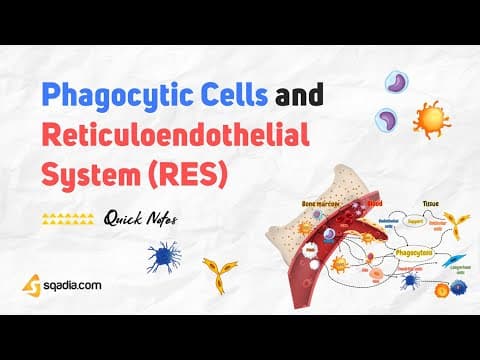
[0:00]Hey Sqwadians, welcome again. Today's topic is Phagocytic cells and Reticuloendothelial System (RES). We all know that we inhabit a world dominated by microbes, where many of them can cause harm. But nature has prepared our body to fight against these harmful microbes by none other than our body's immune system. The immune system is the body's primary defense system against invasion by microbes. We are very well aware that our body's immune system is organized into innate and adaptive components. The innate immune system is the first line of defense for the body, and it uses non-specific cells, such as phagocytes and molecules, such as complement components to attempt to eliminate invading organisms. This is followed by an introduction to the antigen specific mechanisms used by the adaptive immune system, which include, among others, antigen recognition molecules and specific sets of lymphocytes that not only aids in resolving current infection, but create memory for future protection as well. The human body has many natural barriers to prevent entry by microbes, for example, the skin and mucous membranes. However, if these barriers are broken, such as after a cut, microbes and potential pathogens, harmful microbes, can enter the body and can begin to multiply rapidly in the warm, nutrient rich systems, tissues and organs. One of the first features of the immune defense system that a foreign organism encounters after being introduced through a cut in the skin is the phagocytic white blood cells or leukocytes, such as macrophages, which congregate within minutes and begin to attack the invading foreign microbes. Among many other phenomena that body used to fight against foreign invading microbe, phagocytosis is an important mechanism. Although phagocytosis is a normal cellular process for ingesting and eliminating particles larger than 0.5 micrometer in diameter that can be cells own debris or waste, microorganisms, foreign substances, and apoptotic cells. So this process exists in many types of cells and it is in consequence an essential process for tissue homeostasis. Hence phagocytosis is a fundamental defense mechanism against invading foreign microbes. We will discuss this detailed mechanism in our upcoming videos, but here we will try to understand this concept briefly. Inside phagocytes, the process of phagocytosis takes place. Phagocytosis is the internalization of particulate matter by cells into cytoplasmic vesicles. Such vesicles containing foreign pathogen is termed as Phagosome. Phagocytes contain lysosomes that are the granules that contain enzymes that fuse with the vesicles and degrade the particulate matter. In addition, activation of a cascade of phagocyte enzymes leads to the production of toxic molecules, the oxidative burst, which is necessary to kill phagocytosed organisms. Phagocytes are therefore mainly concerned with curing small extracellular pathogens, such as bacteria, protozoa, fungi, and cellular debris. A second important role is that phagocytes can also produce cytokines and cell surface molecules, which alert the adaptive immune system to the presence of infection. So this was brief introduction about phagocytosis. There are many cells that undergo process of phagocytosis and all these cells are called phagocytes or phagocytic cells. The main focus of this video lecture will be different phagocytic cell types. The body-wide system of phagocytic cells that mainly phagocytose foreign particles is known as Reticuloendothelial system (RES). Let's look at the definition of Reticuloendothelial system. The Reticuloendothelial system, RES, is a heterogeneous population of phagocytic cells that play an important role in the clearance of particles and soluble substances in the circulation and tissues and forms part of the immune system. RES consists of the vascular endothelium and reticular tissue cells, and phagocytes mainly various types of macrophages with routine functions that included clearing up the body's own debris and killing and digesting bacteria. However, there is a fundamental distinction between phagocytic cells and endothelial and reticular cells. Phagocytic cells derived from the bone marrow or myeloid cells, while endothelial and reticular cells formed locally from the tissues themselves. Also phagocytic cells, as name implies are the excellent phagocytes, but neither reticular nor endothelial cells are outstandingly phagocytic. In fact, the main function of both vascular endothelial and reticular cells is partly structural. They play role in maintaining the integrity of the lymphoid tissue and blood vessels respectively. However, both cell types have equally important role as signposts regulating the migration of hemopoietic cells from blood into the tissues and through the various subcompartments of lymphoid tissue. Let's have a look at the cells involved in this system. Reticuloendothelial systems mainly consists of endothelial cells and reticular cells, where endothelial cells makes the inner lining of blood vessels and are able to take up endogenous or exogenous debris etc. But these are not truly phagocytic, but provide structural support to blood vessels. Endothelial cells direct the passage of leukocytes from blood into tissues and can both produce and respond to cytokines rather as macrophages do. They can also present antigen directly to T-cells under some circumstances. Whereas reticular cells, the main supporting or stromal cell of lymphoid organs, usually associated with the collagen-like reticulin fibers and not easily distinguished from fibroblasts or from other branching or dendritic cells. Reticular cells provide structural support since they produce and maintain the thin networks of fibers that are a framework for most lymphoid organs. Other than endothelial and reticular cells, there are various other types of phagocytic cells as well. They all originate from stem cells. The totipotent bone marrow stem cell gives rise to all the cells found in blood-like platelets, RBCs, monocytes and all polymorphonuclear cells. Starting with monocytes, monocytes are myeloid cells that means they have bone marrow origin. Monocytes in the blood are immature cells migrating to their site of activity. Monocytes migrate into tissues where they mature into macrophages and take on a number of specialized forms. All macrophage forms have long life spans and survive in the tissue for months or years. The major phagocytic cells involve in reticuloendothelial system are macrophages. So this system is also named as mononuclear phagocytic system (MPS). Tissue macrophages are large cells with specialized granules and cytoplasmic compartments that are found in a wide range of sites. In some tissues, such as bone marrow and lymph nodes, these active macrophages are referred to as histiocytes. Inside tissues macrophages takes on a number of specialized forms. Like, in sites of chronic inflammation, macrophages undergo further maturation and become multinucleated giant cells or epithelioid cells under the influence of T-cell cytokines. Epithelioid and giant cells participate in prolonging the inflammatory response by presenting antigen to T-cells and by secreting cytokines. These macrophages when associated to particular organ, we call them as fixed macrophages. Like, osteoclast, microglia, Kupffer cells, alveolar macrophages and dendritic cells.
[8:50]Osteoclast, the most specialized macrophages are the osteoclasts found in bone which participate in regulating calcium metabolism by resorbing bone and releasing calcium into the blood. It is regulated by cytokines such as TNF-alpha and Interleukin-1 and is thought to have a role in degenerative diseases of joints such as rheumatoid arthritis. Microglia, these are the phagocytic cells of the brain implicated in tissue injury leading to Alzheimer's disease and multiple sclerosis. Unlike other tissue macrophages, microglia may be derived from a special precursor cell that enters the brain before birth and divides within the brain. They are involved in clearing dead neuronal cells. Kupffer cells, specialized macrophages found in the liver where they remove dying or damaged red blood cells and other material from the circulation. They make up a major fraction of the phagocytic cells in the body. While alveolar macrophages as name implies, contribute to the lung's innate defenses. They are involved in disease processes such as chronic obstructive pulmonary disease. Dendritic cells, these are the weekly phagocytic Langerhans cell of the epidermis. They migrate through the lymphatic vessels or blood to lymph nodes and spleen, where they are the main agents of T-cell stimulation. T-cells recognize foreign antigens in association with cell surface antigens coded for by the MHC, a genetic region intimately involved in immune responses of all kinds. There are separate follicular dendritic cells for presenting antigen to B-cells that specialize in trapping antigen antibody complexes. T and B lymphocytes are often found in close contact with dendritic cells. This is presumably where antigen presentation and TB cell cooperation take place. Other than these phagocytic cells, there are some other cells that are not mainly phagocytic, but under certain conditions, inside these cells, phagocytosis may occur. Like, blood platelets, although primarily involved in clotting, are able to phagocytose antigen-antibody complexes and can also secrete some cytokines, such as transforming growth factor beta (TGF-beta). Whereas red blood cells that are mainly responsible for oxygen supply throughout the body, also sometime take part in phagocytosis. Antigen-antibody complexes that have bound complement can become attached to red blood cells via the CR1 receptor, which then transport the complexes to the liver for removal by macrophages. This is sometimes referred to as immune adherence. So, this was all about phagocytic cells that undergoes phagocytosis and thus are an important part of our body's immune system. This video must have improved your knowledge. For more such educational videos, keep watching sqadia.com.


