[0:00]We've seen in several videos so far that most of the waves that humans have have encountered in nature, waves in the water, sound waves or just waves traveling along a rope, they were disturbances traveling through a medium.
[0:15]And so when light displays or has wave-like properties, a very natural assumption was, well, light must also be a disturbance traveling through some type of a medium, even if that medium wasn't so easy to detect.
[0:29]But they conjectured that there is some type of medium that light is a disturbance traveling through, and they called it the luminiferous ether.
[0:36]And much of physics in the 19th century was all around proving that the luminiferous ether existed, and also figuring out what our relative velocity was, what what our relative velocity was in regards to that luminiferous ether.
[0:51]And why do we feel confident or why did they feel confident that there was a relative velocity? Well, we talked about that in the last video.
[0:59]The Earth is spinning and then it's spinning around, the it's orbiting around the Sun at a nice clip, and then the whole solar system is orbiting around the center of the galaxy at a nice clip.
[1:09]The galaxy itself might be moving, so if you have some absolute frame of reference that's defined by the ether, well, we are going to be moving relative to it.
[1:20]And if you said if we're moving relative to it, well, maybe you just measure the speed of light in different directions and see whether the speed of light is faster or slower in a certain direction, and then that might help you identify, well, one, validate that the ether exists, but also think about what our what our velocity is relative to the ether, relative to that absolute frame of reference.
[1:41]But the problem in the 19th century is that we did not have any precise way of actually measuring, uh, or or precise enough way of measuring the speed of light where we could detect the relative difference due to go the light going for or against or into or or away from the actual direction of the ether wind.
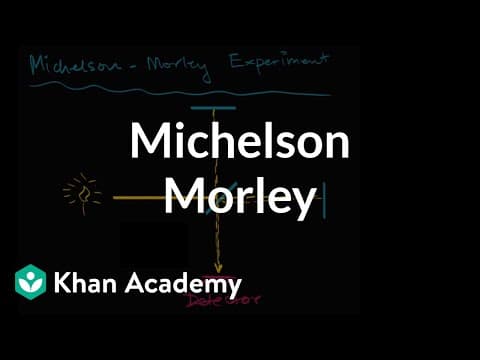
[2:03]And so the experiment that is usually cited with first kind of breaking things open and starting to really make a dent in this whole idea of a luminiferous ether is the Michelson-Morley Experiment.
[2:15]Michelson-Morley Experiment.
[2:20]They recognized, okay, we can't measure the speed of light with enough precision to detect has it gotten slowed down by the ether wind or sped up by the ether wind.
[2:27]But what we could do, and this is what Michelson and Morley did do, but I'm going to do a very a oversimplification of the experiment, and they said, okay, you have a light source.
[2:37]You have a light source right over here. So, you have a light source, and so that's going to send light in this direction.
[2:45]It's going to send light just like that, and what you do is you have a half-silvered mirror that allows half the light to pass directly through it and half of it to be reflected.
[2:56]So let's put a half-silvered mirror right over here.
[3:00]So, there's a half-silvered mirror.
[3:05]And so half of this light will bounce off like this, and this is just a simplification of it.
[3:10]Let me do it a little neater than that.
[3:13]So, half will bounce off like that, and then the other half will be able to go through it.
[3:19]Will be able to go through it, it's a half-silvered mirror.
[3:23]And then we make each of those light rays, we've essentially taken our original light ray and split it into two.
[3:30]Will then will then bounce those off mirrors.
[3:33]Bounce those off mirrors that are equidistant, and there are some adjustance when you actually have to factor in everything, but just as a simple notion, these things are just now going to bounce back.
[3:43]So this one is now going to bounce back, and it's half-silvered, it can go through, or part of it can go through that mirror.
[3:53]So that's that ray, and then this one is going to bounce back.
[3:56]This one's going to go bounce back, and part of it is going to bounce into this direction.
[4:01]And then you can detect what you see. You can detect what you see, so this right over here is a detector.
[4:09]And you might be saying, okay, Sal, well, what's the big deal? You've taken a light source, you've bounced, you've split the light rays, you've put them back together, you've bounced them around a little bit.
[4:18]But think about if there was a luminiferous ether, these light waves that are going in orthogonal directions will be going at different velocities.
[4:30]Let's say if that luminiferous ether, if the ether wind was doing something like, let me see if it if the ether wind were in this direction.
[4:39]If the ether wind were in that direction, when the light wave is going that way, it should be going faster, and when the light wave is coming back, it should be going, it should be going slower.
[4:53]And so what Michelson and Morley did is says, okay, let's assume let's just let's adjust our apparatus right over here.
[5:01]So, when these two light rays bounce off and then come back together, if there were no ether, you would have some basic interference pattern.
[5:10]So, what do I mean by interference pattern? Well, let's say that you have maybe this one bouncing from up here.
[5:19]Let me do that in a different color. So, the one bouncing from the one bouncing from up here.
[5:27]Let's say that that is looks like this, I'll just draw it as a longitudinal wave just like this.
[5:35]Best I hand-drawn longitudinal wave, and then the one coming from the other direction, the one that bounces here, and then comes back like this, is another longitudinal wave like this.
[5:49]And when they overlap, they are going to interfere with each other, either constructively interfere or destructively interfere.
[5:56]So, you could have something like, you could have something like this, so let me copy and then let me paste it.
[6:03]So, depending on how far, how fast each of these traveled, you're going to have different levels of interference.
[6:10]And you would have a difference depending on the orientation, depending on what the actual ether wind is doing.
[6:17]But what Michelson and Morley observed is that no matter how they oriented this apparatus, and they did it at different times of the year, and they rotated it around, and they rotated it in the in the vertical direction and the horizontal direction, no matter what they did, they always got the same interference pattern.
[6:32]The interference pattern did not change, and because the interference pattern did not change, it implied that, well, maybe this ether isn't really having an effect on slowing down or speeding up the light waves.
[6:44]So, this was in is is often called one of the most famous failed experiments in physics.
[6:49]So, let me write this down. What's powerful about it is that it was a failed experiment.
[6:54]Let me get my pen tool out.
[6:57]It was a failed, failed experiment, but it made people start to question, well, maybe there isn't an ether, a luminiferous ether, maybe light just somehow travels through the vacuum, and as we'll see, it's going to be traveling at the same velocity, uh, no matter what frame of reference you look at it from, but we'll explore that more in future videos.


