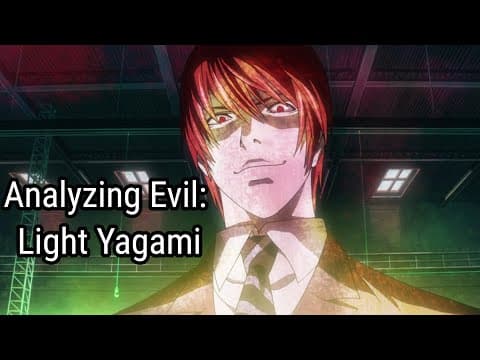
[0:03]Hello everyone and welcome to episode 112 of analyzing Evil, featuring Light Yagami from Death Note. This story is one of constant intrigue, a story that stands out as being one of the greatest ever created in the medium. And within its pages we find a young man given the power of a God who presents us with an interesting moral quandry. If one had the power to kill anyone at the stroke of a pen, would it not be just that you should use that power to eliminate all criminals and evildoers in the world for the betterment of society? Well, in this video, we're going to explore the man who poses this question to us as an absolute truth, and whether or not his actions and beliefs could indeed be considered correct in the grand scheme of things. For those of you who have seen any of my previous videos, you'll know that I typically delve into the intricacies of a character to determine why they do what they do, the reason they do it, and whether or not these components of their character allows us to designate them as being evil or anywhere else on the vast spectrum of morality. This video will contain that, but because of the overarching dilemma that Death Note presents us, that being whether or not killing criminals and the like for the sake of society is good, we're more so going to be focusing on that concept, rather than Light. Though that focus will inevitably allow us to pass judgment on Light and his actions as well. So with that in mind, because of the nature of this topic, this video will inevitably include some of my own personal views on certain things, but I've tried to remain as objective as I can regarding this concept. Feel free to challenge everything you hear in this video down below, as this is a complicated topic and we can all benefit from different insights on this matter. Also, because we aren't so much focusing on Light, what you're hearing in this video can be applied to both the manga and the anime. But I will say that if you haven't read the manga, I recommend you do so, as there are some things in there missing from the anime that really add to the story. Now, without further ado, let's begin. Light Yagami was by all accounts a genius. The son of the chief of the National Police Agency, Light was given every opportunity to allow his intelligence to blossom, and this is shown in the frequent accolades given by his peers, mentors, and loved ones regarding his performance in school and on national exams, which he always placed first in. However, Light doesn't just get by with smarts, as he's shown to be exceptionally dedicated to his studies, quick-witted, and resourceful, traits that would later help him succeed in his efforts to create a new world with the Death Note. Now, because Light's father is a member of the police force, the ideals of a man in such a position were instilled within Light from a very young age, and Light's own values reflected his father's, and so naturally, he formed a strong sense of justice. However, where Light differs from his father is in his view that the world is rotten, a place filled with horrible people doing horrible things, and the worst part is, it never changes. Day in and day out, the news reports the deeds of criminals who just never seem to stop, wars that are always being waged, and atrocities that seem to be just around the corner. He's not exactly wrong, but rather than deriving his sense of justice from a desire to serve society, it would appear that Light's is derived from his desire to ensure that the bad are punished for their misdeeds, which is a key difference. Therefore, when Light acquires the Death Note, who he is and what he has experienced so far in his short life, result in him developing the idea that he must become the one who will change the world for the better by dealing with criminals in the way they should be dealt with, and upon gaining this power, he becomes a much different person. One whose previous sense of justice has caused him to develop the belief that he will be the martyr who will bring ultimate justice to the world, giving his heart and soul up to do what needs to be done for the sake of humanity. Though to what degree he can claim to hold the title of martyr is debatable, as Light often likens himself to a God who will shape the world anew, which along with his propensity to use everyone around him in order to accomplish his goals, without much regard for their safety or well-being, could indicate that Light was a natural-born narcissist. However, because we have minimal exposure to who Light was prior to obtaining the Death Note, it's difficult to say whether or not he is, as it's quite possible that Light would never have displayed many of the traits he shows after his ascension to Kira, had he not acquired the Death Note. And even if we take into account who Light is after he forfeits the Death Note halfway through the series, we still aren't any closer to deciphering whether or not these traits are an intrinsic part of who Light is, as again, our exposure to a Light untainted by Kira, is too limited to know whether or not this truly is who Light is, without the Death Note. So with that in mind, Kira could be considered to be an entirely new personality that was created after Light acquired the Death Note, and that makes a lot of sense. I can't imagine how any of us would react after obtaining an instrument that not only gave you godlike powers, but gave you undeniable proof of the supernatural. Follow the teachings of God and the blessings of the sea will be bountiful, and there will be no storms, a line that we're given at the start of the anime from an unknown text that sums up Light's self-righteous view of his own actions. So, while who Light was is very much a part of who Kira is, it's impossible to tell which components of his personality came from Light, and which came from Kira. We do know that Light became much more vindictive, egotistical, and unsympathetic, but who's to say that these traits weren't already present in his personality prior to his transformation, and that his newfound purpose only amplified them. However you want to look at it, Light could have a personality disorder like narcissistic personality disorder or anti-social personality disorder, or maybe he doesn't. I think the answer is left up to your own interpretation of his character and how he evolves. Now, as we all know, Light develops the goal of killing criminals to make the world a better place. But what's interesting to note here is that these idealistic beliefs that Light displays after obtaining the Death Note can be categorized as being the result of youthful naivete. I imagine that a good majority of adults watching this video can remember a time in their youth when they held some sort of extreme belief that they developed as a result of their lack of experience and wisdom. And perhaps some of you who are currently in the throes of youth watching this video are questioning whether or not you have some beliefs like that right now. I'd like to add though, that there's nothing wrong with having these ideas when you're younger, unless of course, they develop into something wrong. It's just a fact of life. Now, at this point, you might be saying, but wait, six years passed between Light's discovery of the Death Note and the end of this story. So how can you claim that his beliefs are the result of lofty teenage ideals? Well, that's because the difference here, in comparison to yourself or anyone else, is that as you aged, for any number of different reasons, you realized that your larger than life ideas were either wrong or weren't possible for one reason or another, and you subsequently shed those beliefs. Whereas Light was given the opportunity to make these impossibilities a reality. Do you think as you aged that you would have abandoned an idea like criminals and evildoers deserve to die for the sake of the world, if you were given the opportunity to make that dream a reality? I'd say probably not, and Light is no different, but is this such a bad idea? Is Light truly in the wrong and deserving of being labeled an evil person holding evil beliefs? Well, let's explore that now. So on the surface, the idea that all criminals should be killed in order to stop further crime from happening due to the threat of instant death hanging over everyone's head, should they commit a crime, seems like a decent proposal, a classic case of the ends justifying the means. But when we take a deeper dive into this idea, the cracks begin to show. The first problem that I can see is a problem that institutions dedicated to justice all across the world face all the time, the conviction or execution of innocent people for crimes they didn't commit. Light executes people that he's been made aware of through news outlets or other means, and the criminals who appear in these reports are often featured right after they've been arrested for their crimes. So that means that a sizable portion of the people that he kills are people who haven't been proven to be guilty, and it's more than likely that some of the criminals that Light kills are innocent. Also, as this series proves, if you're going to start killing a specific group of people in a supernatural way, someone is going to eventually notice, and to keep yourself away from the authorities, you'll inevitably have to end more innocent lives. Then you have the fact that Light isn't just killing criminals that are traditionally given the death sentence. For all we know, he's killing nearly anyone whose crimes are reported on the news, so even a person whose crimes don't warrant death, like say an embezzler, who Light does kill in the series, are being punished with death, which is far from being the right thing to do. However, if we circle back to that old adage, the ends justify the means, what does it matter if a few innocents are put to the torch, if the result is world peace? In Death Note, once a good amount of time has passed, and Kira has shown what he can do to the world, the global crime rate has reportedly dropped 70%, and all wars have ended. So wouldn't this be enough evidence to suggest that what Light is doing is the right thing to do? Well, yes, and no. Evil isn't something that just sprouts up one day out of nowhere. It's created by a whole bevy of different factors, which includes a person's upbringing, education, social status, wealth, and everything else you can imagine. So while Light might be stopping crime at the moment, he hasn't fixed anything that led to people committing those crimes in the first place. And just like criminals have changed their tactics to survive in the digital age, they changed their tactics so they could survive in the Kira age, and the fact that crime has only been reduced by 70% is a testament to that. So then comes the problem of eliminating every other problem in the world, as just eliminating criminals obviously doesn't fix the world, and we're shown that Light realizes this, when Teru Mikami, through Naomi Takada, tells everyone that he's going to essentially start killing lazy people, so he can eliminate laziness, something that Light seems to agree with, when he says to himself that Mikami is starting this part of the plan too early. And I believe that this notion proves one thing in particular, that no one human being should have this power, as the possibilities it allows is a slippery slope that will lead to horrendous abuses of that power in service to one's own personal goals or their desire to shape the world into a better place at the expense of innocent lives. Now, if Light were actually a living, breathing God, there wouldn't be much we could do or say about this situation, as what are human beings in the face of divinity? But Light is not actually a God, he's a human, and therefore, we can say that a human holding such a power over others is not only dangerous, but using that power in the way that Light uses it is more likely than not, wrong, and there are several reasons why that is. To get a better idea of how we can determine this, let's first discuss how we can determine that something is right or wrong, by using an example of how we are able to establish objective morality. Now, the vast majority of people watching this video know someone that they love and would protect at any cost, be that a sibling, a parent, a child, a friend, or anyone else. Chances are that you can think of at least one person that you would never wish death on. So with that in mind, for example, it's reasonable to suggest that since I wouldn't like it if someone killed my mother, someone else probably wouldn't like it if I killed their mother either. As with any scenario, there are, of course, exceptions, but from this common ground regarding morality, we can derive near objective moral foundations, which we can then use to create laws. And though there are different views on morality, different sources from which we derive our morals, such as religion, and different systems in place across the world that deal with morality in varying ways, you can find that the entire world more or less agrees that certain actions are objectively evil, and that crimes should be punished, even if the way in which that evil is perceived, and the way in which those crimes are punished, are placed differently on the spectrum of morality and justice. And this is true, whether you believe that morality is derived from the divine or not, as what really matters is the general consensus of the majority of people regarding their feelings towards actions both good and evil. A Hispanic person doesn't want to see their loved ones murdered, any more than an Asian person does. A Hindu and a Christian can agree that murder is abhorrent and needs to be punished, without having to convert to the other's religion. They might handle it differently, but every governmental body on the planet can agree that murder is wrong. Yes, if you put a thousand people in a room and ask them all if murder is wrong, and one person says no, it isn't, that means everyone doesn't agree that murder is wrong, and therefore, saying murder is wrong isn't technically objective, but what makes it essentially objective is asking yourself one simple question. If 0.001% of the population actually truly believes that murder isn't wrong, do I really care what they think? I imagine the answer to that question is no. Therefore, we can use examples of objective morality to better evaluate whether or not something that could be considered to be a branch of that moral dilemma is closer to being objectively evil or subjectively evil. So with that in mind, are Light's actions closer to being objectively evil or subjectively evil? With all that we've discussed about the implications of his plans so far, I believe that his actions are closer to being objectively wrong. However, one of the biggest challenges that this series presents us with is the constant battle that a lot of people in it face in regard to their beliefs regarding Light's actions, and because we can't argue that his results aren't overall a net positive, it's hard to definitively claim that what Light is doing is evil. And your answer to that question may be very different than mine depending on your own beliefs. However, I believe it becomes easier to objectively look at this scenario when you take into account a few things. First, is that most, if not all of you can agree that killing innocence is wrong, and Light kills his fair share here. And even though we can again circle back to the whole ends justify the means argument, I'm never a fan of murdering innocents for any reason, and hopefully you aren't either. Now, I'd like to clarify that there's a big difference between murdering innocents and killing innocent people due to some sort of unfortunate circumstance. For example, if 10 people were drowning right in front of you, and the only way you could save nine of them was to drown one of them, that's an entirely different situation and moral dilemma that warrants its own separate discussion. What I'm proposing to you here is that deliberately killing innocent people for the supposed greater good is more often than not the wrong thing to do, and could even be considered to be objectively evil. As even if some good is achieved by killing innocent people, who's to say that it's going to continue and that you'll be able to achieve your goals by doing so. As we can see with how the world was shaping up under Light, it's more than likely that your supposed greater good was only a pipe dream that, if it could even become a reality, would take an enormous amount of control over people's lives to get to that point. Never mind whether or not murdering innocents produced the results you wanted, think about whether or not you'd be okay with dying for the sake of some grand cause, because someone else told you that it would make the world a better place. Unless it was some divine command coming directly from a God right in front of your eyes, I doubt you'd sign up for that. It's easy to say that scores of innocent deaths are okay in service to a greater purpose, when you aren't one of those innocents. It's easy to say the ends justify the means when you aren't a part of the means. But those people are still people, and they have thoughts and feelings just like you do, so condemning them to death for your own idea of what the greater good is, is about as fair as if they were going to do the same thing to you. Just like I wouldn't appreciate you killing my loved ones, and you wouldn't appreciate me doing the same to yours. So again, you could still have a different view of this notion than I do, but this is one of the primary reasons why I feel that I can safely say that what Light is doing is wrong. But let's take it a step further and compare what Light is doing, specifically how he's killing the guilty, to how we handle things in the real world, by focusing on the power of the Death Note. While Light's plan poses its own set of problems, the existence of the Death Note period, poses even more. And it begs the question that if you could find the perfect person or organization to use this power that had the perfect plan to make the world a better place, should they be granted this power? I suppose the answer to that question is yes. But the problem is that no matter how high and low you searched, you would never find that perfect person, and this is one of the reasons why the world has gradually started to shift away from the death penalty. Now, where the death penalty does exist, there should be and are restrictions placed upon it that designates who can be sentenced with it, how that sentence is reached, and what crimes a person has to commit to qualify for it. And the answers to those questions will differ from person to person. When it does exist somewhere, it should specifically be reserved for mass murderers and serial killers, which seems reasonable. But even then, they're the exception, not the rule, and studies have increasingly shown that reform is a much better policy to take in regard to dealing with the majority of criminals, even if you use the death penalty with those exceptions. The problem still remains that you're placing the power of life and death in the hands of people, as what are institutions of law and order without the people that make them up? Yes, we can base how we decide if this particular policy is just, based on group consensus, like other concepts that we can claim to be objectively moral. But when you're dealing with something like the death penalty, and the margin of error associated with it, the objective value of it becomes virtually non-existent, as the problems I highlighted earlier, pertaining to Light's judgments, namely the death of innocent people who are accused of committing crimes, and deciding who deserves to be killed and who doesn't, makes it so that the death penalty is far and away from being a perfect solution to criminal activity. When you look at how Light uses his powers, you see that it's not the death penalty which is dolled out based on the findings of a court of one's peers, but the judgment of one man who's taken it upon himself to be judge, jury, and executioner, and he often does so without knowing whether or not the people he's killing are actually guilty of committing the crimes they committed. And just like it's not a good thing for a government to have too much power, it isn't a good thing for one person to have such an enormous amount of power over everyone else. In that same vein, imbuing one person with ultimate power over the lives of everyone else will inevitably limit the freedom of others and their ability to live their lives according to their own free will. Based on the way he has to accomplish his goals, everything that Light does as Kira in this series is evil. As it's not like he's apprehending unknown murderers and bringing justice to them when the justice system failed. He's killing criminals who have already been arrested that are either awaiting trial or have already been convicted of the crimes they're accused of committing, some of which likely do deserve to die, but who are already on the path to reaching that point anyway. And again, for all we know, there could be plenty of people who have been accused or convicted of crimes, who are actually innocent that Light murders. So all of his crimes either fall under the category of murdering innocence for the greater good, or circumventing already established judicial rulings to accomplish the same goal. And as I said earlier, it's not as if the results he produced by doing so, guaranteed that the world would remain a better place than it was before he became Kira, and this becomes even more of a hard truth when you factor in that Light will die one day, and there is no guarantee that he'll be able to pass on the powers of the Death Note to a suitable person, who will be able to continue imposing his plan for the world upon it. So in the end, with all this in mind, is Light an evil person? No, he's not. You might be a bit shocked at that answer, considering everything we've discussed throughout this video, but to claim that a person is evil, you have to establish that the actions they're taking are more or less centered around their own desires. If Light were killing people simply to satisfy his own bloodlust, then yes, we would be able to claim that he is an evil man. But he was killing people in order to make the world a better place. You might be saying that you could say the same thing about dictators and despots who claim to be doing what they're doing to make the world a better place. But I challenge you to find a single one that wasn't doing what they were doing for themselves, or to subjugate one group of people in order to advance the well-being of a specific group of people. Light as Kira is similar in many ways to a dictator, but to his credit, he wasn't singling out specific criminals of certain races or beliefs to be murdered. He was eliminating anyone across the world who he deemed to be evil, so he could make the world a better place. However, as I said earlier, his actions are still evil, for all the reasons I've given you so far, not to mention that the number of people that he killed is north of 200,000. In this way, I believe Light is best categorized as an anti-villain. He's still a villain, but he's much more like Ozymandias from the Watchmen series. A man who murdered millions of people in order to end the threat of nuclear war, a man whose good intentions was soaked with the blood of innocence. Light is naive, narcissistic, and incredibly misguided, but Light himself is not evil. But sometimes all you need to sow evil in the world is a hopeful dream and a path to achieve it. And as this series has showed us, that path to utopia and glory can sometimes be shrouded in a choking miasma of death and destruction. Thank you all for tuning into this episode of analyzing evil and I hope you've enjoyed. What are your thoughts on Light? Did I miss anything? Let me know down below and leave a suggestion for a villain you'd like to see featured while you're at it. If you like this video, hit that thumbs up button and make sure to subscribe if you haven't already. A big thank you to all of my subscribers, to my patrons, and to anyone who's decided to honor me with a super thanks. And a most wow thank you to those whose names you're seeing on screen now.
[20:41]Join the channel's Discord server and Reddit to interact with myself and the community, and follow me on the social media platforms listed below to keep up with the channel. As always, thanks for watching and I'll be seeing you soon.


