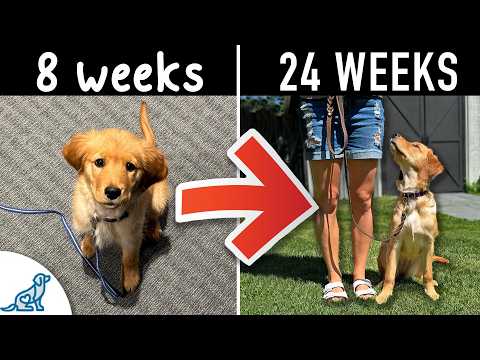
[0:00]It's your lucky day because today we are going to be talking about a puppy schedule that will basically be the only one you're ever going to need. I'm going to break down everything you need to know from your puppy's age at eight weeks all the way up to 24 weeks to make sure that you have a great schedule that you can follow that's going to help you be less frustrated and help set your puppy up for success. Let's jump into it. I'm Kayla. Welcome back to McCain Dogs.
[0:27]Now, I referenced age, but before we get started, I don't want you to get too locked in on the specific age. If you happen to be watching this video and your puppy is already 15, 16 weeks old, don't worry about it. You're going to wind things back and you're going to start right at the beginning. Remember, this is not necessarily age specific, it's more about what we're working on and it's a very progressive program and schedule that we're going to set up. So if you're just beginning, you're going to start right at the beginning and then follow all the way through. And if you get through it faster, perfect. Let's start right at the beginning and that's week one. So this is your like foundational week. Or you might even say it's about survival and building a relationship with your puppy. This week, the most important thing you want to do is start to create a bond with your puppy, and one of the ways that you're going to do that is by making sure that you implement some management skills. Set them up for success so they are not learning the the wrong things first, and you also want to start on a few basic exercises that's going to set the tone for the future weeks. One of the most simple things that you can start off with, um, happens a couple times a day already, and that's when you go to feed your dog. One of the things that we love to do that first week home with our puppy is hand feeding. So rather than just putting the dish down, walking away and let your puppy just eat on their own. I would literally take the food from the bowl, from my hand and feed it right to my dog. And while I do that, I might take the opportunity to teach them what the word yes means. I might work on a couple name associations. I might work some luring and following, teaching my puppy that food doesn't fall randomly from the sky into their bowl. Food comes from me. It's a great way to build some rapport and to start working on that focus and reliability. The next thing that I would start the very first week home, in fact, the very first week, uh, first day home, is going to be crate training. Crate training is not something I wait till the dog is more comfortable with, I actually implement it the moment they come home. What they learn first, they learn best. So with that crate, I'm going to initially in the first week home, keep my puppies crate nearby me. So whether I pull it into the living room, my puppy's literally sometimes spend the first night few nights of their life sleeping in the crate on top of my bedside table right beside me. But I'm going to use it a lot because they learn to get um, better with it more quickly if we're using it multiple times throughout the day to ensure that while we're managing our puppy and trying to focus on them, they're not getting into mischief while we can't pay attention to them. Another thing to think about would be potty training. Now, when we first bring our puppy home, that first week home, potty training is something you can start to implement right away. There's two ways I'm going to do uh that I'm going to go about this. Number one, I'm going to try and prevent accidents from happening in the first place, which means I'm going to be taking my puppy out very regularly to make sure that I I'm just ahead of the game. And number two, I'm trying to to make sure that I'm actually taking my puppy out at times of the day when I know they're most likely to go. That might be when they wake up from a nap, that might be after they've eaten or had a big drink, and it also might be after I do some training and play. So I'm going to try and take as much initiative as I can in that first week home by making sure I'm not just letting them off off doing their own thing and potentially having an accident. I got those eyeballs on that puppy every single second, and I'm trying to make sure that I'm ahead of the ahead of the storm. I should have no accidents that first week home if I'm doing my job properly. I'm going to put a number on the board now that's going to be super important. 100%. 100% of the time, you need to make sure that you are managing your puppy well. And by doing that, it means that you need to have great supervision. Now, the really tricky thing about having a puppy is they move quickly, they get into mischief quickly, and sometimes, when we're not paying attention, that's when bad stuff happens. Accidents, chewing, whatever it might be. So do yourself a favor and implement some good management tools. I've already talked about the crate, but you might also have them wear a houseline in the house so that if they sneak behind the couch or they get too far away, you have a way to stop them that's safe and effective, rather than grabbing the actual puppy. You might also dust off those baby gates and, uh, barricade your puppy in so that they can't wander off into different parts of the house that you're not paying attention to. Now, remember, supervision, 100% supervision, means you're looking at the puppy. Supervision does not mean your puppy's off doing your own thing while you're sitting there writing emails or you're watching your favorite show on TV because a few seconds go by and your puppy could be getting into mischief. Now, remember, puppies don't do anything on purpose. They do things because they're curious and they're trying to figure out, you know, what can they do, what can they not do. And if you're not supervising them and watching them 100% of the time to give them that feedback right then and there, they might end up learning the the wrong things first. So, 100% supervision, I literally mean that. And when you can't watch them 100% of the time, which is lots of times throughout the day, if you're a busy person, utilize your crate so that you know they're safe, they're not doing anything bad, they're not going to get hurt, and then when they're out of their crate, you can give them your all. If you have just brought home a new puppy or you're about to bring home a new puppy, you're going to learn that the very first month is definitely the busiest. And that's why we've created a puppy journal for you to track everything in that first month home, definitely is going to make things a lot easier for you. What they learn first, they learn best, so it's really good to kind of look at it as a whole. Now these are now available on Amazon, so check out the link to grab one today. Let's talk about week two. Now, this is when your puppy is about nine weeks old, but again, they could be a little bit older and that's totally fine. Now, this second week home is really about adding a little bit more challenge to things and creating a little bit of a consistent routine. Now you've had your puppy home for a week, so you're going to start to know things about their sleeping schedule, their feeding schedule, their potty schedule, that will be starting to kind of feel a little bit more comfortable to you.
[6:07]So the next thing you can start to do is add on to those things. Now, first things first, the supervision is not going to change. In fact, that's going to stay consistent throughout all of the weeks of your dog's progressions for sure. But one of the things you can start to think about is continuing on with some of the things you worked on last week. So, for example, in the feeding, you could continue some of the hand feeding that you did in the first week. You might also add in things like feeding some of their meals in the crate. You might add in having other family members be a part of the feeding time, whether it's through just simple hand feeding or maybe having the kids involved in some luring or some basic trick training, some recall training, starting to teach your puppy that it's not just a one-person household, they can learn to listen to everyone. The second week home, too, I'm going to start working a little bit more on some more elevated luring exercises. So, usually when they first come home, so the previous week, all I'm doing is simply having them follow the food and just get the hang of the process of luring. Once they get the hang of that, though, the second week, I'm going to already start to integrate some of my basic exercises. I might lure them into a sitting position, lying down, maybe start implementing some handling, maybe some following me. Something that the dog learns that they don't just follow the food and get it, they actually have to do something, they have to work for the food. At this point, though, since they've only been home for two weeks, I'm going to keep things really easy for my puppy to achieve because I'm also trying to build motivation. I don't want to make what I'm asking of the puppy to be too challenging because I'm trying to get a puppy that is eager and willing to work for me. At this point in the second week home, our puppy should be starting to get quite comfortable with having a collar on. Um, and they also might be getting more comfortable with having a uh a houseline on the house as well. You might see some scratching, you might see the puppy trying to chew at it from time to time. We'll have to address those things, but once the second week comes around, I might start to introduce my puppy to the concept of having a leash on, me holding the leash. I also will get my dog very comfortable, my puppy very comfortable with me putting my hands inside their collar. Now, this is something that people do not put enough focus on. We have to take hold of our puppy's collar many times throughout the day for many different reasons, and there's lots of puppies that will react in two ways. Number one, they'll shy away from somebody reaching in them, or the second thing that they'll do is become a little bit bratty and they'll nip and bite at the person who's reaching to take a hold of them. So part of my training is going to be great association of taking the collar and rewarding, taking the collar and the rewarding, building a rapport with my puppy. So that if I have to hook their leash on, pick them up and put them in the crate, hold them on my lap, whatever the situation is, I have a puppy that from the beginning learns to be very comfortable with my hands getting in their space. I don't want a puppy that's stressed, I want a puppy that is relaxed and completely confident in what I'm doing. As your puppy is home for that second week, you're going to find that they are going to be a little bit more curious because they're going to be starting to be a bit more familiar with their space. And this is where the puppy proofing stage really needs to happen. You know, as they get more curious, they're going to want to get into things, they're going to want to, um, you know, discover new things. So it's going to be a good idea to make sure that your your house is properly puppy-proofed. Again, implementing your baby gates, your houseline, barricading areas off, keeping with that supervision, but don't be surprised if your puppy is a lot more curious and a lot more active that second week home. While we want to make sure that we're not, you know, turning our house completely upside down because we have a puppy there, I also want to make sure that I am setting my puppy up for success. So anything that you can do to puppy puppy-proof your house to keep it safer would be a great idea. And remember, we're still utilizing our crate. So, if your puppy is napping or if they need some downtime, utilize your crate, not just for sleeping at night, but every, you know, all all the time throughout the day as well. Um, you know, my puppies might go in their crate while I'm taking a shower, or if I'm getting the the kids ready for school, or making dinner, anytime where my attention's going to be a little bit away, and I need my puppy to go and have some downtime. That's when I'm going to be utilizing that crate.
[10:09]Moving on to week three. This is when our puppies are about 10 weeks old, and this is when the real fun begins because now your puppy is old enough to really get into the basic training. In fact, your puppy's old enough to start a training class or an obedience class at this point. They are like little sponges at this age, really ready to learn. So, as my puppy approaches the 10-week mark, I'm going to start implementing some basic skills with them. Now, up until this point, the first couple weeks I've had them home, I've been working a lot of on a lot of foundational steps, keeping things really easy and and and fun to learn. I'm still going to keep with that, but I'm start going to get a little bit more specific with my timing and my delivery with the information. Because as my puppy gets older, my ultimate goal is that my puppy can learn to listen to my commands without the requirement of a leash, and more specifically, without the requirement of having to have treats. And 10 weeks old, this week home is actually when I'm going to start to implement this. Now, when I'm working on things like teaching them to sit, lie down, respond to their name, maybe the basis of, um, you know, having a puppy recall, I need to make sure I have a very specific formula if down the road in my puppy's training, I want that reliability and that independence. So, our puppies are going, dogs in general, any dog of any age learns within one second. So, it's very important that when we're introducing something new to our dog that we follow our proper formula and that we have great timing. So, what we're always going to think about is what our cue is, so that could be like, we can use sit is the example. I'm going to say the word sit, then I'm going to lure, so I'm going to use a treat to help my dog into position, and then I'm going to reward. My marker is not very good. There we go. Now, these steps need to be separated by one second. I am not going to put food on the nose at the same time as I give the cue, because if I was talking to you and giving you a command, and as I was doing that, I was holding like a really great like chocolate chip cookie dough. You can see where my love is. Somebody's holding that in front of me, they would just be like, wap, wap, wap. I wouldn't have any idea what they were saying. Same thing with your puppy. If you want them to learn what the word sit means, if you want them to learn what their name is, don't distract them by having the food directly on their nose. So I'm going to say the cue, whatever the cue might be, then I'm not going to wait to see if they listen. They're only 10 weeks old, they don't know yet. I'm going to automatically lure them. I'm going to automatically show them what I want them to do, so it would be sit, then lure them into position, and then once they've completed the task, their butt has at the floor, they've run over to me, whatever the situation situation may be, I'm then going to reward. So just make sure that you have that one second break between each of those steps, and that formula literally is going to be used for everything that you teach your puppy. You need to make sure you have great timing, you have great clarity, and then you can start to open up the world of possibilities for your puppy based on having great info. At this stage in the game, we're going to focus a lot on a lot of this positive training stuff. But one thing that I do want to let you know about is during all of this sunshine and roses fun stuff, you're also going to find that around, you know, 10, 11, 12 weeks, your puppy is probably going to start doing a little bit more nipping and biting. Um, a lot of the time when they're this age, they do like to explore the world with their mouths. Unfortunately, though, if they learn that communicating with you through nipping and biting is something that can actually find them to be in a situation where they get get their own way. It is something that can get a lot worse before it gets better. So, while we're going to continue all of our training and and whatnot, be aware that during this phase, it's very common for our puppies to be starting to nip and bite at us, our children, our clothes, um, whatever the situation might be. And I'm going to tell you that it is essential that you learn to deal with the nipping and biting at this age. It is not something they're going to grow out of. In fact, for some puppies, if they learn that that's how they get what they want, they really can learn to be quite pushy in adolescence. So, it's very important at this stage in the game that you really focus on learning the proper tactics for your puppy on how to address the nipping and biting so that you can get it out of the way quickly and safely and effectively so that you can move on to the fun stuff. Moving on to week four. Now, I want to remind everybody, so this is around the 11-week old mark or so. I want to remind everybody, it's still at this stage, you're going to be following a pretty consistent routine throughout your day in terms of how you interact with your dog. So basically, we got our puppies out, we're going to potty them. It's always a good idea to do some type of training with them, make them use their brain, their mind. It could be more things where you're using food, um, problem solving, anything that's a bit brainy. I usually like to complement that with something to do with play. Um, when my puppies are this age, I don't do a lot of self-play and let them go off and do their own thing. I do a lot of together play. So interactive play like, you know, tug and out, chase games, things where my puppy is active, basically I'm tiring them out to make sure that, you know, I'm getting that energy out. They're using their brain for a little bit in the training, they're using their body to get really tired and exercise, then we'll do a quick a potty break from there and then basically into their crate for a nap. And then, a few hours go by and you repeat the process. All over again and just maybe do something different for your training, do something different for your play, back into the crate. A few hours go by and you repeat again, rinse, wash and repeat over and over and over again. That's going to be really important. But another thing that I want to talk about at this stage in the game is your puppy's now been home for a few weeks, and I usually find at this stage, people are starting to think about the socialization aspect of it. Now, keep in mind, if your puppy is 11 weeks old, they probably haven't had all of their sets of puppy shots yet. Typically, around 12 weeks is when puppies get their second set of puppy shots. You do want to be fairly careful about where you're taking your puppy until they've had, um, their first two sets of puppy shots. Now, it does not mean that you're going to lock them in the house and never take them outside. I I do hear sometimes people saying that. We do want to socialize our puppy, but I'm going to proceed with caution. I'm not going to let my puppy, you know, be visiting a bunch of other dogs, or going to the bathroom in an area where a lot of older dogs have gone to the bathroom to do potty. I really like to say bathroom and not potty, but we're going to move on from that. Um, I'm going to be very careful. I am going to let my puppy, you know, meet some new people. I might do that by holding my puppy in my arms, letting other people come and pet them and give them treats. I'm going to avoid situations where people are bending over top of my puppy. I'm going to avoid situations where my puppy gets to rehearse jumping. I love holding my puppies at that age to say hello because I can kind of control the situation. So, they're learning to greet people, to see people, to be in new places, but I'm being careful about the ground. I'm being careful about what's going on around them to make sure that I'm not causing any sickness or any bad experiences. Puppies are very, very impressionable at this time. And so, if they have any bad experiences with people, other dogs, loud noises, whatever it might be, they will remember it forever. So, I want to make sure that my puppy is exposed to the world, but they're exposed in a way that they feel that it's full of sunshine and roses. It would be impossible for me to go over every single exercise we do at this stage, every single progression and make sure that you were an expert. What I can tell you though is that if you do want to have your hand held through the entire process step-by-step, week by week on all of the exercises that we cover. I definitely would recommend that you check out our puppy essentials program. You can take it with us in person, or you can take it online. It is a four-week course, but there are so many exercises that we break down, um, but then you also get to work with us and we can help you individually on all of your things every week. If you want to learn more about that, check out the link in the description below. Moving on to week five. Now our puppies are about 12 weeks old and now the fun gets to begin because they've had all of their sets of shots for the puppy stage, and now we can really start to implement some of the training. Now, from 12 weeks all the way up to 24 weeks, um, you're going to be working on a lot of the same things. Now, we're really starting to work on some life skill exercises with our puppies. At this point, your puppy should be very, very comfortable in their crate. Um, they should have a good sense of of potty training. Some of those foundational steps, they've already should have worked through, you know, what to chew, what not to chew. Around that stage, some of the behavioral issues should be well on their way. Now we're shifting our focus into the actual training of life skills. And this is where we're going to start to be working on the foundational steps for leash walking, for having a reliable recall, for learning not to jump up on people, for learning to accept handling so that if I need to clip toenails or brush or take my dog to the vet, or whatever the situation might be. This is where I'm working on all of those foundational skills that make living with my dog a little bit easier. Now, of course, at a puppy that is 12 weeks versus a puppy that is 24 weeks, we're going to have a very different level of expectation for those ages of dogs. But every dog is going to progress during the that timespan very, very differently. It depends on their personality, it depends on their their, um, relationship with their person. It depends on how diligent you are as a trainer, so there is a lot of variability. But something that you want to think about is making sure that you're maintaining that great timing we've talked about earlier, and that you start to make sure that you teach your dog to be bulletproof with things. And one of the the, um, sort of phrases that we use in our training here to help people to go through more of a proofing phase, is something that we've referenced as the three D's. So, basically, we have first D would be as my dog starts to get better at something, I'm going to see if my dog can do that thing for a longer period of time. So, for example, laying on a bed, you know, can my puppy lay on the bed for 10 seconds? Can I work myself up so my puppy can lay on the bed for the entire time that I'm making dinner on the stove, so my puppy's not constantly getting in the way? So we have duration, okay, would be the first D. Now, the second one is going to be probably my favorite, and that is distraction. And that is the hardest one because puppies are so distractible. They're super distractible, and often, um, what happens, I almost started writing the word distractible there. Did I write it properly? Okay, I did. Um, something that happens with distraction is that all puppies have a different level of distraction or what they find, um, distractible. However, what we need to think about is that we don't want to just wait until we're bombarded with like natural distractions. One of my favorite things to do is to set up my own distractions and work through them. So, for example, if my puppy is really distracted by squirrels or things that are outside, I'm going to practice in inside the house or maybe in the driveway, and I'm going to bring things out that could be a possible distraction for my dog. Some of their favorite stuff toys, maybe somebody bouncing a tennis ball nearby, maybe bowls of food everywhere. I'm going to basically create like a land mines everywhere where I know the distractions there. I can choose to be close or far from it. Oh, I almost gave away my third D. Hold on. Hold that thought. Um, something that I can use to control my puppy's success rate. If I'm out with my puppy and they don't really have the skills to handle everything that's going around them, and the distraction level's too high, it means that my failure level is going to be too high. So, it's important that I'm controlling these things. I'm going to give you the third D now. So the third D is distance, okay? Distance is going to be your friend. You have the ability to put your puppy in a situation where, you know, maybe they're closer to those distractions and they can learn to work through making great choices, or perhaps it is just a no-go. You know, you want to walk your puppy to pick your kids up at school. You walk up there and there's 30 kids running around screaming. Perhaps that's too much distraction. Perhaps you're too close to what's happening and your puppy's just jumping and pulling and barking and being a total hooligan. Again, well, it means that you're not really respecting some of the D's. So, remember, when I'm training, I might adjust all three at the same time. I might adjust one, I might work on, um, you know, if I'm going to add a lot of distraction, I might not do the exercise for very long. I might keep my distance really close to make it easy while I'm adding distraction. So, you don't necessarily want to hit your puppy with all three things at the same time. You'll get there as they get older, but this is a great way to kind of break down what the training looks like and making sure that you're going at the pace that makes the most sense based on your dog's age. So that was a very fast version of everything you need to know from eight weeks all the way up to 24 weeks. And I want to remind you and state the obvious that having a puppy can be very overwhelming. It sometimes thinks like it seems like you have an endless list of things that you need to do. But remember, you know, it is overwhelming, but the work that you put in now is going to allow you to set yourself up to enjoy a wonderfully well-trained dog for the rest of your life. Um, it is hard, but again, just go week by week. The fact that you're watching this video already means that you're doing a great job because you're putting a little bit of effort into doing the right thing with your puppy. When you get to the end of your 24 weeks, your puppy's going to be around five to six months old, and this is when sometimes our puppy's ad enter into a little bit of an adolescent phase. Dare I say, maybe be a bit bratty. But don't worry, we got you covered. We have a video that's all about how to deal with puppies that are going through the teenage phase to make sure you check that out.


