[0:00]The Sahara Forest Project is all about taking what we have enough of, like salt water, CO2, sunlight and deserts, to produce what we need more of, sustainably produced food, water and energy. It's no longer news that the world's population is ever increasing. It's no longer news that it's going to be tough to feed the extra mouths. It's no longer news that climate change is turning fresh water into our planet's most scarce resource, and that this scarcity challenges our planet's very ability to sustain life. When we look at the set of problems around sustainable energy, food and water systems, the real issue becomes how do you manage the footprint on the landscape? We have two choices, keep talking or start acting. We need solutions that seek to address the intertwined global challenges and we need them fast. We need them where the need is greatest in the hottest and driest parts of our world. We need them to be affordable and easy to replicate. We need to find a way to produce fresh water for biomass production. We need to find ways to store renewable energy from solar and wind and other renewable sources into biomass, so we can sell it all over the world. Imagine the difference it would make if we could turn our deserts green. If we could use seawater and solar power to make this happen to produce enough food, fresh water and energy to sustain local populations. Imagine we could do all this with technologies that are commercially viable with the potential to be scaled up and implemented around the globe. This might sound like a dream, but we've made it a reality. We call it the Sahara Forest Project. In 2009 the Sahara Forest Project was presented at the UN climate negotiations in Copenhagen. People said it was too good to be true. We said, seeing is believing and set out to produce a pilot plant to roll out the possibilities. Now, we are demonstrating the first Sahara Forest Project pilot facility in Qatar. This facility will contain 10,000 square meters of environmental technologies that has never been put together before. We are on our way to the Sahara Forest Project pilot facility here in Qatar. It's just located at Kavco inside Meside Industrial City.
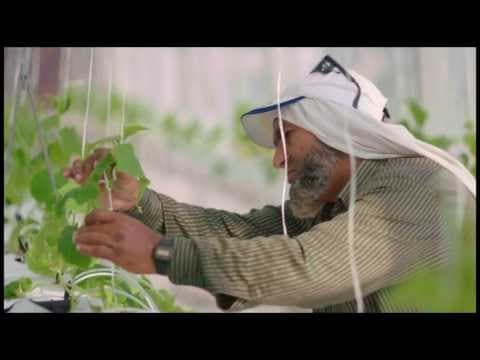
[2:38]Right now, we're standing inside the seawater-cooled greenhouse, one of the core technologies of the Sahara Forest Project. In this greenhouse, seawater is evaporated into the air to create cooling and humidification in the growing space. This creates excellent growing conditions for valuable salad crops like the cucumbers we have here. In addition, the water vapor that goes into the air from the seawater can be condensed back out on the greenhouse roof as fresh water, providing water for irrigation for the plants here in the greenhouse. So, what we want to do is to establish a saltwater infrastructure in a desert. And we do that through establishing seawater-based greenhouses combining them with facilities for concentrated solar power and technologies and practices for revegetation of desert areas.
[3:32]We need to utilize as efficiently as we can land areas that are degraded. We need to minimize the impact on natural parts of the world because we need to preserve ecosystems. And we need to make communities, both rural and urban, as sustainable as possible, minimizing their footprints on the landscape. We are surrounded by seawater but can use none of it unless we change our approach to agriculture. In a world of ever-scarcer fresh water resources and increasing desertification, we must find novel ways to use this resource to produce food and energy in desert environments. This piece of corrugated cardboard is actually a key component in cooling the greenhouse. At the entrance to the greenhouse, seawater runs down this pad. Hot desert air is pulled in into the greenhouse. As it moves through the pad, the seawater evaporates, the air becomes cooler and more humid, creating good growing conditions for the plants inside. Turning our deserts green does not require a miracle, just pure and proven science. Since the wealth is there and the money is available, it is the right time to invest and explore what is after the oil and gas.
[4:53]And that is by going into a green energy or utilizing the abundant energy available from the sun or from the heat here available in the desert. We need the expertise from big industrial players, and we need their innovative skills, we need their knowledge of crop nutrition. We need a lot of people working together if we're going to make this happen. I do believe it is very important that the CEO of whatever company, understand the need to be ahead of the normal development. And I look upon this for our business that the Sahara Forest Project is a project like that where I can participating in seeing a bit beyond the normal business borders that we have a tendency to look at. And I'm excited to be part of it, and I am also driving my organization to really participate in it and to learn from it and then see way into the future. It needs to be good for the environment. It needs to be good for development, and it needs to be good for business. This will not be important for Qatar, but for all the region and elsewhere where they have the same climate as Qatar. It seems like it has a lot of promise. I think, uh, one of the important things, um, uh, that it brings to the table is to connecting the dots between the different technologies.
[6:23]The Sahara Forest Project is a really innovative example of tying together all of the aspects of sustainability. The pilot facility will provide us with a unique opportunity to optimize our technological system, but we are not in this to produce pilots. We want to go large scale. The Sahara Forest Project shows what can be done when great minds think alike and work together without boundaries. It proves that we can take the things we have too much of: deserts, sunlight, salt water and CO2 and use them to produce the things we need more of: food, fresh water and clean energy. Turning our deserts green can be done. See it. Believe it. Then imagine the implications.


