[0:00]Okay, my friends. I'm just going to lay it right out. Apollodorus wrote about Typhon and his battle with the fish Ares.
[0:13]I'm going to read to you what he said and then I'm going to show you the evidence that supports these claims.
[0:21]Okay, this is Apollodorus library, and it's it's so detailed. It's a long library. Now, we're going to go 1.6.
[0:34]All right. We're coming down to where the Earth was and the giants were killing each other, all kinds of crazy stuff.
[0:46]And 1.6.3 is where I'm going to bring you to but this is the whole story of how they have forced each other and killed and Zeus smote him with a thunderbolt.
[0:56]Hercules shot him dead with an arrow, they killed each other.
[1:03]All right, at the very end, the other giants Zeus smote and destroyed with thunderbolts and all of them Hercules shot with arrows as they were dying.
[1:14]And that's the key. Zeus had to have Hercules because Hercules was part human. A God couldn't kill another God.
[1:23]He had to have the help of a human. Now, listen to what this says.
[1:28]When the gods had overcome the giants, Earth was enraged and had intercourse with Tartarus and brought forth Typhon, a hybrid between man and beast.
[1:43]In size and strength, he surpassed all the offspring of Earth. Now, listen to this, they're only going to talk about his thighs.
[1:52]As far as his thighs, he was of human shape and of such prodigious bulk, he out-topped all the mountains, his head often brushed the stars.
[2:07]He was absolutely gigantic, and we're going to look into it right now.
[2:12]All right, here's what it says, unkempt hair streamed on the wind from his head and cheeks, and fire flashed from his eyes.
[2:21]Such and so great was Typhon when hurling kindled rocks, he made for the very heavens with hissings and shouts, spouting a great jet of fire from his mouth.
[2:33]But when the gods saw him rushing at heaven, they made for Egypt in flight, and being pursued, they changed their forms into those of animals.
[2:44]And then it goes on to how Zeus pelted Typhon at a distance and so forth.
[2:49]Some of this, I agree with some of it, it's just I don't know.
[2:53]Anyway, sorely wounded monster and everything.
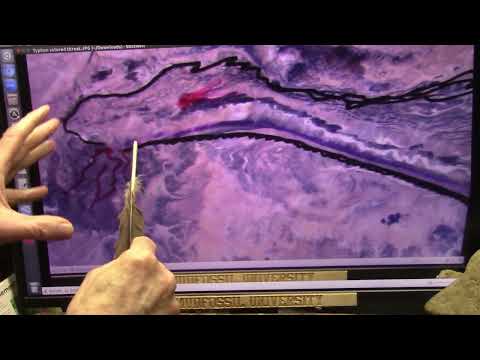
[2:56]All right, I'm just going to drop it on you like a bomb. There is Typhon, and he is all the way across the top of Africa.
[3:10]And he's spitting his fire out of here at this giant fish, which is one of the gods.
[3:19]I believe it's Ares, that turned himself into a fish, and still was attacked and hit.
[3:28]And this is the red flared eye, and he's coming down and all this flashy this and that.
[3:41]And this is all the stuff that he was spitting at the fish and it came down and ate through the fin into the body of the fish.
[3:55]Now, let's stop and take your time. Slow down.
[4:00]Just look at it for a minute. This is the neck, the head.
[4:05]The neck runs all the way down, all the way down, all the way down, all the way down. This is the guts.
[4:13]These are the two legs, the thighs, they were like humans.
[4:19]And all the way up to his flared flashy eye, this is all dragon scales and I'll show them to you.
[4:27]And he was spit, spitting out kindled fire and flames and hit the fish right there.
[4:34]That's the fin. These are scales. The fish would have been going that way trying to get away, and he swished at him.
[4:47]And it ate all the way down into his flesh.
[4:53]Dissolved the scales, and you can see right down into the blood vessels.
[4:58]I've shown this many times. You can see the arteries, the veins, capillaries, everything.
[5:10]Now, we're going to get pretty deep, but here he is. This is Typhon, and he has all that flashy looking stuff, running all the way down his throat, and this is dragon scales.
[5:21]This is just runoff and here's a highlight.
[5:25]So here's what he really was like, and he had a bump on his nose, and for coming down out of his dragon throat, all of that stuff that attacked the fish.
[5:38]It was venom, nasty, toxic, whatever, and this is actually his scales, and this is actually his throat.
[5:46]And all of that flashy stuff and his flashy red eye, exactly what they talked about in Apollodorus, and even knew this in these ancient maps.
[6:01]This is a 19, uh 1375.
[6:04]It's called the Atlas Catalan Abraham Cresques.
[6:07]And this is the world as they knew it, and they knew it pretty good.
[6:12]All the way down here, here's Italy, Spain, and here he is, Typhon, running the whole north of Africa, which he does.
[6:26]And he's even got his throat cut.
[6:30]Why would they put a slash like that? They knew his throat was cut, that ran the whole distance, and it flared at the end because he does have a flared tail.
[6:45]I'm going to show you right about here at the end of his tail because he got chopped up here, but it ran off into almost like feathers.
[6:54]But they knew about this even in 1375, they put him on the map. Pretty detailed map.
[7:03]All right, so on that big map, I showed you a dragon, ran all the way across here. The cut across his throat was right here, and that was written about too.
[7:16]That cut goes right across his throat.
[7:22]And he said Zeus cut him with his great and mighty sword.
[7:27]Other than that, this is throat, runs are straight down.
[7:31]Now, this is just runoff. All that stuff running this way, that's just like, you know, slimy stuff that runs off of a dead body.
[7:43]So, forget that. This right here is his throat, and we can zoom in and see the dragon scales all the way down.
[7:56]Here's inside of his throat. And this is what called the Dura River, which means Dragon River.
[8:10]Look at this.
[8:16]All of these are scales, so his head could go this way and that way.
[8:21]This is just runoff, this here.
[8:28]All right, so his scales, first throat, but he did get cut here and this killed him.
[8:37]That's why it's red and black.
[8:41]All right, but anyway, here he is, running the entire length of North Africa, with the thighs of a human, and he's chopped up here on his tail.
[8:52]You see where his blood's running out, he's cut up here.
[8:58]And these, look at, look at these carefully.
[9:03]Look at the colors, and look at the number of plates.
[9:12]These are these are plates, basically.
[9:17]You see that?
[9:22]And he got cut over here too, and that's bleeding out here, so, and then his tail ran all the way off like they showed on that big map.
[9:33]This is still his tail. And speaking of feathers, there is one that's, uh, we know of as Quetzalcoatl, and he exists too.
[9:55]What you're looking at here is Typhon, it was written about.
[9:58]I just read it to you. Apollodorus, he was chasing the gods to change themselves into animals and Ares was the fish, and he was the god of war.
[10:14]And Typhon spit all this stuff down at him, and hit him on the back, all written about, all written about.
[10:24]And this is coming out of here of his throat, it's nasty stuff.
[10:30]And that's literally, as far as I can see, it's almost like fire, it really is a literally fire.
[10:36]It still is, I don't know what's going on there if anybody drives through there.
[10:50]But anyway, this is, uh, this certainly looks to me like exactly what was written in Apollodorus, and here's his legs, his thighs of a human.
[11:03]Other than that, he's on the map, and so is Quetzalcoatl.
[11:07]Well, here, well, let me show you something.
[11:11]Okay, this is another god. Typhon was considered a god.
[11:16]This is considered a god who is, is Quetzalcoatl, and he had that big feathered hair dress and he was just a serpent, snake, he feathered serpent, they called him, the feathered serpent.
[11:33]And he's eating what looks like a big giant human because he is very large, and I'm going to show you how large he is.
[11:39]He's as big as, uh, as Typhon.
[11:43]And they were, these are things that were written about, these are not things I'm just saying, oh, look at this, it looks like a such and this, oh, look at the, no.
[11:51]This is exactly identical with the feathers out here at the end, with his hair, with his, uh, head dress, the form of his body is identical.
[12:02]His beards. All right, so if you haven't seen the fish and the dragon, I don't know how you missed it, but you can come back.
[12:13]North Africa.
[12:16]Now, we're coming over to America.
[12:20]All right, and this right here is Quetzalcoatl.
[12:25]This is his body, that's his head.
[12:33]That's his head, and this right here is his feathers, the feather head dress he had.
[12:41]And I'll show you that in a minute. His body comes down here, and he snakes all the way up to almost to Canada.
[12:53]And these are the green mountains, they call him, and there's are actually feathers.
[13:02]Feathers make things grow green, very green.
[13:06]They sell feather meal, they crunch them all up and they they put them on plants and they grow extremely green, and these are green feathers.
[13:19]All right, that's how far his body goes, is way up to here.
[13:26]Now, we can follow these feathers down.
[13:29]All, they're not like they stop.
[13:32]And over here on his shoulder.
[13:36]Let's back off. You see this dark spot here? That's where most of his guts are, and his shoulders and so forth.
[13:47]Now, I don't know if he could move, or he had arms or I don't know what it, it was just a snake with no, I don't know.
[13:56]But there's, um, you can easily see that that's the shape and so forth.
[14:06]And he's going to have to have a throat, which happens to be the Mississippi River.
[14:13]It goes all the way down his throat, all the way back, all the way back, and then he had a catastrophic injury back here.
[14:26]But all this is the structure of his body.
[14:34]Now, these are the feathers coming up, and this is one of the feathers that's.
[14:40]And again, you've got Google Earth, you can come up here and do your own little research.
[14:48]You can see they're they're actually feathers, which they are.
[14:54]But you just have to do a little digging around in here, but I can see them very, very clearly, and you can too if you just look at it, you can see.
[15:01]That's where the green feathers are, and this is the green of his whole body.
[15:08]So, feathers make things grow green.
[15:11]That's Quetzalcoatl.
[15:14]So, the size of him is, is probably as big or bigger than than, um, Typhon, but these things were written about.
[15:24]They're not something that is, uh, just made up.
[15:28]They had history about this. All right, Quetzalcoatl, what I showed you on the East Coast is a feathered serpent, major creator and culture God in ancient Mesoamerican religious, particularly the Aztec.
[15:41]And it comes all down through it, and he's he's also associated with Venus.
[15:48]Venus, the Morning Star, and I believe Jesus is Venus at this point.
[15:57]That's the conclusion I've come to, is Jesus is Venus, born from Jupiter, and wiped out Earth, the giants, to and save mankind because mankind was done unless the giants were wiped out, and also destroyed Mars.
[16:17]That's my take now.
[16:20]Now, I'm sort of wondering, could could Jesus split himself into different gods for different regions?
[16:28]Like he's associated with the planet of Venus, is Quetzalcoatl.
[16:36]Now, again, I believe the planet Venus was born from the feared God Jupiter.
[16:44]Basically, that's what Velikovsky discovered, was that a fiery comet was ejected from Jupiter and almost hit Earth or did hit Earth.
[16:57]And then when it came around, and I think it hit us again, and then hit Mars dead on and just wiped Mars completely out.
[17:07]I have to admit, it throws a wrench into everything, but Jesus is also called the bright Morning Star in the Bible, the bringer of a new day and so forth.
[17:20]But then you talk about Satan is supposed to be the Morning Star.
[17:26]Why are both Jesus and Satan referred to as the Morning Star?
[17:31]These are things, these are things to dig into, but I'm going to tell you something right now, as I showed you on Google Earth, these are not just this is not something that is nothing.
[17:41]This is here. It should not be denied. And here's his little beards and everything coming off.
[17:49]You see him?
[17:54]That is a, you know, but could could Jesus be here and be somewhere else at the same time?
[18:04]He was supposed to be the creator of humanity in the in the Aztecs.
[18:14]He was he was the Morning Star and a creator of humanity.
[18:18]There's a lot of pieces here that, boy, I'm going to tell you, I have a hard time fitting together.
[18:27]But from Velikovsky's research, well, let me just see you show you what he did say.
[18:34]All right, Velikovsky did the work.
[18:37]He went to all the cultures in the world, and they all basically had the same story.
[18:43]The people that were in that area said they said they saw Venus being ejected from Jupiter.
[18:50]They didn't know what either object was, but they saw a light in the sky, which is Jupiter, give birth to another light in the sky, which would be Venus.
[19:01]They saw that light move around the sky.
[19:05]Even in modern times when it's harder to see, that light would be piercingly bright.
[19:12]The plasma, gases, and other debris ejected by Jupiter would cover a big patch of sky and develop a tail just like a comet.
[19:22]And it was literally a live birth with umbilical cord, placenta, the whole nine yards.
[19:30]And that's what I did a paper on academia.edu called Jesus Chemistry.
[19:38]And that's what fell on Earth during the times of these disasters where the red blood fell all over the Earth, everywhere.
[19:50]Stones fell everywhere on Earth, so many of them that it killed virtually more zillions of people.
[19:57]And that's from the placenta, or from the umbilical cord, all very, very tough.
[20:06]And then the placenta gave him the mana every night.
[20:10]It would cook and in the morning, they'd have mana cooked up for them.
[20:16]I believe that's what happened, and Venus was referred to as the Morning Star, and I believe it's Jesus.
[20:27]And he was sent by his father, Jupiter, to wipe out and save humanity from his fate, which was very, very close to being done.
[20:42]It's just too many gigantic things. How are you going to live like that? They had to get rid of them.


