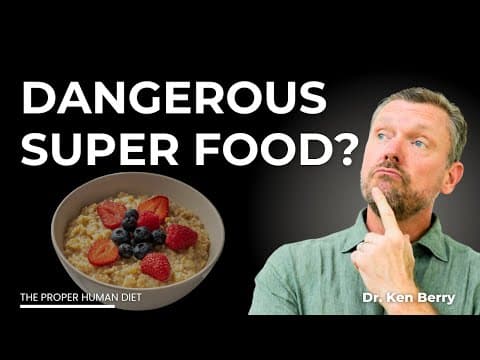
[0:00]Recently, The New York Times published an unbelievable article calling oats a nutritional superstar and a staple of the wellness culture.
[0:10]And of course, they included some oat oat recipes as well. They claim that oats are great for your heart, great for your blood sugar, and great for your gut.
[0:20]And oats are even backed by the FDA, as if that means anything to most of us. But this is classic health washing.
[0:28]Today, I'm going to break down the three big lies that they tell you about oatmeal, about oats in general.
[0:34]Two explicit lies, and one lie by implication. Let's tear these three lies apart with some real science.
[0:41]Lie number one, oatmeal is a heart-healthy food or will save you, protect you from a heart attack or heart failure because oatmeal contains beta glucans, which can lower your LDL cholesterol.
[0:53]Now, there's many, many problems with this lie. I'm going to just deal with two of them briefly here.
[0:59]First of all, there's about three grams of beta glucan in one, a half cup bowl of rolled oats.
[1:07]And this can drop your LDL cholesterol somewhere between 5 to 7%, according to the reasonable research about this.
[1:16]But that reduction in LDL cholesterol is very minor and does not even translate into people in the study actually having fewer heart attacks or strokes.
[1:29]Now, The New York Times article calls this a significant benefit, but in reality, it's minor, it's very small.
[1:36]Especially when you realize the truth about lie number two and lie number three, the other things that oats do to your body.
[1:45]Lie number two, oats and oatmeal will support your blood sugar. Now, first of all, anytime somebody says support, support your immune system, support your brain, that's a colloquialism for BS.
[1:58]Nothing about oats or oatmeal supports your blood sugar. Once again, this is all because of the beta glucan in the oatmeal that we talked about earlier.
[2:08]Because of this beta glucan, it it in some minor way blunts your blood sugar response, or at least in theory it does.
[2:17]But I'm going to tell you about an experiment you can do at home that you can totally disprove this.
[2:22]So, the beta glucan supposedly slows your digestion of the oats and therefore keeps your blood sugar from spiking as high as it would otherwise.
[2:34]I included some pictures of the recipes that they included in this New York Times article about oatmeal and how it's a superfood.
[2:40]They include overnight oats, oatmeal cookies, and slow cooker steel cut oats with fruit or natural sweeteners or honey.
[2:50]All of these things are full of sugar and starch and turn into blood sugar in your blood and spike your blood sugar, which therefore spikes your insulin.
[3:00]So, here's a simple experiment you can do at home, okay? You can make any of the recipes in this New York Times article, and I'll link to the article down in the show notes.
[3:08]Or you can make any kind of oatmeal that you want to make. Check your blood sugar before you start eating it, and then check your blood sugar again 30 minutes and 60 minutes after you've eaten the oatmeal.
[3:19]And watch your blood sugar do this. That's called a spike. And anytime your blood sugar spikes like that, it's very unhealthy.
[3:26]It causes your insulin to spike to try to pull the blood sugar back down, but it also causes something called glycation in all of the cells and tissues of your body.
[3:38]Really, anytime your blood sugar is above 140, you're going to increase the the rate or the percentage of glycation that's happening in your body.
[3:48]Oatmeal does that. It does it reliably. Most people with any degree of insulin resistance, metabolic syndrome, or hyperinsulinemia are going to see a significant spike in their blood sugar 30 minutes, 60 minutes, and up to two hours after they eat that bowl of healthy superfood oatmeal.
[4:05]People report spikes anywhere from 50 to 250 on their blood sugar meter or their continuous glucose monitor after they eat that bowl of super heart-healthy oatmeal.
[4:19]Now, they do have some beta glucan and they do have some fiber, which slows down the spiking of the blood sugar a little bit, but it doesn't stop it, it doesn't eliminate it.
[4:30]And so if you're young and metabolically perfectly healthy, maybe you can eat an occasional bowl of oatmeal if you actually like it, but for somebody who has any degree of metabolic illness.
[4:42]Oatmeal is not a superfood. It is not good for you, it will not support your blood pressure.
[4:47]Here's the thing that the New York Times author and editor don't know or just didn't put in the article is that anytime you're having daily blood sugar spikes like this, you're glycating all your cells and tissues as we said earlier.
[5:01]And you're also doing damage, you're causing inflammation and damage inside of all of the arteries of your body, including the arteries that feed your heart.
[5:10]Remember earlier the the number one lie was that it lowers your LDL cholesterol a little bit, but it spikes your blood sugar a lot of bit, completely canceling any benefit that you might have gotten from the lowered LDL cholesterol.
[5:27]This is going to completely erase that. Because when you compare hazard ratios, and you can you can see the study I'm talking about in my YouTube video called how not to die of a heart attack.
[5:38]I actually go over the hazard ratios of how dangerous is it to have pre-diabetes, type two diabetes, metabolic syndrome, oh, elevated LDL cholesterol, these things have all been measured.
[5:49]And having type two diabetes, pre-diabetes, insulin resistance, hyperinsulinemia, these things are anywhere from 5 to 20 times more dangerous than having elevated LDL cholesterol.
[6:00]The elevated blood sugar is 10 times more dangerous than the elevated LDL cholesterol. So is that really something to brag about or not?
[6:10]The LDL cholesterol lowering effect of the oatmeal, of the beta glucan in the oatmeal is a triviality.
[6:19]It's literally meaningless to your overall health and your overall heart health.
[6:23]Lie number three, that oatmeal is a nutrient dense superfood. Let's let's dig into this.
[6:31]Oats are roughly 60% starch by dry weight. So, starch is just long hands of glucose, sugar, holding hands.
[6:42]And you have an enzyme in your mouth and in your belly called amylase that breaks apart these starch molecules into glucose, AKA blood sugar.
[6:52]That bowl of oatmeal is 60% starch, AKA sugar, and only 4% beta glucan, the magical substance that makes your blood sugar not spike, even though it does.
[7:03]Researchers, they love to focus on the small beta glucan fraction and completely ignore the high starch content.
[7:12]And the added sugars that most people are going to put on their oatmeal. Some people put maple syrup on their oatmeal.
[7:18]That's pure sugar. Agave nectar, pure sugar. Honey, pure sugar. But there's another layer to this thing.
[7:27]This is the final big lie that they don't tell you, because when they imply that oatmeal is a superfood, it's full of vitamins, full of minerals, all that kind of stuff, you're like, oh, oh gosh, it there's protein in oatmeal.
[7:38]It must be a superfood, it contains all these things. But here's the problem. It also contains antinutrients.
[7:47]These are phytochemicals that can actually block your body's ability to absorb the vitamins and minerals that can cause you to have trouble digesting the protein that's in the oatmeal.
[7:59]Mhm. And that can actually lead to inflammation in your body that you're not told about.
[8:04]So these include phytic acid, and this is the biggest issue. It binds very strongly to any iron, any zinc, any calcium, or any magnesium that might happen to be in the oatmeal.
[8:15]The phytic acid binds that up and makes it completely insoluble so your body cannot absorb it well at all.
[8:21]There's also saponins and tannins, which interfere with protein digestion and also lock up the minerals even more.
[8:28]And there's also oxalates, lectins, and other enzymes that can just block your digestive enzymes completely and make it almost impossible for you to use the protein in the oatmeal in any usable way.
[8:42]So the result is that even though the oatmeal contains some minerals and some vitamins and some protein, you're not actually able to absorb the amount of iron, zinc, calcium, magnesium, and other minerals and protein that it lists on the side of the oatmeal container.
[9:00]That's a big problem. Now, here's a second order problem that they definitely never tell you about, especially not in this New York Times article.
[9:05]And that's that if you eat other foods with your oatmeal, so let's say you had oatmeal plus some bacon and eggs, which are superfoods and are full of vitamins and minerals and proteins.
[9:14]The antinutrients in the oatmeal can actually block the absorption of the vitamins, minerals, and protein from the eggs and bacon as well.
[9:24]And there's this one molecule in oatmeal that they never mentioned called Avenin. You've never heard of that, have you?
[9:29]This is the storage protein in oatmeal. You've probably heard of gluten and gliadin.
[9:37]This is the storage protein in wheat. Many, many people have a sensitivity to gluten or gliadin in the wheat.
[9:42]That if they eat it, they either get gut inflammation, or joint or skin or even brain inflammation.
[9:50]If they eat wheat too often or wheat at all. Oatmeal has a storage protein that is inflammatory for many, many people called Avenin.
[9:58]Now, there has been some limited research on the effect of eating oatmeal and its and its avenin in people with celiac disease.
[10:07]And they've they've documented that 5 to 10% of those people will develop gut inflammation from eating the oatmeal that contains the avenin.
[10:14]But here's the problem. No one has ever thought in all of these decades of nutrition research to say, gosh, I wonder if there's a subset of just regular folks out there who have an inflammatory response to Avenin.
[10:27]That study's never been done. Potentially millions of people all around the world who have an Avenin sensitivity, just like a gluten sensitivity.
[10:35]But they have no idea they have it because they've been brainwashed into believing that oatmeal is a superfood that would never harm them, never hurt them, that even though they eat the oatmeal, they get a bloating, they get gas, they get gut discomfort.
[10:51]They would never blame it on the oatmeal. There's just virtually no studies whatsoever on Avenin sensitivity in normal humans.
[10:58]And so if there's any nutrition researchers out there watching this video, maybe one or two, how about we do a study about Avenin and how many people are sensitive to it?
[11:08]So, how many bowls of oatmeal would you need to eat to lower your LDL cholesterol a meaningful amount that would that would actually provably lower your risk of having heart attack?
[11:23]At least 5 to 10 bowls daily, that's that's what you would have to ingest in order to have a meaningful drop in your LDL cholesterol.
[11:33]Now, you can also just imagine based on what I've told you previously, that if you ate 5 to 10 bowls of oatmeal a day, your blood sugar would be off the charts all day long.
[11:45]And that would cancel out any benefit from the LDL lowering, and you'd be right about that. I think that it is safe to say that oatmeal is less bad for you than lucky charms.
[11:53]Just because they're less bad than the sugar sweetened cereal doesn't make them good and it definitely does not make them a superfood.
[12:02]Now, the bigger problem out there is that there are so many news articles and so many YouTube videos that use this exact same type of health washing.
[12:11]Focusing on one small possible benefit while completely ignoring all the sugar and ignoring what the food is actually doing inside your body.
[12:21]If you're completely tired of bouncing around from one metabolic disease headline to the next YouTube video, you want consistent, evidence-based common sense language.
[12:33]Plus ongoing support, come join our PhD community because that's exactly what we do inside there.
[12:40]We've got thousands of people in there from all over the world with one goal, to improve their metabolic health and live their best metabolic life.
[12:50]The link is in the description. And if you do decide to make one of the New York Times recipes and then do my blood sugar check, then I want you to please share your actual numbers in a comment below this on this video.
[13:03]You can come back a week or a month later, watch this video again, and then put your results of your blood sugar experiment in the comments.
[13:12]Now, if this video helped you understand your food a little bit better, please subscribe to this channel and hit the like button. I'll see you next time.