[0:00]The glutes are one of the single most important muscles for building an impressive physique. They're also one of the largest muscles in the body, so regardless of whether you're a man or you're a woman, building this one muscle will make it immediately obvious that you lift from the side and the rear. So, in this video, I'm ranking the best and worst glute exercises for muscle growth using the latest exercise science. We'll go from S tier for super all the way down to F tier for fail. And at the end, I'll show you what I think are the very best and the very worst glute exercises of all time. Now, in order to figure out which exercises are better, we need to understand some very basic glute anatomy first. The gluteals are technically three distinct muscles. There's the very large gluteus maximus, which is the real powerhouse of your lower body. It extends your hips, like in a deadlift, and externally rotates your leg like when you point your toes out. There's the gluteus medius, which is about 1/3 of the size of the gluteus maximus, but it's still well worth focusing on. It's still quite big. It has about the same amount of muscle mass as your delts, and since it sits on the upper glutes, it'll enhance that appearance of an upper glute shelf. The glute medius is very active during hip abduction, where you sweep your leg out to the side, and it's a very important stabilizer. So, it's especially active during single-leg exercises. And there's the even smaller glute minimus, which is about half the size of the glute medius, but also plays a key stabilization role and can add size to the upper glutes. In addition to being split into those three separate muscles, your glutes can also be divided into an upper, middle, and lower portion. And as we go, I'll reveal my number one exercise for each division of the glutes hidden behind these three doors. So, keep in mind that just because an exercise gets into S tier, doesn't necessarily mean it's S tier for the entire glutes. It might be S tier for targeting one specific area. And here's my criteria for ranking glute exercises. To get into S tier, the exercise needs to provide high tension, especially in the stretched position. It should feel good, which means it doesn't cause knee, hip, or low back pain, and there should be some way of progressing the exercise over time, which is ultimately what'll keep your glutes growing. Okay, let's start with the most popular glute exercise on the internet, the hip thrust. The barbell hip thrust is, oddly enough, one of the more studied movements in all of exercise science. There's a pile of studies showing that it is, in fact, very effective at growing the glutes. The hip thrust will activate the entire glute, the upper, middle, and lower, but mainly target that middle meat because it isolates hip extension. It's a great movement for progressive overload. You can almost always add a little weight each week while keeping your form tight. I don't think you need a 500-lb hip thrust to grow your glutes, but if your glutes are getting stronger on this movement, somewhere in the 5-to-15-rep range, then your glutes are also getting bigger. There is a slight issue though. A lot of people find that the barbell pinches their hips. You can alleviate this to some degree by using a big cushy pad or even rolling up some yoga mats, or by strategically placing the bar in that cushy crease of your hip below the anterior superior iliac spine and above the pubic bone. But even if you avoid that painful pinching, it can still feel awkward. It also takes time to set up, especially if you don't have a hip thruster platform or if you're loading a lot of plates. The hip thrust also doesn't get the glutes into a super deep stretch. Even a deep range of motion hip thrust only gets the glutes into about 90 degrees of hip flexion compared to the 130 degrees of range that's possible for most lifters. But this isn't as much of a deal breaker as you might think. I don't know that the glutes need an ultra-deep stretch to grow. A recent nine-week study with untrained subjects found that the hip thrust was just as effective as the squat at growing the glutes, despite the fact that the squat does stretch the glutes more. Now, that's just one study, and other research does suggest that the glutes respond well to deeper training. So, like other muscles, I suspect the glutes will grow best from a combination of exercises that challenge them in a more stretched position like the squat, plus exercises that challenge them in a more shortened position like the hip thrust. As an overall glute max builder, I'm putting the barbell hip thrust into high B tier. Now, if you have access to a good hip thrust machine, like this Nautilus glute drive, I think it can solve a few of those issues. The belt is much more comfy than a barbell. You also don't need to set anything up, and because the machine is very stable, you won't need to use any balance and should be able to focus on engaging your glutes better. I personally do these every single week, and I think they belong in high A tier, and I'm actually going to pick them as my number one option for the middle aspect of the glutes. Their only downside, as I see it, is the lack of a really deep stretch, but we'll pick that up with some other exercises. Another really good option is the single-leg dumbbell hip thrust. These will hit the entire glutes, but unlike the other options, may shift some emphasis to the upper glutes because the glute medius and minimus will need to stabilize for balance. You can also prevent left-to-right muscle imbalances by focusing on each glute individually. I don't like to go heavy here. Just stick to 12 to 15 reps and really focus on controlling the movement. They're going in A tier as well. The glute bridge is really just a hip thrust, but with less range of motion. They're a bit easier to set up because you don't need a bench, and they're great for beginners because they require less stabilization. Some people also say they can isolate their glutes more with these by taking some of the quads out, but I still prefer the hip thrust because it has more range of motion. Low B tier. Frog pumps are also kind of like a hip thrust, except you externally rotate your hips and clamp your feet together. This will shift some emphasis to the upper glutes since abducting your hips will engage the glute medius more. I actually don't hate these as a high-rep finisher, but they're hard to load, which forces you to use really high reps, and they don't stretch the glutes very well. I'm putting them in high C tier. All right, so let's take a look at some exercises that actually do stretch the glutes quite a lot. We'll start with squats. I think squats are a super underrated glute builder on social media. Like the hip thrust, you're extending your hips, so you'll activate all regions of the glutes, but especially that middle chunk. I would say most of my own glute development does come from squats and my background in powerlifting. The only potential downside of squats is that they don't really isolate the glutes well. You get a huge quad stimulus too. So, if you're only trying to grow your glutes without growing your quads, squats aren't your best option. That said, you can make the movement more glute-dominant by placing the bar a few inches lower on your back, leaning further forward, and focusing on really driving through your hips. Also, research shows that squatting deeper is important for glute growth, so try to at least break parallel. Despite some limitations, I'm still putting the barbell squat in A tier for glute growth. With the Smith machine squat, you can place your feet further forward to make it more glute-dominant, and you never need to worry about losing your balance. It's also going in A tier. The Bulgarian split squat gets a deeper stretch on the glutes than the standard barbell squat, and because they're single-leg, in addition to the middle glutes, you'll get the upper glutes more involved. To make them even more glute-focused, place your front foot further forward and lean forward as you squat. Again, think about driving through your hips, rather than just standing up with your knees. This will help you engage your glutes a lot better. These are very close to S tier, but they are a bit harder to overload, especially if you do them with dumbbells. They also smoke your quads and are a really exhausting movement in general. I usually do two sets per leg and call it that. I'm feeling high A tier. Before I get to our first S tier exercise, let's knock out a couple duds. Donkey kicks probably don't grow your glutes very well. They're really hard to overload, even with a band, you're still getting very little tension while the glutes are stretched, and it's hard to progressively overload using a band anyway. I think they're solid as a warm-up activation drill or to help beginners feel their glutes engage, but as a glute hypertrophy exercise, these are going in low D tier. Fire hydrants have similar issues. They just don't get high tension on the glutes. They can work for mobility or in rehab contexts, but I'm putting them in low D tier as a glute builder. All right, let's look at some exercises that target the upper glutes. Kickbacks are great for the upper glutes, especially if you kick up and out diagonally. That's because the upper glute fibers perform both hip extension, which is the up part, and hip abduction, which is the out and diagonally part. Kickbacks are actually very stable if you brace against the machine, and perhaps even more stable if you brace against a bench. The resistance profile should feel nice and smooth. You don't get the biggest stretch, but that can be made up with other exercises that will get to. I don't do a whole lot of kickbacks myself, but I do think they're a really great option if you like them or if you want to isolate the glutes without hitting quads. I'm thinking low A tier. Step-ups will target the upper glutes because you're doing one leg at a time, and the stability requirement engages the glute medius and minimus. They get a deep stretch on the entire glute, especially if you set the box a little higher at or just above knee level, which will force your glutes to work harder than your quads. If you have a handle to grab onto, you can keep your balance better and overload the glutes even more. They can be a bit awkward at first, but once you learn how to engage your glutes more than your quads, I think they're killer. Low A tier. Machine hip abductions are fantastic for the upper glutes. That's because they really challenge the glute medius and minimus directly through their primary function of hip abduction. If you lean forward by about 30 degrees, you'll improve the line of pull of those upper glute fibers, and you should feel a deeper stretch at the bottom. I usually do these for 15 to 20 reps, although heavier low-rep work is also good. You can always progressively overload the movement by just increasing the pin weight, and when you eventually max out the stack, you can use a gym pin to add more. If you want a little extra range of motion, you can add an extra pad on the inside, and while it may not be the best overall glute builder, it's just so good at targeting the upper glutes. And for that reason, it's our first exercise going into S tier. And it's also my number one exercise for the upper glutes, making it the reveal behind door number one. Cable hip abductions do the same basic thing, but I find them harder to overload, they're not quite as stable, and they're a bit more annoying to set up. I'm thinking B tier. The lateral banded walk is the same basic movement pattern, but the band offers virtually zero tension in the stretch. These are fine enough as a warm-up drill or for helping people engage their glute medius better, but they're just not gonna add much meat to your glutes unless you're a beginner. I'm putting them in C tier. Okay, speaking of stretching the glutes, let's talk about lunges. Lunges will hit the entire glute. You'll get the upper glutes because of glute medius activation due to the stabilization demands, you'll get the mid glutes from the hip extension, and the lower glute area from the deep stretch as you lunge. You can accentuate that stretch by taking longer strides forward and by leaning slightly forward by about 30 degrees. There are many different ways to do lunges, but I like old-school walking lunges the best. I like the idea that you're moving through space, it gives you something to actually work toward, rather than just doing reps on the spot. I find that more motivating. And sure, while you can probably get a slightly better stretch with Bulgarian split squats, if you take big steps on lunges, you'll feel a massive glute stretch, too. And even though soreness isn't everything, I get more sore from lunges than anything else. I'm a huge fan of walking lunges, and I'm sending them straight to S tier. Smith machine lunges have all the same benefits, but again, I just don't like doing all my reps on the spot when I have the option to move through space. That's more of a personal preference thing, but I'm still putting these in high A tier. If you elevate your front foot on a small box, you'll get a bit more range of motion at the bottom, which is just enough to sneak these into S tier. With curtsy lunges, you step back diagonally behind your other leg. This requires more balance, meaning it'll activate the glute medius more. So, another good option for the upper glutes. That said, I think because they're harder to overload, I don't think they're quite as good as a standard lunge. They're definitely an option you can include every now and then, but I'm feeling low B tier. Okay, let's cover three lower glute builders. First up, the deadlift. The conventional deadlift is a good glute builder since it trains hip extension, it gives a big stretch on the lower glutes, and it's amazing for progressive overload. The issue is it's just such a fatiguing exercise, physically and psychologically. This is why it's said to have a low stimulus-to-fatigue ratio. You get a lot of stimulus, but you also get a lot of fatigue, especially in muscles other than the glutes like the spinal erectors. As a strength builder, it's elite, but as a glute hypertrophy exercise, I have to put it in low B tier. The sumo deadlift is very similar. This EMG study found no difference in glute maximus EMG activity between conventional and sumo stances. That said, because of the hip abduction and hip external rotation from the wider stance and the foot flare, the sumo deadlift probably does hit the glute medius harder and might shift some emphasis toward the upper glutes. I'm putting it in high B tier as a glute builder. The Romanian deadlift is the better choice for glute hypertrophy in my opinion, especially for the lower glutes and that glute-hamstring tie-in area. And while it does hit the hamstrings hard as well, it smashes the glute max as a basic compound lift that's very conducive to progressive overload. I'm feeling high A tier, and this is actually my number one exercise for the lower glutes. But it's not my number one exercise of all. Before we get to that, let's knock out three final exercises, one that I love, one that I hate, and one that's just okay. I love the 45-degree back extension. A lot of people think of it as just a low back exercise, but since you're extending your hips, your entire glutes will be very active in both the lengthened position at the bottom and the shortened position at the top. I prefer to overload these by adding reps, but you can still work up to some solid weight by holding plates to your chest. If you round your upper back on these, you should be able to connect with your glutes much better. I'm honestly feeling S tier for these. Cable pull-throughs are okay for me. They're great for beginners without much glute strength, but eventually you'll be limited by how much weight you can hold comfortably. They just start to feel awkward once you get some real weight on there. I'm thinking low B tier. I'm not a big fan of kettlebell swings. You can definitely get a good cardio workout with these, and I think they do have some utility for building explosive power, but for glute hypertrophy, you're just not getting enough tension. Low D tier. Okay, and if I had to pick just one exercise from S tier to raise it up to S tier plus, the best of the best, I think I'd have to go with the walking lunge. I realize that's a hot take, but these are all great glute builders, and if I had to personally just pick one, I think it would be the walking lunge. And I'll go with the donkey kick or the fire hydrant as the worst of the worst. Not because they can't have their place as warm-up drills, but it's just really hard to reach high glute tension for muscle growth. I'm actually really trying to bring up my own glutes this year, so I'm doing a ton of hip thrusts, hip abductions, and walking lunges, but it's not enough to just dial your training in. Your diet is also crucial. You need to ensure that you're eating the right number of calories and protein to support muscle growth, and so many people still underestimate the impact of diet on your physique. Dialing in my own diet over the last year made a gigantic difference in my progress. So, if you'd like to get on track yourself, you can download my nutrition app, macrofactor for two weeks for free if you use code Jeff, and I'll put a link to that over here next to my head. All right, that's it for this one, guys. Thank you so much for watching. Don't forget to leave me a thumbs up if you enjoyed the video, subscribe if you haven't already, and I'll see you all here in the next one.
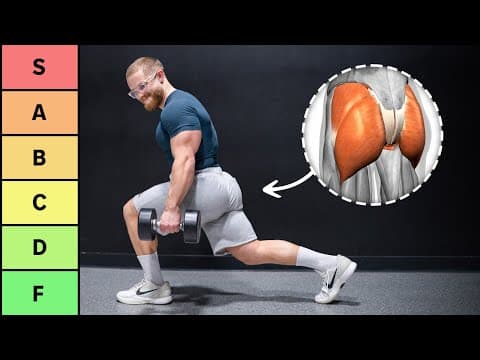
The Best & Worst Glute Exercises (According To Science)
Jeff Nippard
14m 0s3,220 words~17 min read
YouTube auto captions
Transcript source
YouTube auto captions
This transcript was extracted from YouTube's auto-generated caption track. The transcript below is server-rendered so it can be read, searched, cited, and shared without opening the original YouTube player.
Pull quotes
[0:00]The glutes are one of the single most important muscles for building an impressive physique.
[0:00]They're also one of the largest muscles in the body, so regardless of whether you're a man or you're a woman, building this one muscle will make it immediately obvious that you lift from the side and the rear.
[0:00]So, in this video, I'm ranking the best and worst glute exercises for muscle growth using the latest exercise science.
[0:00]And at the end, I'll show you what I think are the very best and the very worst glute exercises of all time.
Use this transcript
Related transcript hubs
Watch on YouTube
Share
MORE TRANSCRIPTS


